
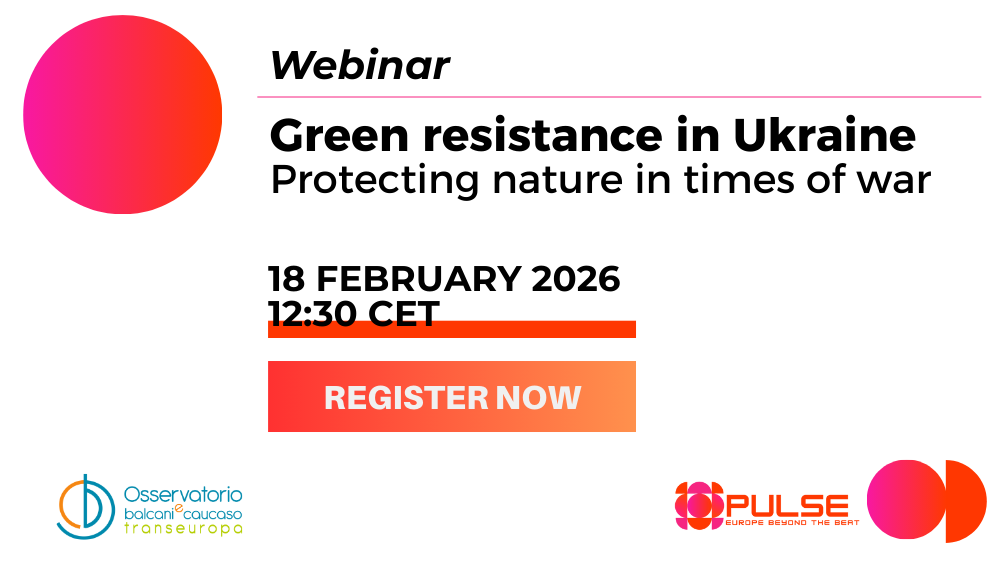
This webinar examines the impact of Russia’s war against Ukraine on the country’s environment and the efforts underway to protect nature despite ongoing hostilities. Moving beyond a focus on military developments and diplomatic negotiations, the discussion sheds light on how environmental protection has become an important – and often overlooked – dimension of the war.
Military operations have caused widespread environmental damage across Ukraine, including land contamination from mines and unexploded ordnance, pollution of soil and water, wildfires, and flooding. At the same time, Ukrainian authorities, scientists, journalists, and environmental activists have continued to document the damage, mitigate its effects, and work on the restoration of affected ecosystems.
Drawing on the work of PULSE journalists and on testimonies from Ukrainian activists, journalists, and experts, the webinar explores how environmental action has adapted to wartime conditions. It looks at how environmental movements have continued to promote nature protection and the green transition, and at how environmental priorities can be integrated into post-war reconstruction efforts. The discussion also considers the role of the EU accession process in supporting a sustainable reconstruction of Ukraine.
Speakers
Viktoriia Hubareva, journalist at Rubryka
Aleksei Ovchinnikov, editor-in-chief of the Ukraine War Environmental Consequences Work Group and freelance journalist
Iryna Stavchuk, European Climate Foundation
Moderator
Lorenzo Ferrari, PULSE Editorial Coordinator
18 February, 12:30–13:30 CET
Online, Zoom, registration required via this link.
The webinar will be held in English.

Viktoriia Hubareva is a Ukrainian journalist who specialises in environmental issues and finding solutions. She is also a project coordinator and mentor. She works at the intersection of environmental journalism, cross-border cooperation and media development. She leads initiatives such as the EcoRubric School and manages projects including the Climate Content Pool. She explores topics such as biodiversity, renewable energy sources, conflicts over nature conservation and green recovery, focusing particularly on the impact of fact-based storytelling.
Alexej Ovchinnikov. Environmental activist, journalist, and researcher. Editor-in-Chief of the UWEC Work Group (uwecworkgroup.info), member of Green Network, a Belarusian environmental organization in exile, and member of EcoVillage Georgia (https://ecovillagegeorgia.ge/). Sphere of interests: Green recovery of Ukraine, grassroots environmental solutions, (de)colonization—the environmental perspective, ecosystem recovery after disasters and wars, posthuman sociology, and forest ecosystems.
Iryna Stavchuk is the Interim Director for the Central & Eastern Europe and Ukraine Programmes at the European Climate Foundation. Before joining the ECF, Iryna worked for the Ukrainian government as Deputy Minister and was responsible for climate change policies, European integration, international relations and biodiversity. Iryna is the co-founder of two prominent Ukrainian NGOs – Ecoaction and Kyiv Cyclists’ Association (U-Cycle) – and has been working for many years within civil society in Ukraine and internationally. In addition, she has coordinated Ukrainian and regional networks of civil society groups working on climate change issues.
The webinar is organised in the frame of the project PULSE, a European initiative coordinated by OBCT that supports transnational journalistic collaborations