
Dreaming of “polenta e osei”. The Italians who hunt in Croatia
Every year thousands of Italians go hunting in Croatia. They are mainly interested in birds: woodcock, quail, but also the ones that once ended up on the Sunday polenta and that are now forbidden
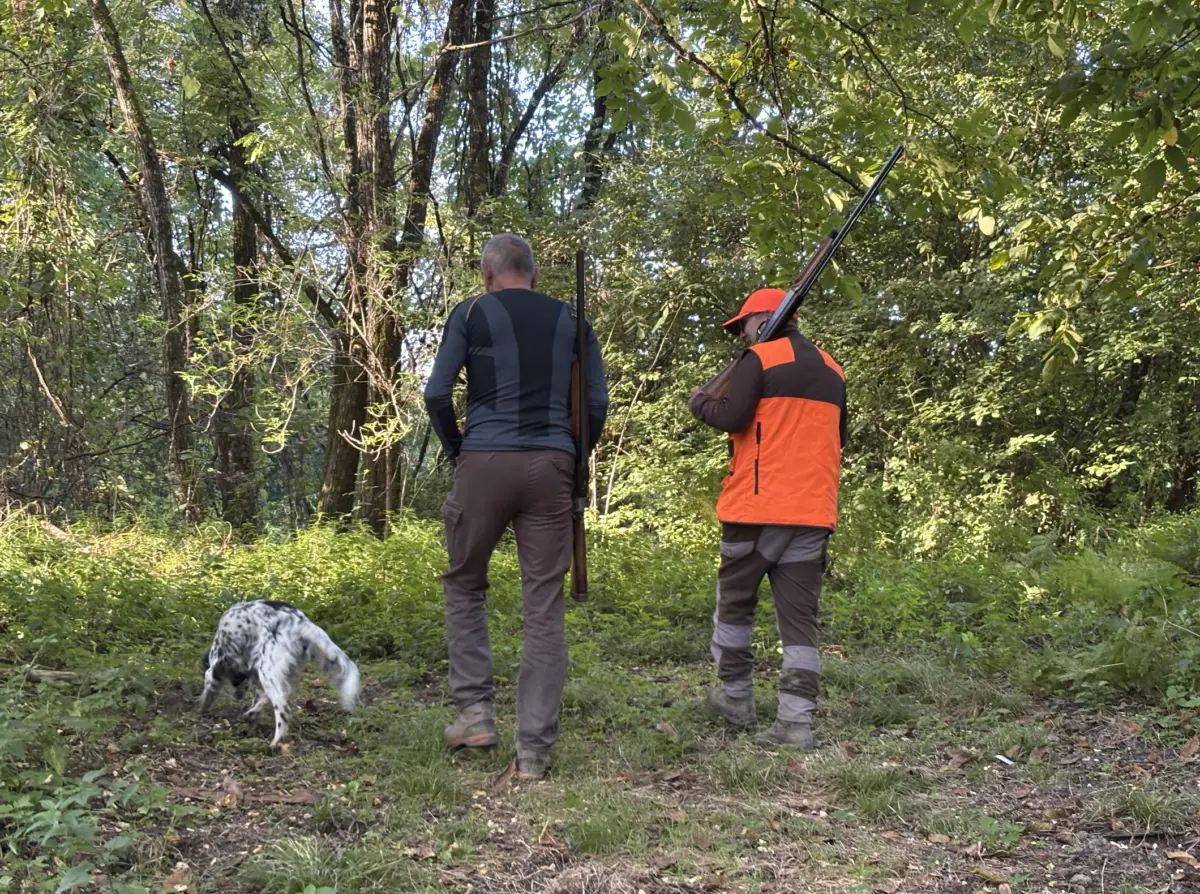
A woodcock hunt in the forest near Krašić, Croatia – Photo Giovanni Vale
A woodcock hunt in the forest near Krašić, Croatia - Photo Giovanni Vale
It is early morning in Krašić, a town of about 3,000 inhabitants some fifty kilometres south-west of Zagreb. A light mist rises from the maize fields and pastures and clings to the car’s windscreen. The Žumberak hills are already lit by the sun. It is Saturday 3 October, and we have arranged to meet some Italian hunters for the first woodcock hunt of the season.
On the phone, Matteo Pirina – born in 1960 and holding a gun licence since he was 16 – had sounded confident. “We’ve always found at least one woodcock at the start of the season,” he had said a few weeks earlier. But when we meet him at the Ćuk bar (the scops owl), he lowers our expectations. “The big late-summer rains haven’t come yet. Woodcock love moisture; without it they can’t find worms in the soil. But we’ll see – it will be a chance to train the dogs anyway, they haven’t worked since last winter,” he says, spreading his arms.
The dogs – Loki and Tipo – are two white and grey English setters. Their collars carry GPS receivers, synced to a handheld device that shows which way the dogs are heading and how far away they are. As soon as they jump out of the van, they vanish into the woods. We set off after them, accompanied by Darko, a retired Croatian police officer who works as a guide for Italian hunters in autumn and winter.
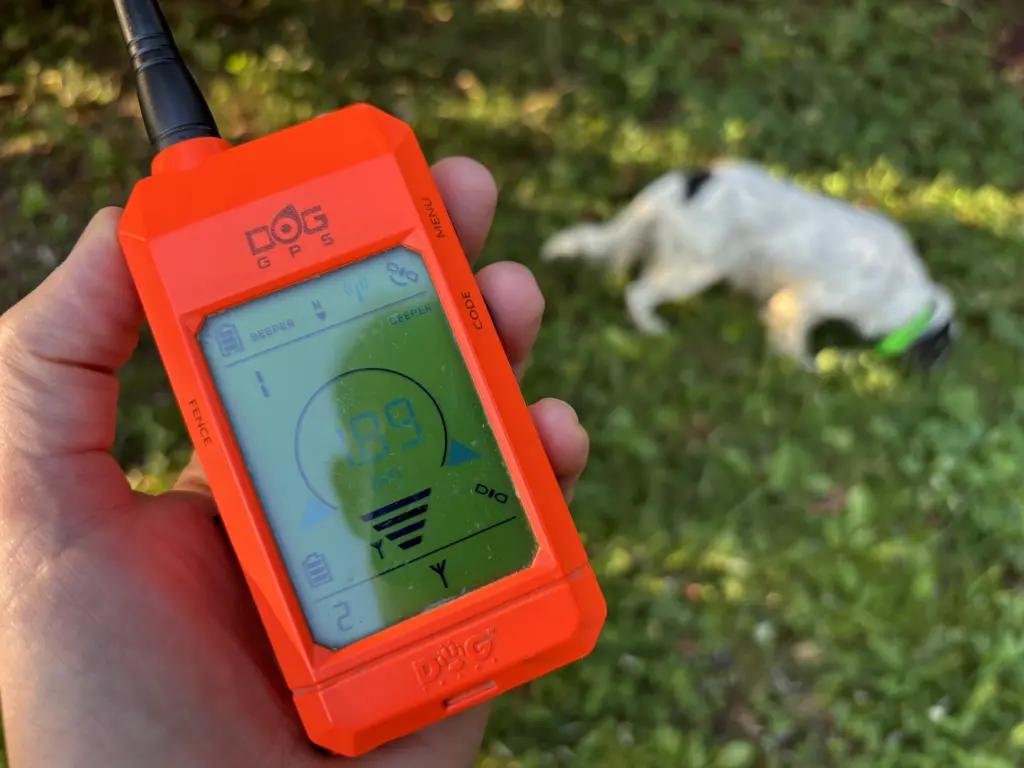
A woodcock hunt in the forest near Krašić, Croatia – Photo Giovanni Vale
Matteo Pirina is not an isolated case. In 2023, according to the Croatian Ministry of Agriculture, nearly 12,000 foreign nationals came to hunt in Croatia. “Most of them are Italians,” says Boleslaw Slocinski, head of the Safe Flyways programme at the BIOM association, a BirdLife International partner. “Italians are mainly after quail, woodcock, thrushes and ducks,” Slocinski continues. “Hunting here costs less, it’s less crowded and there are fewer checks, although things are changing.”
Not all of these birds have the same legal status. Quail, woodcock and most of the ducks hunted in Croatia are not protected there and can be legally shot in season: quail from 21 August to 30 November, woodcock from 1 October to the end of February, and mallard, teal, garganey and tufted duck from 1 September to 31 January. Thrushes are a different matter. EU rules allow member states to open a season on them, but they do not appear in Croatia’s hunting calendar, so shooting them there is not permitted.
Quail, Slocinski says, are “Italian hunters’ favourite animal”. “Poachers use a small loudspeaker, known in Italian as a quagliaia, that imitates the bird’s call. They set it up in the evening, then come back in the morning and shoot the whole flock,” Slocinski goes on. Using electronic callers is banned throughout the EU, but owning one is not illegal. “We locate the callers and alert the police, but officers rarely wait until morning to catch the hunters. Only 4% of cases end up in court,” he says.
Back in the Krašić woods, Matteo Pirina shakes his head when we ask him about quail. “Where’s the pleasure in hunting like that?” he asks. “I’ve hunted everything in my life, from Cuba to Ukraine, and for me woodcock is still the finest hunt,” explains the Sardinian hunter, who lives in Veneto, adding: “I can’t explain what it feels like to kill an animal.”
A few metres away, Darko walks in silence, shotgun on his shoulder. Have the Italians he guides ever asked him to shoot protected birds? “No, they know they’d lose their gun licence,” he replies quickly, “but sometimes they tell me: you know how tasty that little bird is.”
A dish that never really disappeared
Until the 1960s, in the butcher’s shops of the valleys around Bergamo and Brescia, small birds were sold in bunches, hung next to the salami. Thrushes, skylarks, chaffinches, bramblings and sparrows were cooked with butter, lard and sage and served on polenta, usually on Sundays.
In 1992, Law 157, which transposed the Birds Directive, banned trapping with nets and snares and the trade in wild birds, with the exception of six species. Imported birds remained outside the ban until 2014, when Decree-Law 91 extended it to them as well. Since then, “polenta e osei” has disappeared from restaurant menus. In Bergamo the name lives on in a cake made of sponge and yellow marzipan topped with chocolate birds, created in 1910 and inspired by the famous Sunday dish.
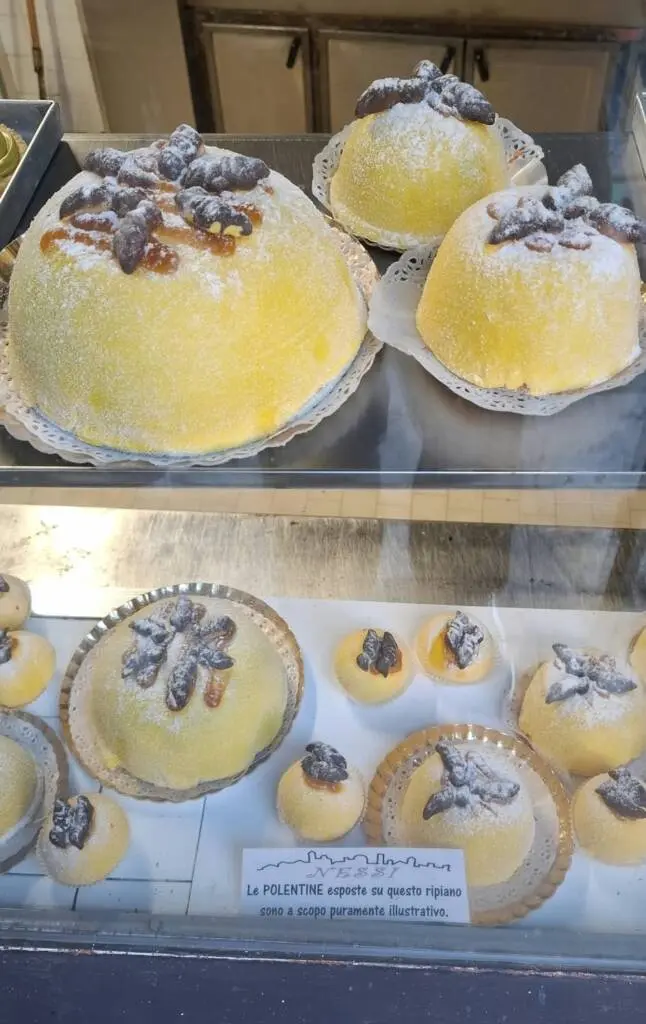
The polenta e osei cake on sale in Bergamo – Photo Davide Denti
“A tourist gimmick,” says Oliviero Manzoni of Slow Food Valli Orobiche (Bergamo), who believes the original dish has never really disappeared. “You can still find it, especially in the valleys,” he says. “People eat polenta e osei at home, and I can say that for certain because people bring them to me too, every now and then.” It is hunters who give part of their bag to neighbours and acquaintances. Others, he adds, go hunting abroad.
According to Mario Pedrelli, who works against poaching in the Brescia area and the Po Delta, the practice is widespread in the valleys around Brescia, Bergamo, Vicenza and Verona, with Brescia as its “stronghold” – and knowingly so.
“Anyone who eats polenta e osei knows they are breaking the law,” says Pedrelli. It is usually eaten at home, sometimes in a restaurant: a hunter brings a hundred or so robins to a restaurateur he knows and one evening, after closing time, the restaurateur cooks them for a group of friends. For Pedrelli, imports from abroad are far from over. Now that Croatia and Slovenia are in the Schengen area, there is no longer any need for cool bags on planes: “To bring a hundred thousand passerines over here, two crates are enough. You put them in a refrigerated van and unload them when you arrive.”
Officially, there are no data on the illegal bird trade. But those who know the hunting world from the inside insist that the “osei” are still fair game. Matteo Brogi runs Hunting Log, one of Italy’s leading hunting websites. “For many reasons Croatia is a destination for people with pointing dogs, first and foremost for woodcock,” he says. “Those who go bring the fruits of their activity back here and then eat it.” Asked whether this amounts to a source of supply, he replies: “Yes, it’s a source of supply.” And he adds that large-scale imports of game “happened in the past and are still happening”.
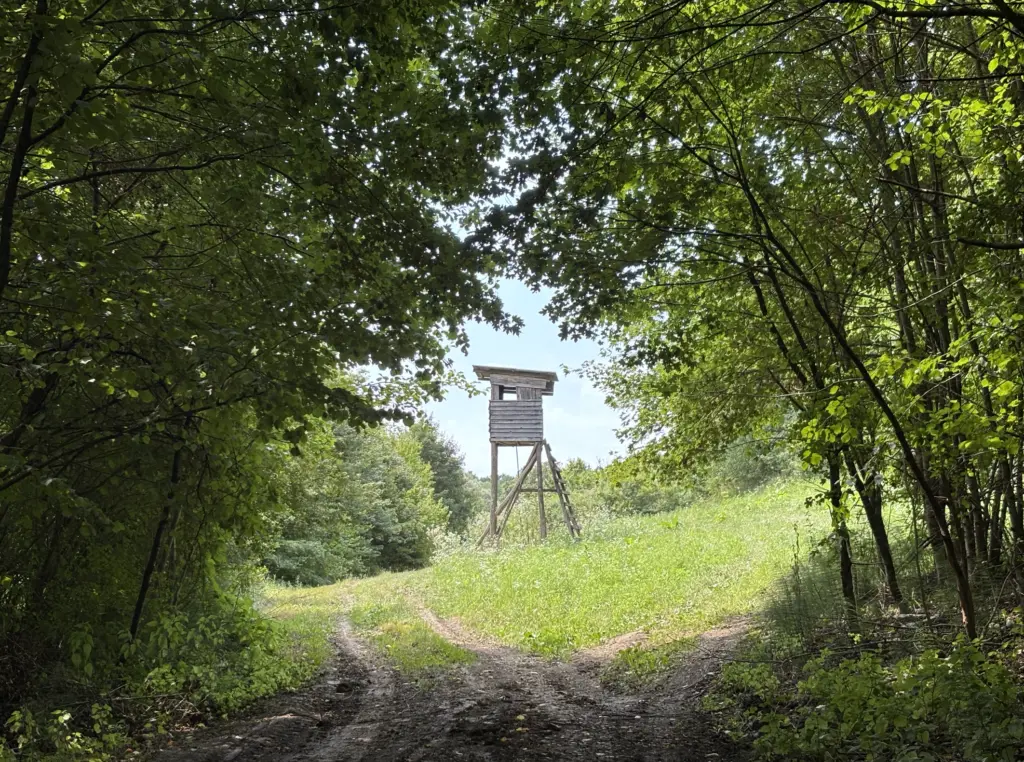
A hunting stand near Krašić, Croatia – Photo Giovanni Vale
There is, in fact, a legal way of getting game into restaurants: a hunter who has taken the meat hygiene course can supply small quantities to an establishment in his area by filling in a form. For birds, the limit is 200 head a year, shot in the same province or in neighbouring ones.
“Obviously there is a grey area where, on the one hand, the game isn’t traced and, on the other, the hunter doesn’t take responsibility,” says Brogi. Woodcock shot in Croatia fall outside that perimeter. And in his circles, he admits, certain practices are viewed “with embarrassment”. He describes a sector divided between those seeking sustainable harvesting and those who are “a bit more driven by passion”, and one that has yet to recover from “decades of mismanagement of the environment and of game”.
In Lombardy, rather than narrowing the perimeter, politicians have tried to widen it. Domenico Aiello of WWF explains how regional law 12 of 2022 allows hunters to give birds free of charge to restaurants and village food festivals on the basis of a self-certification. WWF has nicknamed it the “shoot and eat” law. The European Commission opened an “EU Pilot”, the stage that precedes infringement proceedings, but the Region did not repeal the law: in June 2026 it amended it, restricting such transfers to huntable species and specifying that they must be free of charge. Lombardy, Aiello points out, is also one of the regions most represented on hunting trips abroad, and thousands of birds brought back by hunters returning from Eastern Europe have been seized at Orio al Serio airport.
The queen of the forest
Some 450 kilometres to the east as the crow flies, in the Krašić woods, the walk goes on, so far without a single woodcock. Matteo Pirina heads an association – The Queen of the Forest (TQF) – which for almost 15 years has been organising hunting trips to Croatia devoted exclusively to woodcock. Last year Pirina brought more than 200 Italian hunters to Croatia. Each of them paid the Croatian Hunting Federation (HLS) a monthly fee of 70 euros or an annual fee of 300 euros, plus board and lodging and the guide’s daily rate of 70 euros.
“I don’t offer quail because I know that without a caller they’re impossible to hunt,” explains Pirina, who insists that “anyone offering quail hunts in Croatia is clearly using callers – otherwise you might come across one, two at most, in a whole morning”. What is the link between restaurants serving game and hunting? “None. The meat you eat in a restaurant necessarily comes from farms, because it has to be certified. What you cook with wild animals can’t be sold,” Pirina says curtly.
Mario Pedrelli is more sceptical. “Restaurant quail come with a nice invoice from the farm, but you can’t check whether trapped or shot quail are getting in too,” he says. And in any case, he adds, “90% of customers are perfectly happy, because they know they’re eating a wild animal”. Hunting abroad also makes it possible to reach large numbers. “In Italy a hunter kills the three woodcock he’s allowed in a day, then goes to Croatia, or Bulgaria, or Albania, and in a week of hunting he gets 200,” Pedrelli continues. “If 2,000 or 3,000 hunters go every year, you can do the maths.”
A green police
In Croatia, in fact, controls are stricter than they used to be, and the turning point is partly linked to the name of Željko Vuković, state secretary at the Ministry of the Environment and for more than twenty years a nature protection inspector. “I started in 2001, and in the first ten years I handed out fines totalling 1.2 million kuna (almost 160,000 euros) and seized more than 100,000 animals,” recalls Vuković, who says that “most of the poachers were Italians, who then moved on to Serbia, Bulgaria and Romania”.
“Today poaching has fallen significantly,” the state secretary continues. He would like Croatia to introduce a forestry corps like Italy’s Corpo forestale. “There is no other way to fight green crime. They have to be afraid. You don’t negotiate with them, because they know perfectly well that what they’re doing is forbidden,” says Željko Vuković, who in mid-September, in the wake of the waste scandal that shook the country, submitted to the Croatian parliament his proposal to set up an armed “green police” of 2,000 officers. “The time is ripe,” says the war veteran, now a politician with the far-right Homeland Movement (DP), part of Croatia’s governing coalition.
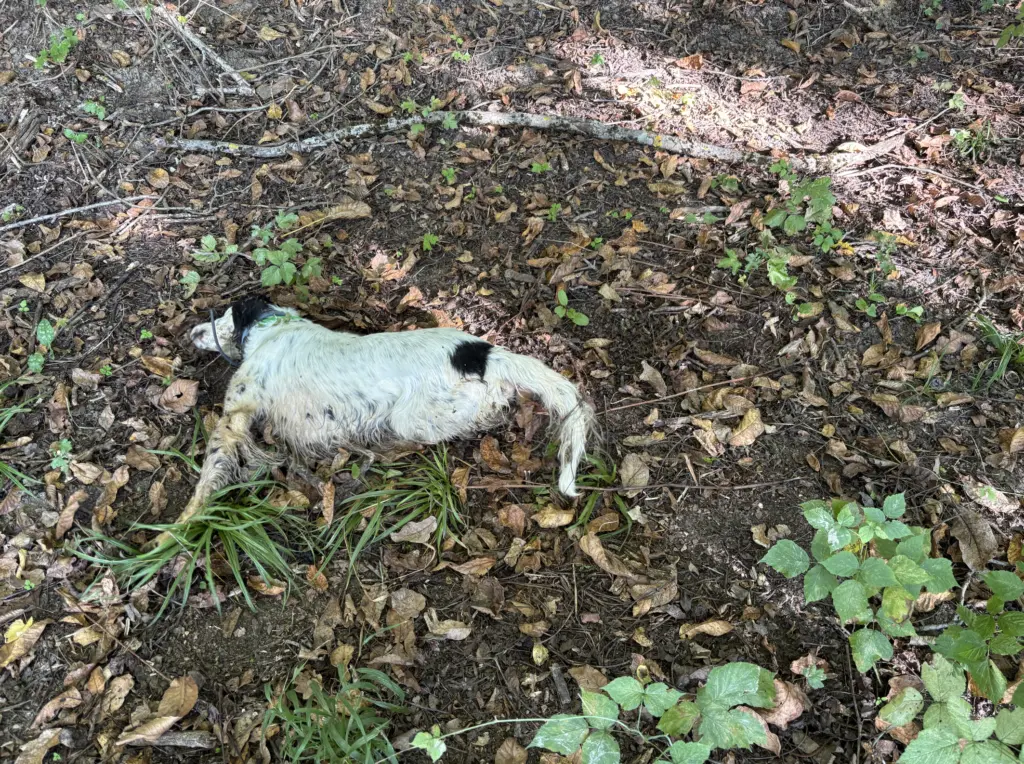
Tipo plays among the dry leaves – Photo Giovanni Vale
“Loki’s on point!” Matteo Pirina exclaims excitedly. The GPS receiver shows that the dog has stopped about fifty metres from us. “Loki never gets it wrong,” says Pirina as he loads his gun. But Darko, a little way ahead, stops us: “He’s having a poo,” he says, almost irritated.
We keep walking, but as we go on it becomes increasingly clear that we won’t see any woodcock today. During the season, from October 1st to the end of February, Darko goes out “almost every day” with groups of foreign hunters. “They’re almost always Italians,” he says, “industrialists, doctors, winemakers, well-off people.” Why aren’t Croatian hunters interested in birds? “A woodcock weighs less than 400 grams, a wild boar 150 kilos,” he answers with a smile. Meanwhile, Matteo Pirina is on the phone with hunters keen to come to Croatia.
“Matteo, carry on or are we done?” Darko asks him in Italian as soon as he hangs up. “Nah, let’s head back – can’t you see the dogs won’t even leave our side?” Matteo Pirina replies. Tipo rolls happily in the dry leaves and seems in no mood to look for long-billed birds. “Shall we go again tomorrow?” Darko asks. “No,” Matteo Pirina replies, “tomorrow, Italy.” The disappointment on the retired policeman’s face is plain to see.
So the van leaves empty. But the season has only just begun, and Pirina’s phone keeps ringing.
Found an error in this article? Please contact our editorial team at redazione@balcanicaucaso.org.
This article was produced with the support of the Earth Journalism Network.
Tag: Animals
Featured articles
 the students' voices
 Investigation