Serbia, the dramatic “behind the scenes” of election night
Despite the clear victory for the students, the night of October 25th could have taken a violent turn. Pressure reportedly convinced Vučić to abandon the option of resorting to violence
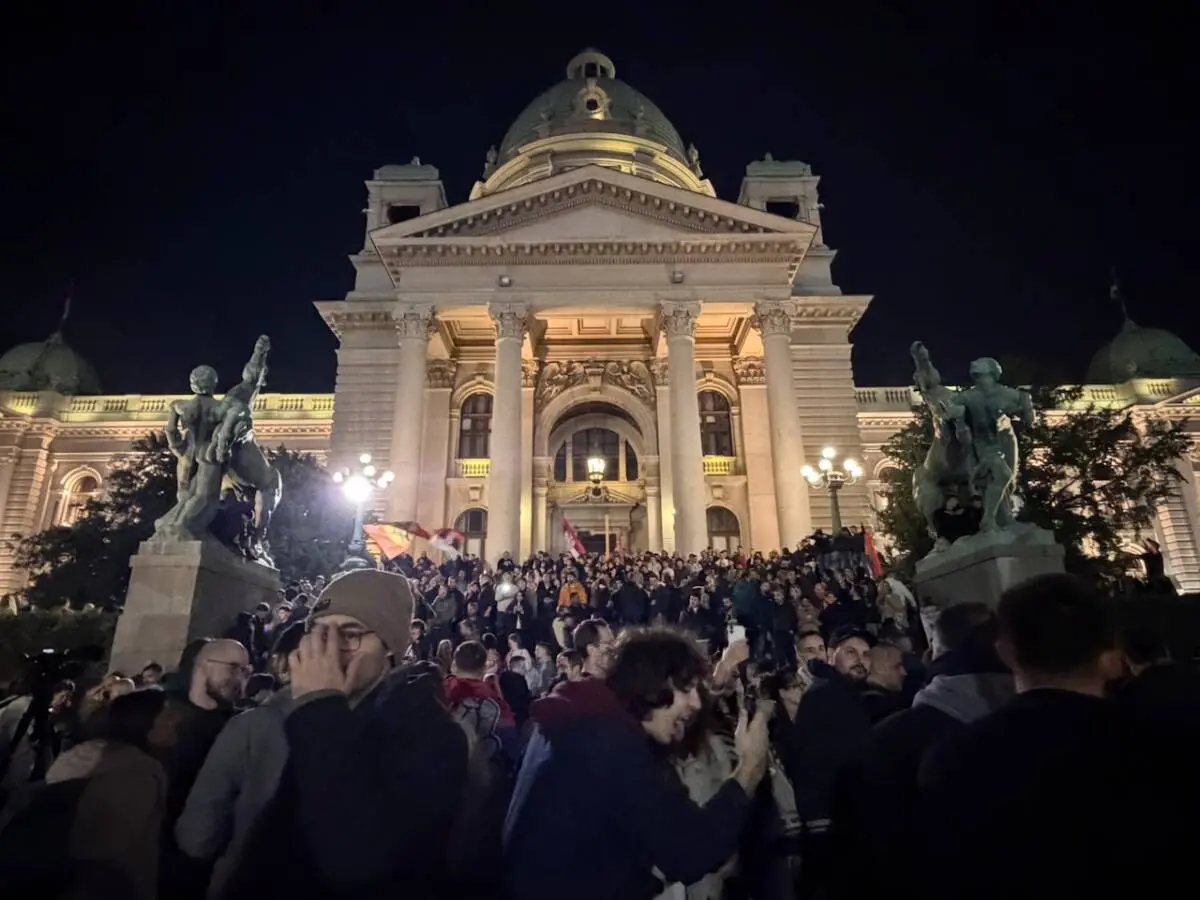
Belgrado, Serbia, la notte delle elezioni, 25 ottobre 2026 – Foto M. Moratti
Belgrade, Serbia, election night, October 25, 2026 - Photo by M. Moratti
Aleksandar Vučić, the former president and leader of the Serbian Progressive Party (SNS), took the floor last Sunday at 9:31 p.m. and, in front of the cameras, conceded defeat, acknowledging the victory of the student-led list.
While Vučić’s words reflected the proper decorum expected between political opponents, the reality behind them appears to be quite different. Many have questioned whether, on Sunday evening in Belgrade, there was a genuine risk of an outbreak of violence, stemming from an attempt by the SNS to hold onto power by force.
In the days leading up to the election, the signs were clear; observers were deeply concerned about how events might unfold, particularly in the hours immediately following the closing of the polls.
The European Commission delegation intervened several times, reminding the incumbent government of its responsibility to ensure a peaceful electoral process and expressing concern over acts of violence that had occurred during the campaign.
A report by the ODIHR/OSCE election observation mission also highlighted a climate of intense polarization and instances of violence. Vučić, meanwhile, stated in an interview with Russia Today Balkan that he neither expected nor feared any unrest — adding that, should any disturbances arise, they would be brought to an end very quickly.
Election day
On Sunday, October 25, the atmosphere in Belgrade was electric — a stark contrast to a typical Sunday, when traffic is virtually non-existent and the streets are deserted. From the moment voting began, the streets were crowded, and there were very long queues at the polling stations. Early signs pointed to a record turnout, both in Serbia and abroad, that kept growing by the hour; many observers believed that a high turnout would favor the student-led electoral list.
At the same time, however, far more concerning signals began to emerge. The street in front of the Electoral Commission had been closed since the early morning, with pedestrian access also prohibited. The Electoral Commission is located directly behind the Presidency, practically facing Pionirski Park — a space that, since March 2025, had been occupied by the “ćaci”, staunch loyalists of the SNS, and dubbed “Ćacilend.”
The anti-corruption organization KRIK had previously identified a large number of individuals among the park’s occupants who had prior convictions for violent crimes. As a “defector” recently revealed, these individuals were recruited during student protests and paid handsomely in cash to physically hold the park, attack journalists, and intimidate members of the opposition. Many were armed and coordinated their actions closely with the police.
Preparations for a confrontation
Late Sunday afternoon, around 5:00 PM, the situation shifted dramatically. Large numbers of riot police, accompanied by armored vehicles, arrived in the cordoned-off area and took up positions near the park. Simultaneously, tents were being set up inside “Ćacilend,” which had been deserted until that moment.
Meanwhile, reports from media sources suggested that former Hungarian Prime Minister Viktor Orbán had personally called Vučić, urging him to acknowledge his defeat and relinquish power peacefully. Vučić, however, did not seem open to a peaceful solution.
Around 7:00 PM, groups of “ćaci” began to flood into the park, with the police looking on and allowing them to pass. It was clear that preparations were being made for potential clashes, and messages circulating on social media strongly advised people to avoid the area and stay home.
The scene was reminiscent of 15 March 2025, or November 1 of that same year, when protesters had nearly come into conflict with “ćaci” who had enjoyed police protection.
As “Ćacilend” filled up, voting concluded with a record turnout; a great sense of uncertainty hung in the air, both regarding the outcome and what might happen once the results were announced.
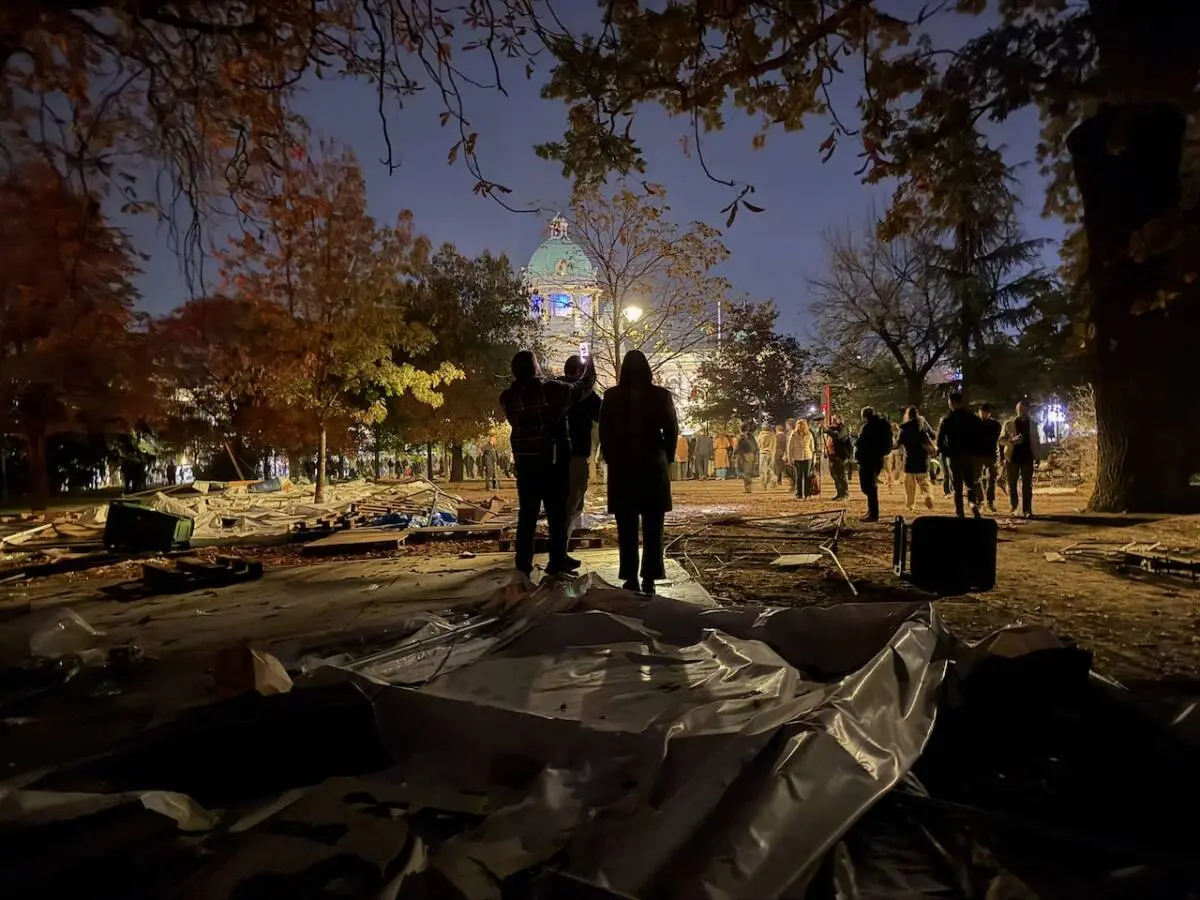
Belgrade, Serbia, October 25, 2026 – Photo by M. Moratti
The turning point
At this juncture, as reported by the London Times and the news portal Nova.rs, the pressure on Vučić, most likely exerted by European governments, must have intensified to the point of compelling him to abandon any pursuit of a violent confrontation; hence, his dramatic admission of defeat.
Shortly after Vučić’s announcement, the “ćaci” hastily abandoned the park and scattered throughout the city. Around 11:00 PM, as celebrations were already underway in Belgrade, the police forces also withdrew from the area, met by the fury of citizens, who hurled stones and other objects at the departing armored vehicles.
At the same time, citizens tore down the barriers erected around “Ćacilend,” reclaiming the park by dismantling and burning the structures the “ćaci” had built. The following day, groups of volunteers and municipal workers cleaned up the park and returned it to the city.
Multiple sources, therefore, seem to agree that election night could have taken a dramatic turn had it not been for the pressure placed on Vučić and his subsequent decision to yield.
Nevertheless, the days ahead remain fraught with high tension, and the transition will not be easy. There is a genuine fear that the SNS, before relinquishing power, might attempt further reckless maneuvers in an effort to destabilize the country.
Found an error in this article? Please contact our editorial team at redazione@balcanicaucaso.org.
Featured articles
 the students' voices
 Investigation
 students' protest