Bulgaria: Winds of war on the Black Sea
Over the past two weeks, four merchant ships have been attacked by drones in the waters of the Black Sea off the Bulgarian coast. Prime Minister Rumen Radev has opted for a cautious approach, without directly accusing Russia. This stance has sparked protests from the opposition, which accuses him of being too accommodating towards Moscow
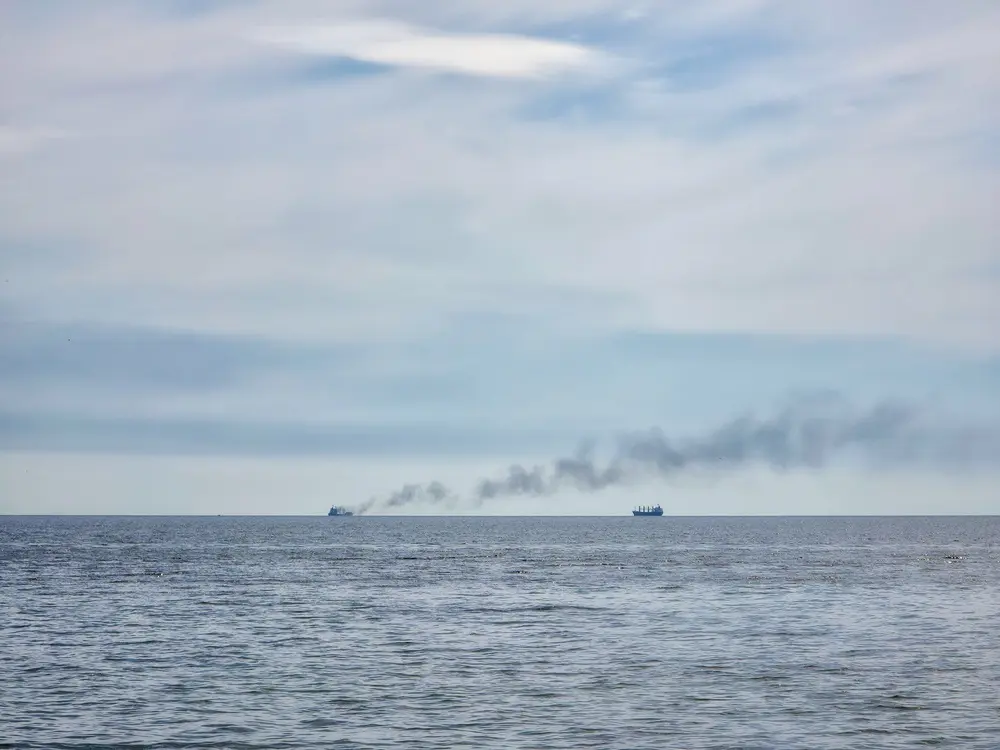
Ukrainian ships attacked in the Black Sea © FotoNova Shop/Shutterstock
Ukrainian ships attacked in the Black Sea © FotoNova Shop/Shutterstock
The Black Sea was tense and turbulent for much of yesterday as Bulgarian naval vessels, civilian ships and two helicopters scoured the waters for 11 missing crew members of the HS Dignity, a merchant vessel attacked and sunk by drones in the early hours of October 13.
The HS Dignity, sailing under the flag of Guinea-Bissau, was struck just 17 nautical miles off the Bulgarian coast. Five crew members were rescued, but the fate of the remaining 11 remains unknown. Search and rescue operations were suspended in the middle of the afternoon as weather conditions deteriorated.
Another merchant vessel, the Chelsea 3, was also hit and damaged about 18 nautical miles off the coastal town of Byala. All 15 crew members — seven Ukrainians and eight Azerbaijanis — were rescued from the sea and taken to Varna, where some received treatment for minor injuries.
Tuesday’s incident was the second attack on merchant vessels near the Bulgarian coast. On the night of October 6, two other ships, the Able and the Alfa Watan, were targeted in Bulgaria’s exclusive economic zone. The Alfa Watan, sailing under the Togolese flag, sank rapidly. Despite search efforts, all 12 crew members remain missing.
The Black Sea, a Theater of War
Since Russia launched its full-scale invasion of Ukraine in February 2022, the Black Sea has become a war zone and a flashpoint not only between the two warring countries, but also between Russia and NATO member states.
Until now, however, the war’s impact on Bulgaria had largely been limited to distant echoes, along with reports of drones crashing into the sea and being washed ashore by currents. The latest attacks at sea have sharply raised the level of concern in Sofia, prompting growing alarm over Bulgaria’s exposure to the conflict.
Although the vessels were sailing under different flags, they are Ukrainian-owned or involved in transporting cargo — mainly grain and other agricultural products — from Ukrainian ports to Turkey. So far, Bulgarian authorities have presented no conclusive evidence identifying those responsible for the attacks off their coast and have maintained a cautious stance.
Following Tuesday’s attack, however, Prime Minister Rumen Radev bowed to mounting pressure from the opposition and public opinion by summoning Russia’s ambassador to Bulgaria, Eleonora Mitrofanova.
According to the news outlet Mediapool, Radev told Mitrofanova that, despite the lack of conclusive evidence, “logic points to the Russian Federation […] given that Ukraine has no interest in attacking its own ships”.
The Russian ambassador replied that she had received no information on the matter from Russia’s Defence Ministry and could not rule out the possibility that the attacks off the Bulgarian coast were “a provocation by a third country”.
After meeting the Russian ambassador in what was described as a cautious exchange, Radev swiftly convened the National Security Council. He then spoke by phone with European Commission President Ursula von der Leyen and NATO Secretary General Mark Rutte.
Both expressed concern and solidarity with the Bulgarian prime minister. Von der Leyen described the renewed attacks near Bulgaria’s coast as “unacceptable”.
Radev also moved to strengthen regional cooperation, announcing plans to coordinate with neighbouring Romania and Turkey, the other NATO members bordering the Black Sea. During a call with Radev, Romanian Prime Minister Ilie Bolojan described the attacks as “a consequence of Russia’s war of aggression against Ukraine”. The two leaders discussed the possibility of working together with Ankara to ensure safe navigation in the Black Sea.
Political Clash
The drone attacks and the dramatic sinkings of recent days quickly became a source of domestic political friction, as Bulgaria entered the final stretch of campaigning ahead of the presidential election scheduled for October 25.
Radev, his party Progressive Bulgaria and incumbent President Iliyana Yotova, who is seeking re-election with their backing, have come under fire from the opposition. They are accused of being too accommodating towards Moscow and failing to protect the country from the Kremlin’s increasingly aggressive posture in the region.
During yesterday’s parliamentary hearing with the government, Plamen Tonchev, head of Bulgaria’s State Agency for National Security (DANS), said he could not rule out the possibility of Russian sabotage operations on Bulgarian territory.
In addition to the attacks at sea, lawmakers discussed a recent arson incident involving several antennas supporting the Starlink satellite system, which is also used by the Ukrainian military to coordinate its battlefield operations. The incident took place near Sofia on October 9.
The case, which remains under investigation, was brought to public attention by Ivaylo Mirchev, co-chair of the opposition party Democratic Bulgaria. He disclosed the incident despite the silence of the police and security services. A protest against the government, organised on social media, has been announced for this evening outside the Council of Ministers in central Sofia.
“We Are Blind to the Drones”
Despite the criticism, Radev has opted to maintain a cautious approach. “We want to establish precisely which country the drones attacking ships near our coast are coming from,” the Bulgarian prime minister said. Meanwhile, Defence Minister Dimitar Stoyanov announced that Bulgaria could join NATO’s anti-drone defence initiative, from which it had initially distanced itself.
Military experts have meanwhile voiced concern over the Bulgarian armed forces’ ability to respond to a direct drone attack on the country.
Speaking to Bulgarian broadcaster bTV, Vasil Danov of the non-governmental organisation Atlantic Council said that, although Bulgaria had a sound coastal surveillance and response infrastructure, it was ill-prepared for the modern drone threat.
“The system is designed to monitor maritime traffic. Drones are a completely different matter. As far as this threat is concerned, we are currently completely blind.”
Found an error in this article? Please contact our editorial team at redazione@balcanicaucaso.org.
This article was produced as part of PULSE, a European initiative coordinated by OBCT that supports transnational journalistic collaborations
Tag: PULSE
Featured articles
 Montenegro Pride 2026
 Political deadlock