Imvros, stop by stop: The slow revival of the last Greeks of the Dardanelles
On Imvros/Gökçeada, a Turkish island at the mouth of the Dardanelles with a fascinating and complex history, faith, hospitality and history intertwine every 15 August for the Feast of the Dormition of the Virgin Mary, whilst the island’s Greek community is still trying to understand what it really means to return
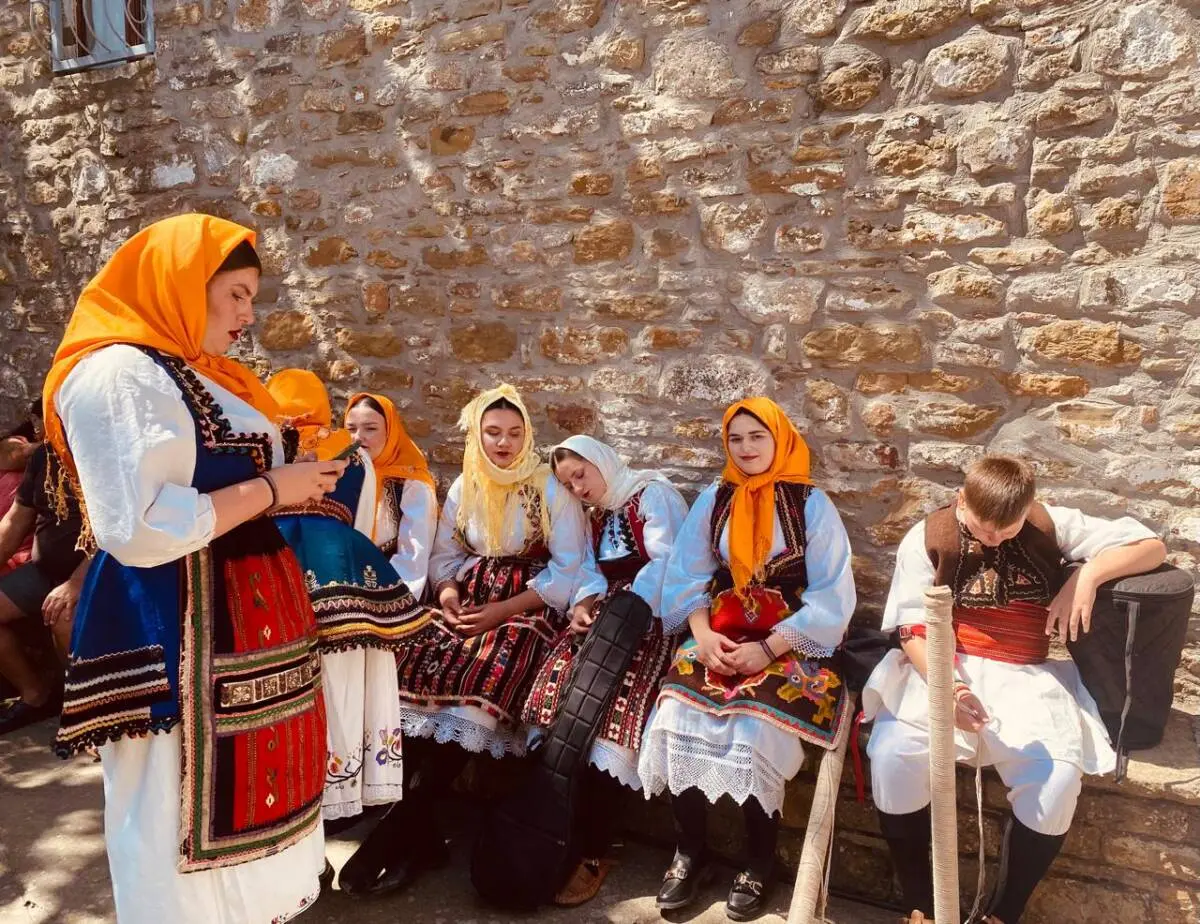
Imvros – M.Drosopoulos/OBCT
Imvros - M.Drosopoulos/OBCT
Everyone I met on Imvros assumed I was a visitor. I was, in fact, coming home.
My great-great-uncle, Spyros Meletzis, was born in Agioi Theodoroi in 1906 — the same village, the same stone streets, that would one day produce a Patriarch. He left as a boy of seventeen, when Lausanne handed the island to Turkey, and became, decades later, the man history remembers as the photographer of the Resistance: the one who climbed into the mountains and made Aris Velouchiotis, a small man, look like a giant.
My grandmother, Anna Olziersky, ninety-nine years old and still sharp with memory, tells me how Meletzis married her cousin in Alexandroupolis, folding himself into the Christides family and, through them, into mine. Before he died, his niece — Eleni Aimatidou-Argyriou, the author and researcher I have always known as my beloved Aunt Nitsa — worked with him on a book compiling his photographs of Imvros, so that, in his words, “the younger generation does not forget.” I attended the exhibition as a small child, without yet understanding that I was looking at my own inheritance.
This past August, I made the same crossing, notebook and camera in hand, to spend the Dormition (or Kimisis, a feast marking the Virgin Mary’s death and assumption into heaven, known in Italy and parts of the Mediterranean as Ferragosto), among the people who still live this contested inheritance. Imvros rarely makes the news pages — not in Greece, not in Turkey, and almost never abroad — yet it remains one of the few places where the aftermath of Lausanne, the fate of a shrinking minority and the daily texture of Greek-Turkish coexistence can still be observed firsthand, rather than argued about in the abstract.
This time, it was no ordinary “panayır” (πανηγύρι, feast): His All-Holiness Bartholomew, Archbishop of Constantinople–New Rome and Ecumenical Patriarch, had arrived days earlier with two brother primates — Theodoros II of Alexandria and Ioannis of Albania — and it was alongside Archbishop Ioannis that he presided over the liturgy at Tepeköy, a concelebration that the Orthodox press called historic.
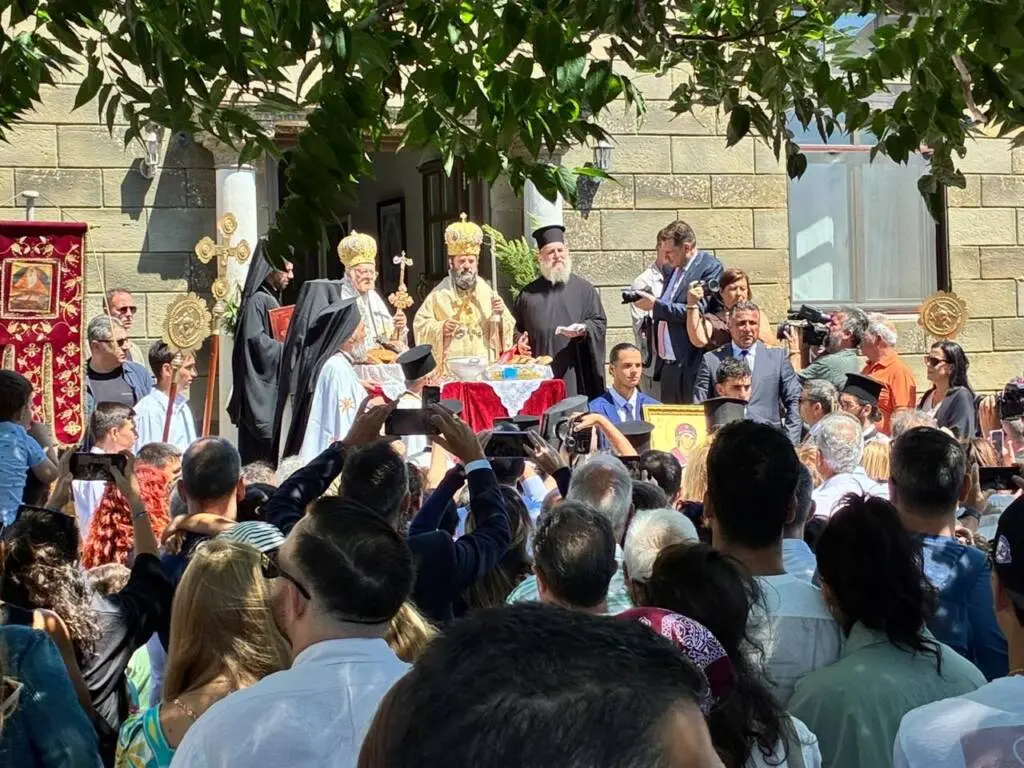
Patriarch Bartholomew on Imvros – photo by M. Drosopoulos
First Stop: Tepeköy/ Agridia
The road up to Tepeköy (or Agridia/Αγρίδια in Greek) climbs until the sea disappears behind it — the highest of the island’s Greek villages, and on the fifteenth of August, the fullest. By the time I arrived, the churchyard of Evangelismos tis Theotokou (Church of the Virgin Mary) was already dense with visitors: Greek and Turkish, Christian and Muslim, year-round islanders standing shoulder to shoulder with the diaspora who fly in every August for exactly these three days.
The animals had been slaughtered the evening before, blessed by the village priest with incense and the sign of the cross before the knife touched them. İskender Oymak’s ethnographic study (2002) describe both büyükbaş (cattle) and küçükbaş (sheep/goats) being offered, with the priest performing the blessing at a distance for the larger animals.
It is a detail that catches outsiders off guard: Gökçeada’s Orthodox Christians keep a kurban tradition of their own — but it has nothing to do with the Islamic Kurban Bayramı (Eid al-Adha), the Islamic feast of Sacrifice, observed on a fixed date in the lunar calendar, marking Abraham’s willingness to sacrifice his son. For each Christian believer, the kurban represents a personal vow made to Panagia (the Virgin Mary), in exchange for a recovery from illness, a son’s safe return from military service, or a grandchild’s birth, and it is fulfilled specifically at churches dedicated to her Dormition.
By morning the meat had become keşkek — a thick wheat-and-meat porridge, boiled for hours in enormous cauldrons in the churchyard until it breaks down almost to a paste — then carried out and shared, free, at long communal tables, with anyone who came. Before the meal was served, the village walked together to the cemetery, where local women handed out candy at the graves: a gesture that folds mourning into the feast rather than setting it apart. The dead remain in the prayers of those who stay behind.
The Feast and the Fault line
In this blessed, emotional atmosphere, the incense hadn’t even cleared before the first argument broke out.
One moment we were standing in silence and awe, watching a rite older than the nation-states squabbling over this island; the next, we were watching something almost subversive: the islanders quietly breaking the oldest rule either culture has. Philoxenia or misafirperverlik — call it what you like in Greek or in Turkish, it amounts to the same near-sacred law: the guest eats first, and eats best.
And yet, year after year, on this island where both cultures overlap and where both would swear on their grandmothers that the rule is inviolable, the locals worked the line so that the best cuts stayed home. Nobody stayed quiet about it, either. Christians and Muslims alike, standing in the same line, started pushing and arguing, while others peeled off entirely — deciding the wait wasn’t worth it — and walked away, drenched in sweat under the hot summer sun.
It was, in its way, the least surprising moment of the day: the locals were served, the village officials were served — as they always are — and the visitors were left standing a little apart, sensing, without anyone saying so, that hospitality here has a hierarchy of its own.
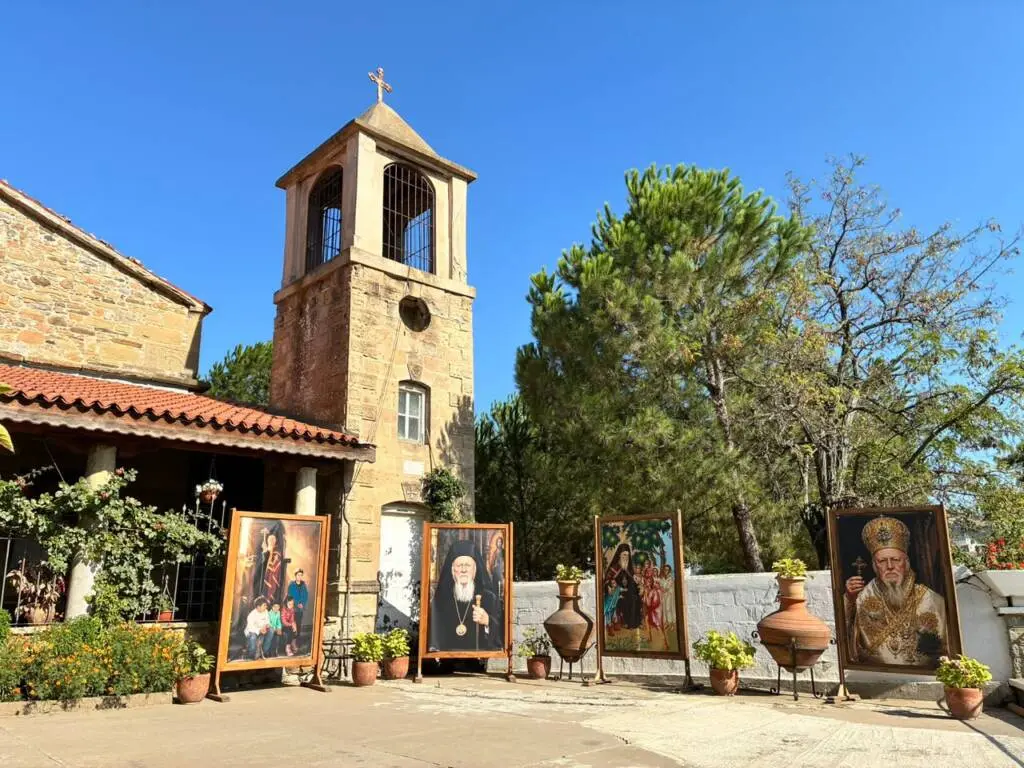
Church of Panagia – photo by M. Drosopoulos
Second Stop: Imvros town / Çınarlı (Gökçeada Merkez)
In the town of Imvros, inside the Metropolitan Church of Panagia — set back from the pedestrian promenade lined with restaurants, near the museum with its small café — the walls carry nearly as many photographs as icons. Most show the same man, almost always surrounded by children. This is Bartholomew, Archbishop of Constantinople–New Rome and Ecumenical Patriarch, and on this island the distance between “His Holiness, the Patriarch” and “the boy from Agioi Theodoroi” barely exists.
He was born Dimitrios Archontonis on 29 February 1940 in Zeytinliköy — known to Greeks as Agioi Theodoroi — the fourth child of a barber and coffee-shop keeper. He attended the village school, then the Zografeion Lyceum in Istanbul, then the Theological School of Halki, graduating with highest honors in 1961; like any Turkish citizen, he also completed his military service, as a reserve officer.
The Ecumenical Patriarch holds Turkish citizenship and belongs, ethnically, to the remnant of the Greek “Rum” community that Lausanne left in place rather than exchanged — which is, in miniature, the whole story this island keeps retelling. He was elected the 270th successor to the Apostle Andrew on 22 October 1991 and enthroned on 2 November of that year. 2026 marks thirty-five years since that enthronement.
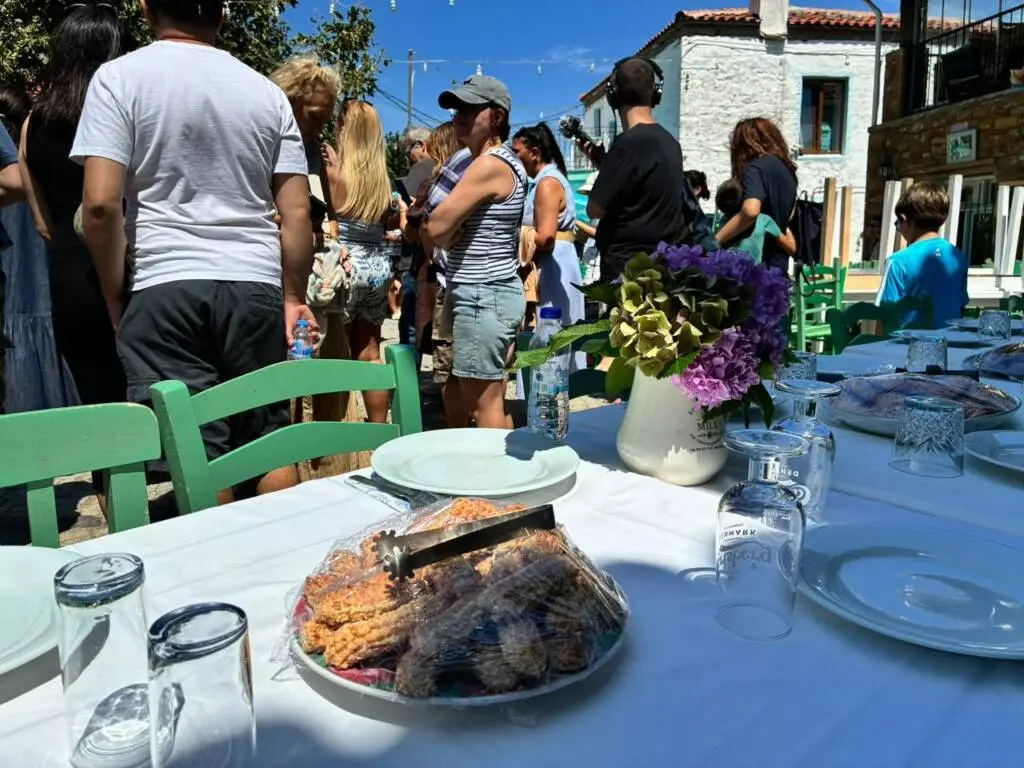
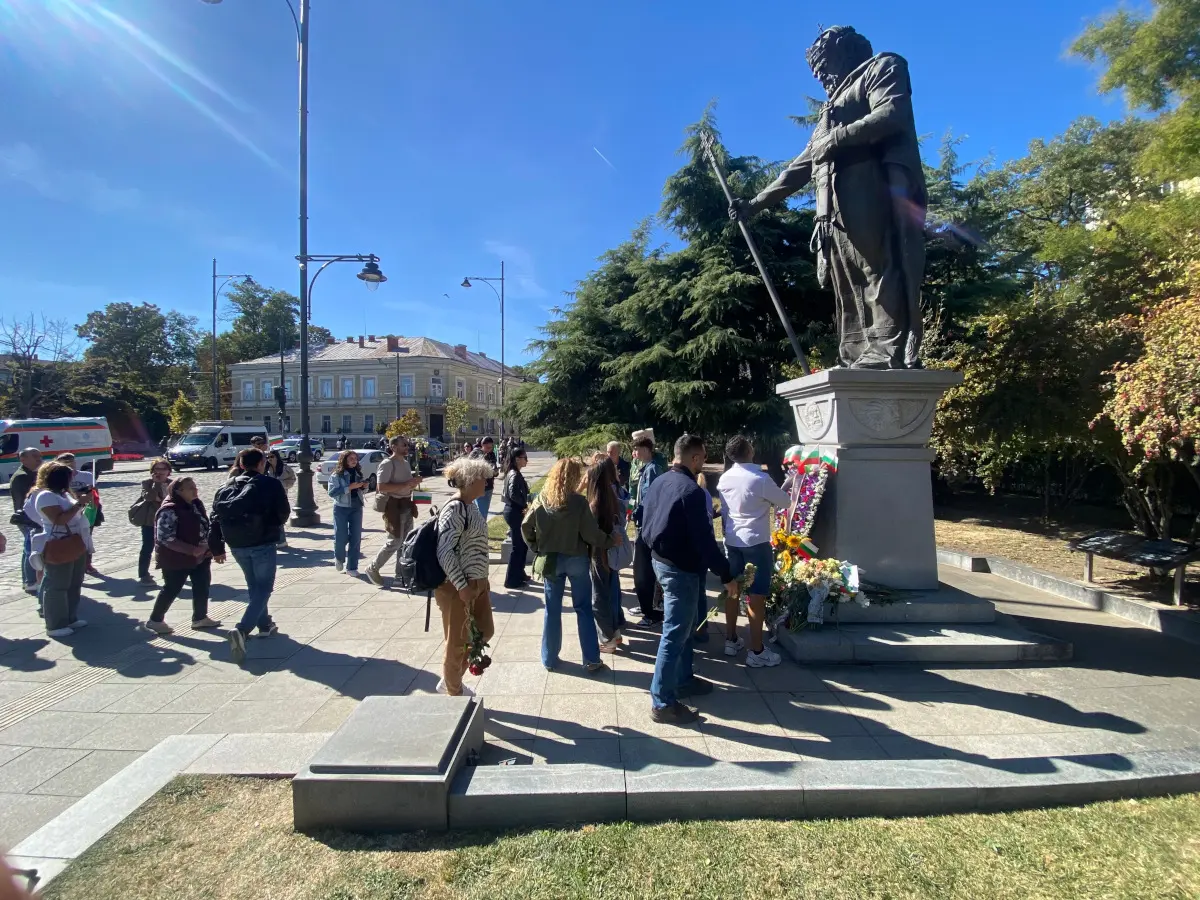
Greek community on Imvros – photo by M. Drosopoulos
A short history of Imvros as Greek land
To understand why a Patriarch’s baptismal story hangs, in photographs, on a village church wall, you have to go back to a clause most people have never read.
Imvros (Gökçeada since 1970) was, from antiquity through the mid-twentieth century, an overwhelmingly Greek island — an Athenian colony in classical times, later an Orthodox stronghold at the mouth of the Dardanelles. Briefly ceded to Greece under the 1920 Treaty of Sèvres, it reverted to Turkish sovereignty under the 1923 Treaty of Lausanne — but, uniquely among the Aegean islands, without the population exchange applied elsewhere.
Article 14 of the treaty exempted Imvros and Tenedos (Bozcaada) explicitly, promising the islands “a special administrative organisation” that would guarantee the native non-Muslim population’s rights over local government, education, and property.
That autonomy was short-lived. In 1927, it was formally revoked, and private Greek education was placed under Turkish state control; land purchases and business activity were increasingly restricted through the 1940s and ‘50s. Then, in the tense climate surrounding the Cyprus conflict, Turkey’s National Security Council closed the island’s Greek-language schools in March 1964, expropriated more than 90 percent of the island’s arable land at minimal compensation, and in 1965 opened an agricultural prison colony at Dereköy, the island’s largest village, settling convicts and their families alongside the remaining Greek residents (Grigoriadis 2021).
Within a generation, a population of roughly 6,700 Greek islanders, recorded in the 1928 census, had fallen to around 400 by the late 1990s; most left for Athens, Alexandroupolis, Thessaloniki, Istanbul, or further abroad.
In a 2021 study of Turkey’s Greek minority, Dr. Ioannis N. Grigoriadis — a political scientist who has taught at Bilkent University in Ankara and now heads the Turkey Programme at ELIAMEP, the Athens-based foreign policy think tank — tempers the celebratory version of this story. Since the early 2000s, roughly 200 first- and second-generation Imbriots have resettled on the island full-time, with another hundred or so spending most of the year there, alongside a few thousand summer visitors — a recovery that coincided with the reopening of Greek-language schools in Zeytinliköy and Tepeköy after 2013, for the first time in decades.
But he is careful to note that this demographic recovery “has been, however, based on rather fragile grounds.” Most of the land expropriated in the 1960s never returned to Greek hands; it remains under state control or was long ago resettled with Turkish citizens, leaving returnees able to rebuild their houses but not, easily, a livelihood from the land around them.
Bartholomew has spoken plainly about the “stone years” of the 1960s — the closure of the schools, the confiscation of Imbriot land, the forced exodus that scattered his own generation across Athens, Istanbul, and further abroad. The Ecumenical Patriarch has been returning to Zeytinliköy nearly every year since his enthronement, celebrating the liturgy in the church where he was baptized, and in a widely cited 2017 address urged young Imbriots in the diaspora not merely to remember the island, but to visit it — “as long as I live and breathe, I will not stop speaking about what we, the Imbriots, went through.”
When Greek-language schooling finally returned to the island in 2013, after nearly fifty years of silence, he called it a “blessing” long prayed for rather than a political victory — but it is difficult to separate the two: It was precisely his decades of outreach to the diaspora, and his own standing as Imvros’s most famous son, that gave Ankara, Athens, and the Patriarchate each a reason to treat the island’s revival as a shared success story.
Dr. Fotini Toloudi, a historian at the Aristotle University of Thessaloniki who made the same pilgrimage this year, sees this revival from the inside. She came, as she told the OBCT, to visit the Patriarch’s birthplace, to talk with the Imbriots, and, if only for an afternoon, to feel like a Romia of Imvros herself, wandering streets she described as “lifted from a film.”
What struck her most was practical rather than sentimental: the Greek diaspora had gone as far as building housing for the teachers recruited from Greece to staff the reopened schools. In her view, the island’s “educational renaissance,” which began in 2013, did more than restore a curriculum — it pulled back families who had left for Istanbul or Greece for their children’s sake in the first place. “The island came back to life,” she said.
Between Grigoriadis’s caution and Toloudi’s optimism sits the truth of Tepeköy’s churchyard: a revival that is real, contested, and still, every August, negotiated one line at a time.
Dr. Mary Drosopoulos is a COFUND Postdoctoral Researcher, part of the Migration Diaspora Citizenship Programme, at the Institute of Ethnology, University of Münster, Germany.
Found an error in this article? Please contact our editorial team at redazione@balcanicaucaso.org.
Tag:
Featured articles
 Montenegro Pride 2026
 Political deadlock