Analysts urge Kosovo and Serbia to strengthen their economic relationship
What could motivate Kosovo and Serbia to cooperate now, without waiting for long-term normalization of relations? A recently published study identifies regional economic cooperation as a potential lever
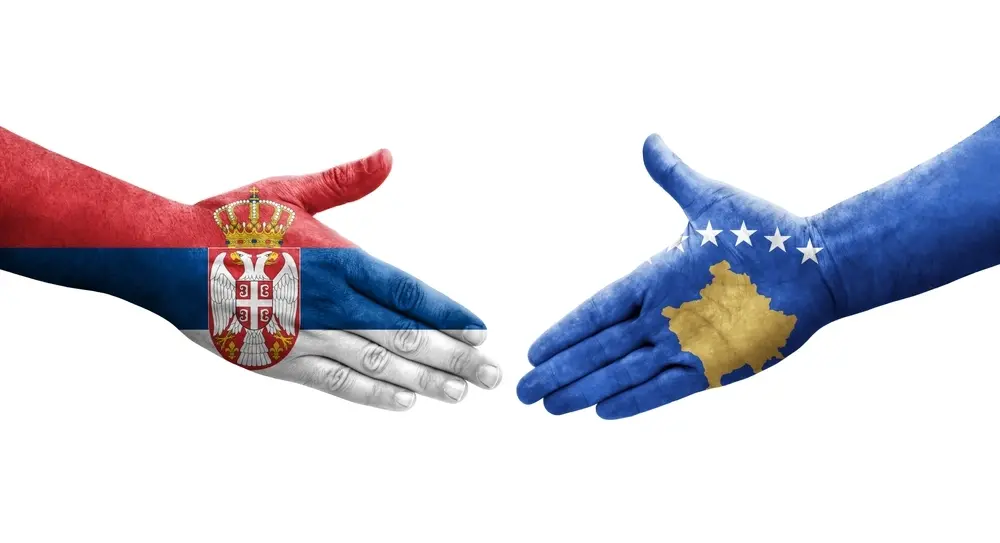
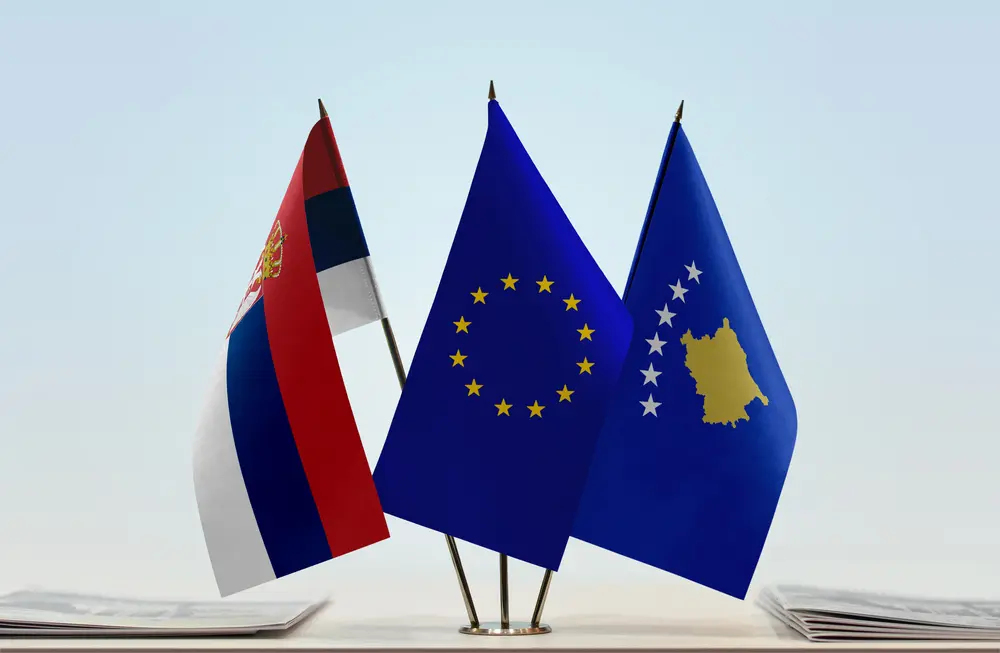
The flags of Serbia and of Kosovo
The flags of Serbia and of Kosovo - ©Prehistorik/Shutterstock
If economic relations can continue despite incomplete political normalisation, can they also be strengthened in ways that support the longer-term normalisation process?
This is the question that scholars and practitioners, Will Bartlett, Bernard Nikaj and Nenad Djurdjevic examine in a recent study on economic cooperation between Kosovo and Serbia. It is also a topic that speaks to broader issues in terms of how economic relations between the two countries have been handled, especially since the first agreement of normalization of relations was reached in 2013. Another important agreement reached in 2023 focused on recognition of documents, including passports, diplomas, license plates and customs stamps, as well as economic cooperation. Moreover, the paper asks what the missed opportunities are for investment, business partnerships, skill development and innovation.
Therefore, the analysis focuses on the existing frameworks already in place, such as CEFTA, the Common Regional Market and the EU Growth Plan, and on how they can be used more effectively to keep economic cooperation moving forward when, as the authors say, political progress is slow.
While the benefits of the current framework remain limited due to unsolved political issues, the paper argues that the economic relations have proved more resilient than the political relationship might suggest.
“Kosovo and Serbia are geographically close, economically interconnected and part of the same regional market. Kosovo trades significantly with CEFTA partners, while Serbia remains an important source of imports. Commercial links have continued even during periods of serious political tension,’ the authors write in the paper “Strengthening Kosovo-Serbia relations through economic cooperation: the role of regional economic integration”.
Also, the countries’ ambitions to join the European Union and the European market is a reason for cooperation to advance before normalization and deliver economic benefits.
“As businesses develop relationships, invest in supply chains and depend on functioning economic links, disruption becomes more costly. Over time, these interests can strengthen support among businesses and other economic actors for more predictable relations. Economic interdependence does not automatically lead to political reconciliation, but it can strengthen the incentives for it,” the authors write.
This calls for a political-economy approach that connects economic opportunities to institutional acceptance, accountability and the distribution of benefits.
The paper argues that increased trade alone should not be seen as evidence of deeper regional economic integration. While removing traditional trade barriers has helped expand intra-regional trade, deeper integration requires conditions that allow investment, supplier relationships, services, digital transactions, skills mobility and participation in regional and European value chains to develop across borders.
“The policy objective should therefore be not only trade expansion but the reduction of the institutional and economic frictions that prevent trade from developing into deeper and more diversified economic interdependence.”
Serbia doesn’t recognize Kosovo’s independence; what does it mean for economic relations between the two countries?
According to Besnik Vasolli, the director of the German Kosovar Chamber of Commerce, the main constrain is a lack of confidence that business relationships can operate under stable rules and equal treatment.
“A Kosovo company should receive the same fair treatment in Serbia that a Serbian company should receive in Kosovo. Both need accepted documentation, predictable procedures and confidence that their rights will be protected. We should look ahead and ask what kind of region we want our children to live in. Better business relations can create jobs, attract investment, and help us serve European markets together,” Vasolli told OBCT.
Practical concerns for businesses include customer and transit procedures, document acceptance, payment arrangement and recognition of qualifications. However, the fact that Serbia doesn’t recognize Kosovo’s independence is seen as a fundamental obstacle.
“Political divisions affect confidence directly. Serbia’s non-recognition of Kosovo remains a fundamental obstacle to an equal relationship. Confrontational rhetoric can deepen insecurity and make businesses less willing to invest in a shared future, ” Vasolli said.
On the other hand, it is up to business association to identify partners, connect them with buyers and support the process through contracts.
“Business associations can identify partners, connect them with buyers and support the process through to contracts. Certification, training and investment support should help close the specific gaps buyers identify. This would give companies stronger reasons to cooperate and governments stronger reasons to remove obstacles,” Vasolli told OBCT.
Rrezarta Gashi, who has worked in supply-chain and import management for major Kosovo retailers, says barriers impact the operational costs and the costs that Kosovars pay in the end.
“For example, a supplier may offer highly competitive prices, but if there is uncertainty regarding transportation, documentation, or border procedures, the company must also factor in these risks. In such cases, a business may decide to source from another market, even if the price of the product is higher. This directly affects operating costs and, ultimately, the price the consumer pays for the product,” Gashi, currently an associate professor at AAB College, told OBCT.
According to the Kosovo Agency of Statistics data, between January and August 2026 Kosovo imported goods worth €154.6 million from Serbia, while its exports to Serbia amounted to €48.3 million. According to the Kosovo Agency of Statistics, in 2025 the amount of imported goods from Serbia, was 234.6 million – approximately 20 million per month – while Kosovo’s export to Serbia was 61.5 million. Serbia was able to export less goods in Kosovo only when Kosovo imposed a 100 percent tariffs in Serbia’s import and Bosnia and Herzegovina due to political tensions – in part in response to Serbia’s lobbying against Kosovo’s membership in INTERPOL and other international bodies- as it was the case in 2018.
But these numbers also show the differences in the structures and strengths when it comes to the economies of both countries.
“Serbia has a relatively strong manufacturing base and has attracted substantial foreign investment into export-oriented production. Kosovo’s private sector is dominated by SMEs and has developed particular strengths in services, including ICT and business-process outsourcing,” reads the paper.
For the authors, the relationship should not be viewed only through the bilateral trade balance. “Serbia’s manufacturing companies, including multinational companies operating in the country, need a wide range of suppliers and business services. Kosovo SMEs could potentially provide some of these inputs if they can meet the required standards, quality, reliability and delivery conditions.”
For the director of German Kosovar Chamber of Commerce, improving economic cooperation requires governments to ensure that existing rules are actually implemented, while businesses need clear mechanisms for addressing problems when procedures fail.
“Governments should make agreed rules work in practice. That means equal treatment, reliable acceptance of documents and qualifications, and effective dispute resolution, the EU and partners such as Germany could support regional supplier programmes built around actual demand from buyers,” Vasolli said.
Found an error in this article? Please contact our editorial team at redazione@balcanicaucaso.org.
This publication is the result of activities carried out within the "Contribution of the economic cooperation to Kosovo-Serbia normalisation", a project co-funded by the Italian Ministry of Foreign Affairs and International Cooperation. All opinions expressed represent the views of their author and not those of the co-funding institution.
Featured articles
 the students' voices
 Investigation
 students' protest