Serbia-Kosovo, the economy as a lever for the success of EU-mediated dialogue
By broadening the scope of action and involving the societies of both countries, “we can accelerate political normalization and bring the process to completion, integrating the entire region into the European Union.” An interview with Bernard Nikaj, former Minister of Trade and Industry and Kosovo’s Ambassador to Belgium
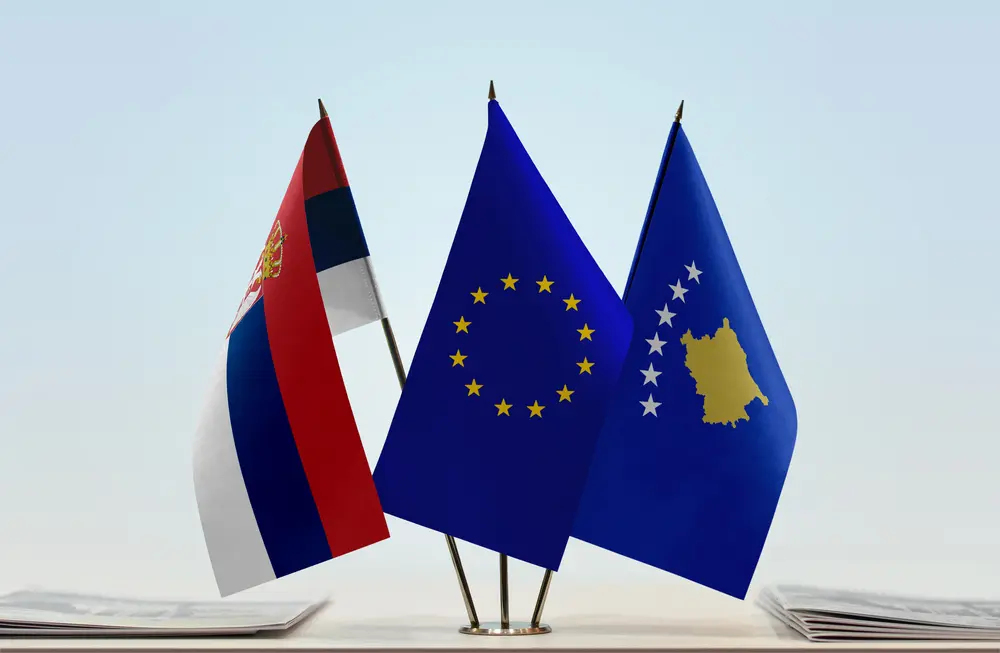
Flags of Serbia European Union and Kosovo © alexfan32/Shutterstock
Flags of Serbia European Union and Kosovo © alexfan32/Shutterstock
The failure to normalize relations between Serbia and Kosovo has a massive economic impact on both countries.
However, the economy could serve as a starting point – even amidst strong tensions and nationalist sentiments – to get the Brussels-based mediation process back on track after years of stagnation and no clear prospects for resumption.
“For a long time, the normalization process remained confined to a narrow circle of politicians in Brussels, Belgrade, and Pristina, without the public understanding what was happening or the concrete benefits of such normalization for both countries being explained,” explains Bernard Nikaj in an interview with OBC Transeuropa. Nikaj is Kosovo’s former Minister of Trade and Industry and former Ambassador to Belgium, having been involved in the country’s EU and NATO integration processes.
Drawing on a recently published paper regarding the strengthening of Kosovo-Serbia relations through economic cooperation, Nikaj warns of the consequences of a dynamic that has generated “a certain resistance to the dialogue process.”
Conversely, “by broadening the scope of action and focusing on the economy, we can accelerate political normalization and bring the process to completion, integrating the entire region into the European Union.”
Can economic interests in Kosovo and Serbia truly overcome the political obstacles preventing deeper cooperation?
What emerges from the research is that both countries – for citizens and businesses alike – stand to gain financially from increased economic cooperation. This is particularly true for Kosovo, a developing country grappling with access to new markets and technological transformation.
I am not suggesting that economic cooperation alone can overcome political disagreements and outstanding issues. However, by leveraging these tangible benefits, it can provide additional incentives to surmount political obstacles.
Economic cooperation should be viewed as a process that contributes to normalization by identifying solutions to economic issues – solutions that can subsequently translate into broader political agreements to resolve the overall situation.
Politically, the positions of Belgrade and Pristina diverge. This research seeks to identify common ground upon which both sides can make progress.
Which sectors hold the greatest potential to benefit from the integration of regional and European value chains?
There are various proposals to capitalize on the strengths that both countries offer.
For instance, Kosovo has a very young population; it would be advantageous to harness this workforce to develop vocational training programs across the region, with the aim of enhancing the workforce’s capacity to integrate into the value chain.
This applies not only to Kosovo and Serbia but can be extended to any other Western Balkan partner.
Furthermore, there is significant potential in many sectors that have already proven to be complementary – such as agricultural processing and primary agricultural products destined for export to Serbia, which can then enter high-value-added supply chains.
This can also help build Kosovo’s capacity to move up the value chain toward EU markets.
Indeed, this is the very idea behind a number of European Union initiatives – such as the Common Regional Market and the Growth Plan – which aim to foster industrial linkages among Western Balkan countries.
Could businesses and private investors become an independent force driving closer relations between Kosovo and Serbia?
In a perfect world, politicians make decisions – even difficult ones – and all issues are solved in this way. However, the EU-facilitated dialogue has been ongoing for nearly 16 years, and we have seen that matters are more complex than they appear in theory.
It is essential that various sectors of society be involved in this normalization process, and everyone can make a contribution.
The private sector, particularly the part that creates economic value, knows how to recognize when an economic opportunity arises for growth, new markets, new skills, and new products.
That is why there is still untapped potential in economic cooperation to help forge a bond between the two countries.
If value chains were established between Serbia and Kosovo, pressure on politicians to move towards normalization would increase, given that the cost of failing to normalize affects businesses and citizens alike.
But would the benefits of improved trade be distributed relatively evenly between the two economies, or might there be winners and losers?
We must pay close attention to the fact that the size and potential of the two economies are disproportionate, and ensure that benefits are distributed fairly.
We do not want cooperation that ties Kosovo’s economy to a dependency on the larger Serbian economy.
We need solutions that allow Kosovar producers – and the country’s economy as a whole – to access European markets and value chains via the Serbian economy.
We must ensure that any dependency cannot be exploited as a political tool, as this is precisely what politicians and the public fear when greater cooperation is discussed.
Should Kosovo and Serbia prioritize specific, concrete economic measures with immediate benefits, or pursue a broader package of economic integration as part of the normalization process?
There are numerous regional initiatives and agreements between the two countries stemming from the EU-facilitated dialogue, yet they have not yielded the results initially expected.
Some aspects are straightforward and technical in nature.
Eliminating just a few of the administrative barriers related to trade, phytosanitary certificates, and border delays could boost the regional GDP of both countries by approximately 2%.
This normalization process, which has faced delays, has brought us to a point where we should focus first on the fundamentals, ensuring that goods can move easily in both directions without administrative or non-tariff obstacles. And that people can move more easily, thanks to the mutual recognition of academic qualifications, for instance.
Only then will we be able to integrate these fundamental aspects with more complex initiatives.
We should not be held hostage by existing structures and agreements; instead, we should seek to overcome bottlenecks through new, temporary agreements that drive the process forward.
This is where the European Union has a role to play: it can measure this progress far more effectively than it currently does – for example, by linking it to specific political advances in both the European integration process and the normalization of relations between the two countries.
The document offers both an economic and a political perspective, demonstrating that normalization is not limited to the EU-facilitated dialogue but can take on many other facets through the involvement of businesses, chambers of commerce, and a wider range of stakeholders capable of contributing to the process.
Found an error in this article? Please contact our editorial team at redazione@balcanicaucaso.org.
This publication is the result of activities carried out within the "Contribution of the economic cooperation to Kosovo-Serbia normalisation", a project co-funded by the Italian Ministry of Foreign Affairs and International Cooperation. All opinions expressed represent the views of their author and not those of the co-funding institution.
Featured articles
 the students' voices
 Investigation
 students' protest