The case of Jülide Yazıcı: political refugee in France, prisoner in Albania
Jülide Yazıcı, 32, a Turkish philosophy teacher who has political refugee status in France, has been in an Albanian prison since August 4 because of an Interpol notice. Her situation raises an old question: when Turkey makes a request, does Albania comply?

(Adam Radosavljevic – Shutterstock)
Albania-Turkey relations are tested by Yazıcı's case (Adam Radosavljevic - Shutterstock)
Yazıcı, 32, arrived at Tirana’s airport on August 4, planning to go meet with her family. Instead, Albanian border police detained her because of an international arrest request from Turkey that had been issued about four months before. Three days later, on August 7, the Tirana First Instance Court of General Jurisdiction ordered her to stay in custody while extradition proceedings continue. In court, Yazıcı said she was being persecuted for political reasons and that her life would be in danger if sent back to Turkey. The judge agreed with the prosecution. Yazıcı has since been moved to the women’s prison in Pojskë (Pogradec), about 150 kilometers from Tirana, where she is still being held. On August 21, the Appeal Court of General Jurisdiction confirmed that Yazıcı should remain in detention. Her lawyer argued that she was not a flight risk and could be put under house arrest, but the court disagreed. The judges said she might try to return to France and that questions about her refugee status would be addressed in a later hearing about the extradition itself. Representatives from the French embassy in Tirana attended the hearing as observers. Afterward, officials from a Western diplomatic mission, who did not want their country named, told BIRN that Albania must respect the international agreements it has signed.
The case Ankara wants her to serve
On January 28, 2016, police raided homes in eight districts of Istanbul and detained six university students. Two were released, while four were sent to court. At the time, Yazıcı was a philosophy student at Boğaziçi University and was not home during the raid. She went to the courthouse with her lawyer the next day to give a statement and was arrested there. Because of a confidentiality order, neither she nor her lawyer saw any evidence for the alleged crimes. Yazıcı was released six months later, in July 2016. As the trial went on, she left for France and applied for asylum. During the trial, the prosecutor dropped the charge of being a member of a terrorist organization and instead accused her of “knowingly and willingly aiding a terrorist organization.” Defense lawyers argued there was no evidence for any of the charges, but in November 2017, the Istanbul 14th Heavy Penal Court sentenced Yazıcı and two other students to four years and two months in prison. Two other defendants were acquitted.
Yazıcı’s supporters and France’s National Court of Asylum tell a different story. She joined the 2013 Gezi Park protests and supported the pro-Kurdish, left-wing HDP, which later became the DEM Party. According to asylum court documents obtained by BIRN, Yazıcı was arrested “for having allowed a young woman she did not know, who had been introduced to her by a friend, to stay in her student room”. France’s National Court of Asylum (CNDA) recognized Yazıcı as a refugee on November 16, 2020. Her status became official in September 2021.
Where the case stands
As of early September, the court has not decided on whether Yazıcı should be extradited. The August 7 hearing was only about procedure, confirming her detention based on the Interpol request. The August 21 appeal was just about whether she should stay in custody, not about extradition itself. The court will decide on extradition only after Turkey sends the full case file. Support groups in France say Ankara has until September 12 to do this, which matches the 40-day limit for provisional arrest under the 1957 Convention.
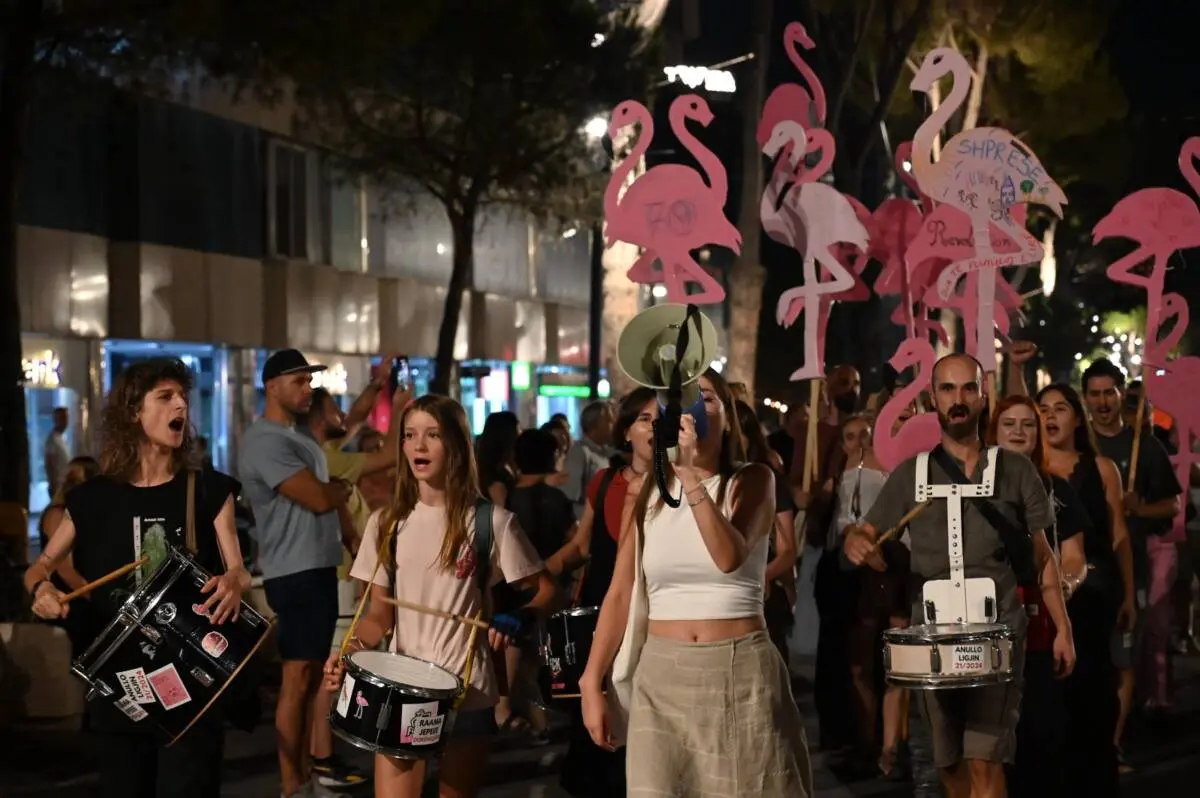
Meanwhile, support for Yazıcı in France has grown. Committees have formed in Tours, Angers, Segré-en-Anjou-Bleu—where she taught at Lycée Blaise-Pascal last year—and Paris. There have been rallies, a petition, and a fundraiser. The Nouveau Parti anticapitaliste has asked the French government to help someone it has already given protection to. Former colleagues told France 3 that diplomacy “must do its work.” Her partner, Remy Durand, spoke to her at length for the first time on August 19. He said she is being treated well and plans to use the time to work on her thesis. He expects the process to take a long time and thinks she may not return to France before November or December. There are also efforts to remove the red notice.
In a statement posted on X and reported by BIRN, the Union pour la Reconstruction Communiste, a French left-wing group Yazıcı belongs to, said she risks torture and inhuman treatment if extradited. The group called on Tirana to respect the Geneva Convention, the ECHR, and the principle of non-refoulement. So far, neither the French foreign ministry nor the Albanian government has made a public statement. At the same time, the European Exiles Assembly has called for Yazıcı to be released immediately.
What Albania has done before
Yazıcı is not the first Turkish national to be detained in Albania at Turkey’s request. However, what happens next has varied depending on the person involved.
Harun Çelik, a teacher who worked at a Gülen-linked school, was arrested at Rinas airport in 2019 with false travel documents and sentenced for forgery. After his release, he applied for asylum in Albania. But on January 1, 2020, just hours after leaving prison, police took him to the airport and put him on a plane to Istanbul. They used the “aliens” law for expulsion instead of the extradition process, and his asylum claim was not decided. The EU delegation, the Council of Europe rapporteur for Albania, and five UN human rights officials all objected. The Albanian government said it did not know he was being prosecuted in Turkey. The opposition linked the quick removal to the close relationship between Prime Minister Edi Rama and President Erdoğan.
Selami Şimşek, who was arrested with Çelik, also asked for asylum after his release in March 2020. Authorities rejected his claim, saying he was not in serious danger in Turkey, and ordered him to be expelled. He was held for months in a closed center for foreigners. In January 2021, the European Court of Human Rights told Albania not to deport him. The next month, the Tirana Administrative Court of Appeal ruled that the ministry had acted unlawfully and ignored UNHCR recommendations. Unlike Çelik, and after pressure from Strasbourg, Şimşek was not sent to Turkey.
Faruk Fatih Özer, who founded the failed Thodex crypto exchange, was arrested in Albania in August 2022. The Tirana court ordered his extradition in November 2022, and the Durrës Court of Appeal confirmed the decision. He was handed over in April 2023. At the time, Foreign Minister Mevlüt Çavuşoğlu visited Tirana and pushed for the extradition, also giving a new list of alleged Gülen followers Turkey wanted. Özer was later sentenced in Istanbul to more than 11,000 years in prison and was found dead in his cell in November 2025.
The legal question
Both countries are parties to the Council of Europe’s 1957 European Convention on Extradition, cited by the Tirana court in its own detention ruling alongside the Albanian criminal procedure code, whose Article 3 bars extradition for political offences and for requests made in order to punish someone for their political opinions. Albania is also bound by the 1951 Refugee Convention’s non-refoulement rule and by Article 3 of the European Convention on Human Rights. What makes Yazıcı’s case unusual is that she is not seeking asylum in Albania. She already has refugee status from another Council of Europe and EU country, whose asylum court reviewed the same Turkish prosecution and decided it was political persecution. For Albania to extradite her, its court would have to disagree with the CNDA’s conclusion on the same facts.
Why Tirana hesitates
Albania has some of the closest ties with Turkey in the region. Turkey built Tirana’s Namazgah mosque and helped with reconstruction after the 2019 earthquake. Prime Minister Rama and President Erdoğan have a strong personal relationship. Tirana is home to the only memorial outside Turkey for the victims of the July 2016 coup attempt, and the Albanian government transferred former Gülen-affiliated schools to Turkey’s Maarif Foundation after pressure from Ankara. This close relationship is why many are watching the Yazıcı case. Albania is a candidate for EU membership and is negotiating chapters on fundamental rights and judicial independence. Extraditing a recognized European refugee to Turkey, especially when her asylum country has already called her conviction political persecution, would be hard to justify under these standards. The next hearing, once Turkey sends its case file, will show whether Albania’s courts see this as a routine Interpol matter or as a test of whether refugee protection applies across European borders. As Yazıcı’s stepmother in Segré told French media, the outcome may depend on whether the court wants to please Turkey or focus on Albania’s goal of joining the EU by 2030.
Found an error in this article? Please contact our editorial team at redazione@balcanicaucaso.org.