From cooperation to war: Water in the karst heart of the former Yugoslavia
Bosnia and Herzegovina, Croatia and Montenegro are united not only by a common past, but also by a key natural resource, the most precious one. The first episode of a report on the joint management of transboundary water resources
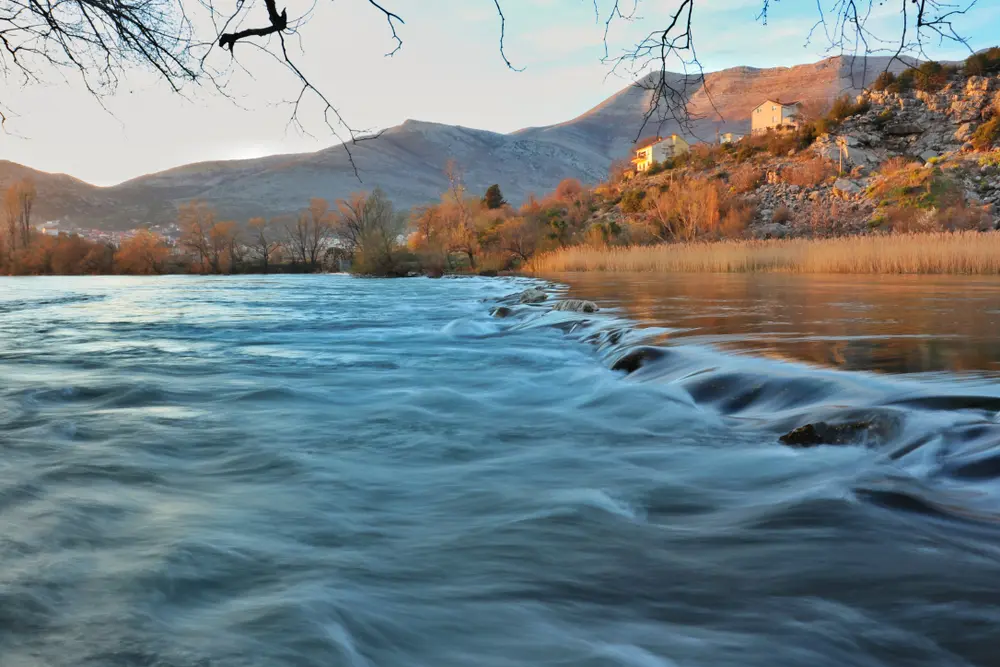
The Trebišnjica River in Trebinje, BiH © Sale97 /Shutterstock
The Trebišnjica River in Trebinje, BiH © Sale97 /Shutterstock
In the Western Balkans, there is a red, or rather blue, thread that connects the mega-infrastructures of socialist modernism, the bloody Yugoslav wars and the cohesion policy of the European Union. This thread does not stop at artificially created borders, but crosses them, winding through the Dinaric Alps from Trieste to North Macedonia.
In these regions, water is an active force that shapes space and the lives of local communities. It is absorbed by limestone rocks that “swallow” it, only to resurface kilometers away, creating a complex system of surface and underground water bodies that deeply shape the landscape. Dinaric karst is not just a geomorphological process, but a genuine permeability phenomenon, that makes even the most solid borders porous, spontaneously encouraging cross-border cooperation and making joint water resource management inevitable.
Restlessness and porosity
Dženeta Hodžić, a researcher at the Institute for Social-Ecological Research (ISOE) in Frankfurt, describes this unpredictability with the term “unruliness”.
“Unruliness is a characteristic of karst groundwater, making it extremely difficult to predict its flow and behavior”, explains Hodžić. “The effects of climate change further complicate the situation”, points out the researcher, citing as an example “variations in precipitation, which can affect the flow of water on the surface and underground”.
The Trebišnjica River, which flows through Bosnia and Herzegovina, Croatia and Montenegro, is an excellent example. It springs from rapid underground springs (which are themselves fed by karst streams) near Bileća in eastern Herzegovina, then branches off through the Herzegovinian hinterland, disappears several times and re-emerges to the surface, to finally flow into the Adriatic at two locations, Slano and Komolac, near Dubrovnik. It runs underground for 90 of its 187 kilometers, and is one of the longest underground rivers in the world.
In hydrographic terms, the Trebišnjica basin forms a single unit with the Neretva basin, which flows further north through Bosnian territory, and in its lower course intersects Croatian territory. The Trebišnjica joins the Neretva near Čapljina, southeast of Međugorje, through porous karst subsoil.
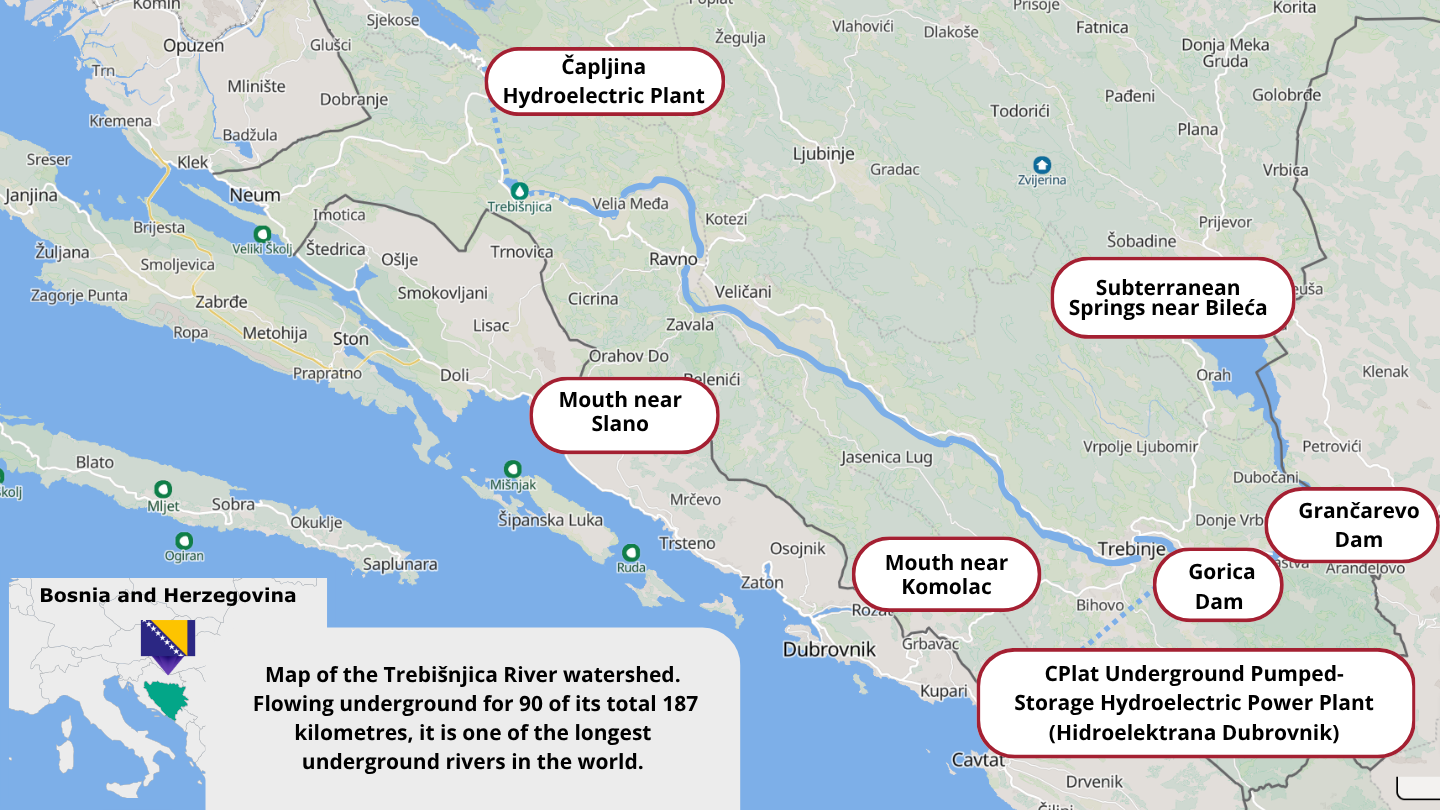
Map by OBCT
Yugoslav infrastructural gigantism
Cooperation in water supply in this area began in the sixties of the last century, when borders did not separate sovereign states, but federal republics of socialist Yugoslavia. This was primarily achieved through a series of large engineering projects on the Trebišnjica River for the production of electricity.
The first dam was built in 1965 in Gorica, near Trebinje. Part of the collected water was diverted to Dubrovnik-Neretva County, the southernmost part of Croatian Dalmatia, to power the Dubrovnik Hydroelectric Power Plant, an underground storage power plant in the town of Plat. Built between 1960 and 1965, the Dubrovnik Hydroelectric Power Plant was equipped with two turbines, which are still in operation today: one produces electricity for Croatia, the other for Bosnia and Herzegovina.
The Miruša valley was flooded in 1967 by the Grančarevo dam to create the Bileća reservoir, on the border between Bosnia and Herzegovina and Montenegro. Since then, the reservoir serves the Trebinje and Plat power plants, and together with the Gorica reservoir, provides a reserve of water for drinking and irrigation.
This mega-infrastructure project – called Donji Horizonti because it was built along the lower reaches of the Trebišnjica River – was completed in 1981. The pipeline, which passed through Konavle in Croatia, connected Plat with Herceg Novi (in Montenegro) in order to supply it with water from Bileća, and two more hydropower plants were built in Čapljina and Trebinje.
The integrated hydraulic system perfectly embodied the spirit that inspired Yugoslavia’s economic and technological development. Katarina Kušić, associate professor at the University of Rijeka, described it for OBCT as “modernism aimed at improving the country, making it more productive”.
Siege of Dubrovnik
Then disaster struck. War, which broke out in the summer of 1991, engulfed the region in September. The Yugoslav People’s Army (JNA) attacked Dubrovnik, the “Pearl of the Adriatic”, on 1 October, while continuing to occupy Konavle. On this battlefield, water was a key strategic resource for both attackers and defenders.
The JNA targeted water resources from day one. After destroying a radio transmitter on Mount Srđ (above Dubrovnik), Yugoslav MiG-21s hit the Komolac transformer station, on the other side of the ridge. This operation immediately deprived the besieged city of electricity and running water, as the city’s water supply was almost entirely dependent on the hit facility.
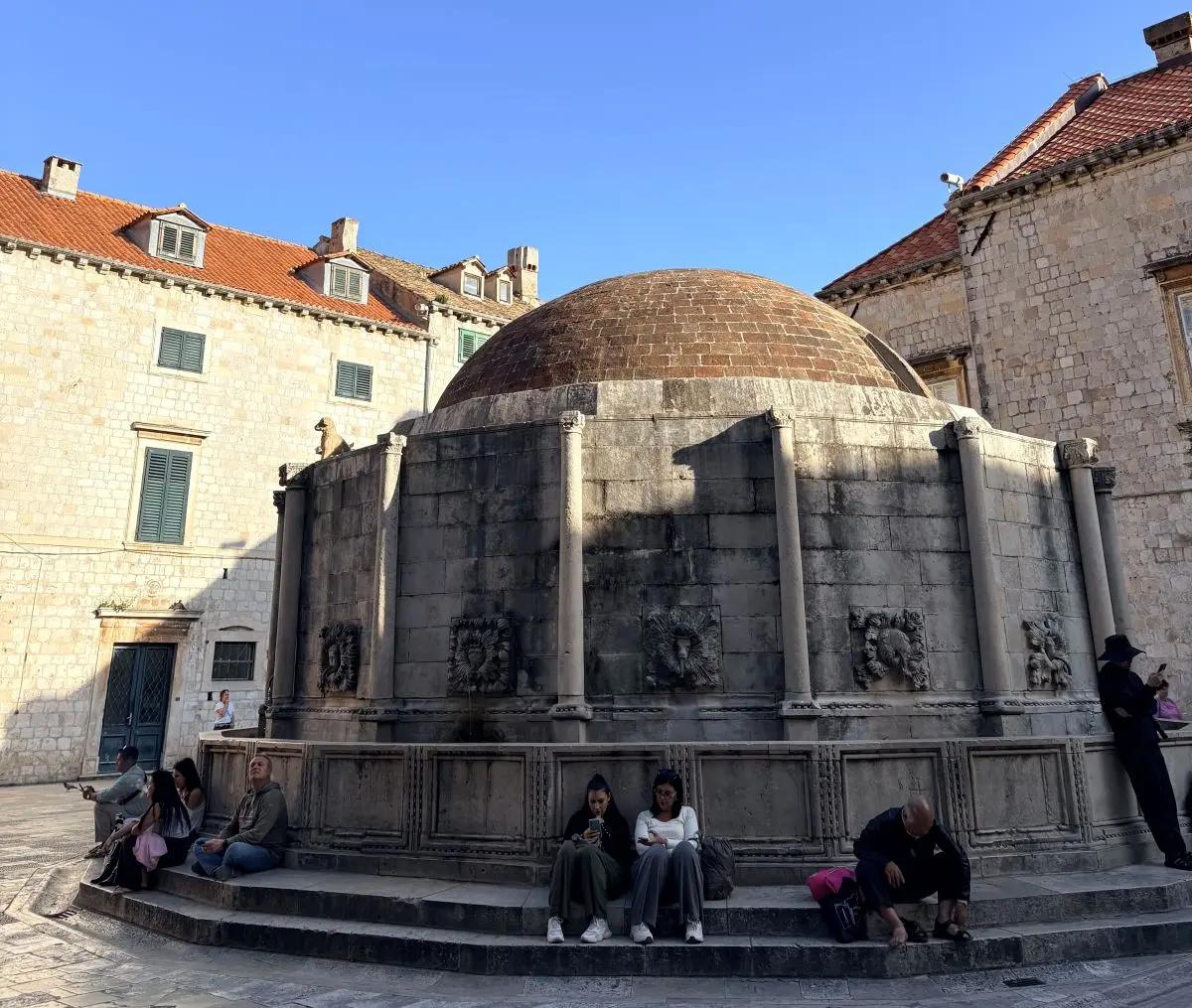
The Great Onofrio’s Fountain in Dubrovnik’s Old Town. Photo: Francesco Bortoletto
The tunnel, which extends under the Srđ hill for a length of approximately three kilometers, connected the Komolac plant – which pumped water from the karst spring of Ombla, one of the shortest rivers in the world (only 30 meters), fed by the Trebišnjica – with a 15th-century aqueduct and, most importantly, with a reservoir that, since 1964, has fed the gravity water pumping system in the administrative center of Dubrovnik County.
On the night of 10-11 October, technicians of the Dubrovnik Waterworks climbed the tunnel and manually pumped water from the Komolac reservoir into the city reservoir below. This crucial, albeit risky, move prevented the JNA from tormenting Dubrovnik with thirst during the eight-month siege.
The city’s inhabitants and the fifteen thousand refugees who had fled from rural areas relied, in addition to the humanitarian convoys that occasionally broke through the naval blockade, on a network of ancient cisterns – a dozen tanks, mostly underground – including the Great Onofrio’s Fountain from 1438.
According to local chronicles, which we reviewed at the State Archives in Dubrovnik, rationing allowed a maximum of five liters of water per person per day. But as soon as availability increased, reports Dubrovački Vjesnik, everyone began to “spend excessively and recklessly”, and a call was made to “save water so that you and others can continue to have it”.
Photos from that period show long lines for filling canisters, such as those preserved in the War Museum housed in the Napoleonic fortress on Mount Srđ. Finally, residents also obtained drinking water from precipitation, collecting rainwater and melted snow. For other needs (such as flushing toilets and extinguishing fires), they used water from the Adriatic.
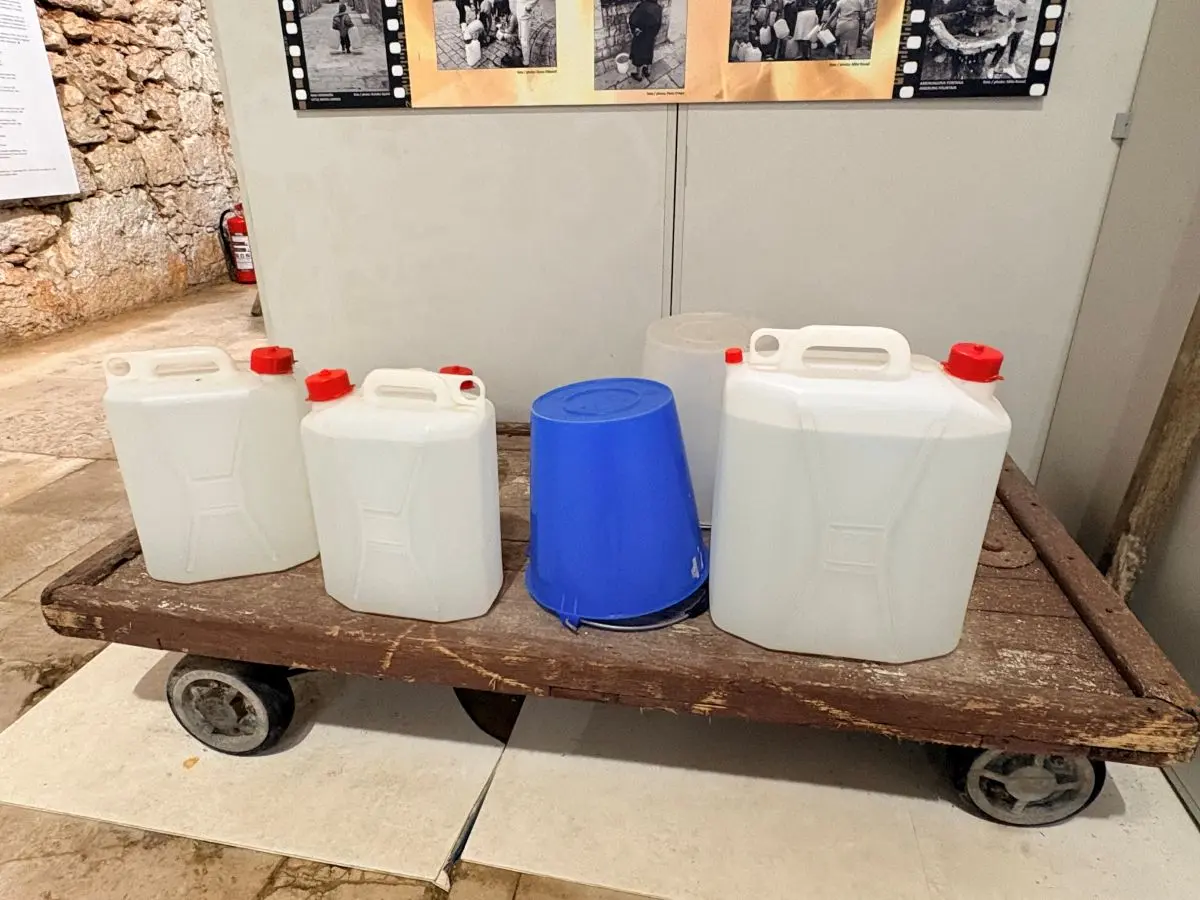
Canisters and buckets used by Dubrovnik residents for water supply during the 1991-1992 siege. Photo: Francesco Bortoletto
Konavle
Since it was independent of the Ombla hydraulic system, the Plat power plant was not directly affected by the attack on Komolac. However, the plant was damaged in the fighting and left without its operators (who fled to Dubrovnik), and was closed in October 1991.
This had no immediate consequences for the water supply of Konavle, which depended on two local karst springs (Duboka Ljuta and Konavoska Ljuta). However, in another operation of water militarisation, the JNA also attacked this infrastructure during the occupation.
After months of intense negotiations, Croatian Electric Power Company employees began repairs to the Dubrovnik thermal power plant in February 1992. The plant was back in operation in mid-April, but continued to operate intermittently. The Croatian Army retook it in late May, and the water flow from Plat to Herceg Novi remained halved until the end of hostilities, to around 300 m3/s from the original 600.
Viewed in the context of water management, these tragic events are sobering. The fragmentation of Yugoslavia’s mega-infrastructure – with its various components in the hands of opposing warring parties – made the negotiations particularly delicate, but it was also one of the reasons for sitting down at the negotiating table in the first place.
Since they controlled the Bileća reservoir, the Bosnian Serbs could threaten to cut off the supply to the Plats and flood Croatian villages downstream of the dam. On the other hand, the Dubrovnik Hydroelectric Power Plant could block the electricity supply to the self-proclaimed Republika Srpska and Montenegrin Dalmatia. This mutual benefit contributed to a certain extent to the maintenance of common infrastructure and cooperation in water supply between the two factions, preventing their complete disruption even during the most intense phases of the war.
(Read the second part of the story: Western Balkans, water and cohesion policy: the case of Waterlink)
Found an error in this article? Please contact our editorial team at redazione@balcanicaucaso.org.
This article was produced as part of the EuSEE project, co-funded by the European Union. However, the views and opinions expressed are solely those of the author(s) and do not necessarily reflect those of the granting authority, and the European Union cannot be held responsible for them.
Featured articles
 Political deadlock
 Economy and Dialogue