2016 Turkish coup attempt: Sabahattin, the Gazî of the Turkish state
Ten years after the 2016 coup attempt in Turkey, we have gathered four firsthand accounts from the country. Sabahattin, 46 years old president of the Veterans and Martyrs’ Families Foundation, recalls: “Allah commanded us to protect the state against any aggression”
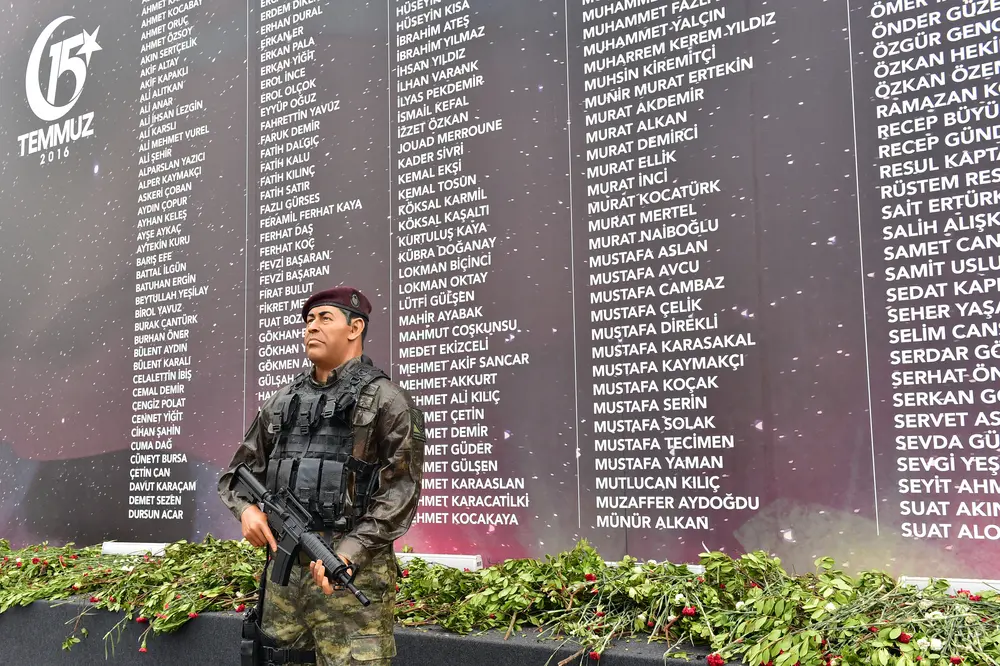
Monument to those who died during the attempted coup, Istanbul © Thomas Koch/Shutterstock
Monument to those who died during the attempted coup, Istanbul © Thomas Koch/Shutterstock
“I invite all the population to take to the streets”. In the famous video call broadcast on the night between July 15 and 16, 2016, Recep Tayyip Erdoğan addressed CNN Turkey journalist Hande Fırat with those words. As the Turkish president spoke those words, Sabahattin was in his apartment in Fatih, on Istanbul’s historic peninsula.
Sabahattin is a 46-year-old man with a partially disfigured face. He is of Arab ethnicity; his ancestors moved from the Levant centuries ago and settled in Siirt, in southeastern Turkey. He grew up in Istanbul in a large family. He married in 2011 and has two children. He used to earn his living running a small textile workshop.
“When the president appeared on TV and urged people to resist the coup plotters, I didn’t hesitate for a moment: I said goodbye to my wife and children, performed ablution, prostrated myself in prayer, and left home. With other citizens, I found myself near Istanbul City Hall, at Saraçhane. There was great chaos, tension was extremely high. To my great sorrow, I saw army soldiers trying to intimidate us, despite our being unarmed. Over time the situation worsened. A group of soldiers opened fire on the crowd. I was hit by a bullet in the head and fell onto the asphalt. From that day on, my life changed completely. I remained in a coma for weeks and was in danger of death for months. Over the years I underwent 26 surgeries; I have platinum plates in my skull and my meninges are damaged. Just this morning I was at a specialized hospital for yet another check-up”.
Click here to read the other testimonials we collected to mark the tenth anniversary of the attempted coup in Turkey
During the attempted coup of 2016, 251 people lost their lives, while another 2,740 were injured. The former are recognized as şehit (martyrs), while the latter obtained the status of gazî (veteran). The term gazî, of Arabic origin, indicates in modern Turkish a person who was wounded defending the homeland.
“Being a ‘Gazî’ is for me a reason for great pride. I receive respect for this title from the government, the opposition, military personnel, police officers, and ordinary people. However, it is also a great responsibility. I have the duty to do nothing that could tarnish this recognition. My reputation must remain impeccable”.
The Turkish State pays a monthly pension to veterans, and also guarantees them free medical assistance and psychological support. For the families of martyrs, it recognizes important benefits for children, including scholarships, exemption from university fees, and facilitation in accessing public employment.
“People often ask me if I regret going out into the streets that night. For me the answer is simple and I want to declare it once again: I would behave in exactly the same way. I am Muslim, I believe in Islam, and Allah has ordered us to protect the state and nation against any external aggression. We are reminded of this during military service: for the motherland we must be ready to sacrifice ourselves, just as those who fought at Gallipoli or in the War of Independence did”.
Sabahattin is currently president of the Foundation for Veterans and Families of Martyrs, established under the auspices of the presidency. For his institutional activities he has at his disposal a blue car with a driver. He is dressed to the nines: blazer and striped pants, gold watch, patent leather loafers. The foundation supports veterans and martyrs’ families through various initiatives: it organizes cultural events, meetings, and conferences in schools and universities, as well as raising public awareness about what happened on July 15, a date the government formally established as a public holiday under the name Democracy and National Unity Day. Fethullah Gülen, considered the mastermind behind the failed coup, died in exile in the United States on October 20, 2024. Sabahattin does not hide the influence the religious leader had for a long time in Turkey.
“It cannot be denied that many politicians, businessmen, or simple citizens had contacts or supported the power network of the terrorist organization FETÖ in the past. The Gülenists had infiltrated the fabric of the state so thoroughly that it was impossible not to have dealings with them. But that chapter is closed. The Hizmet movement no longer has followers in Turkey”.
Ten years after the attempted coup, for Sabahattin it is time for reckoning. He is optimistic about the country’s future and remains faithful to the political line of the governing coalition.
“The current economic situation is not simple; the pandemic and the earthquake were hard blows to the country. But Turkey has the resources to overcome this crisis; the Turkish people precisely in moments of difficulty set aside differences and divisions. Moreover, our army is one of the most powerful in the world, thanks to the development of our defense industry.
I believe President Erdoğan will run for the next elections and win without worries. After all, no one can trust this opposition. Of course, one day he too will pass away, but he will leave behind a strong state. The state is the only thing that really matters”.
Found an error in this article? Please contact our editorial team at redazione@balcanicaucaso.org.