Giro d’Italia: Bulgaria’s first time
The 109th edition of the Giro d’Italia sets off today from Nessebar, on the Black Sea. For Bulgaria, which is hosting the first three stages, this is an important opportunity to promote sport and tourism, although the arrival of the ‘Giro d’Italia’ is not without unanswered questions
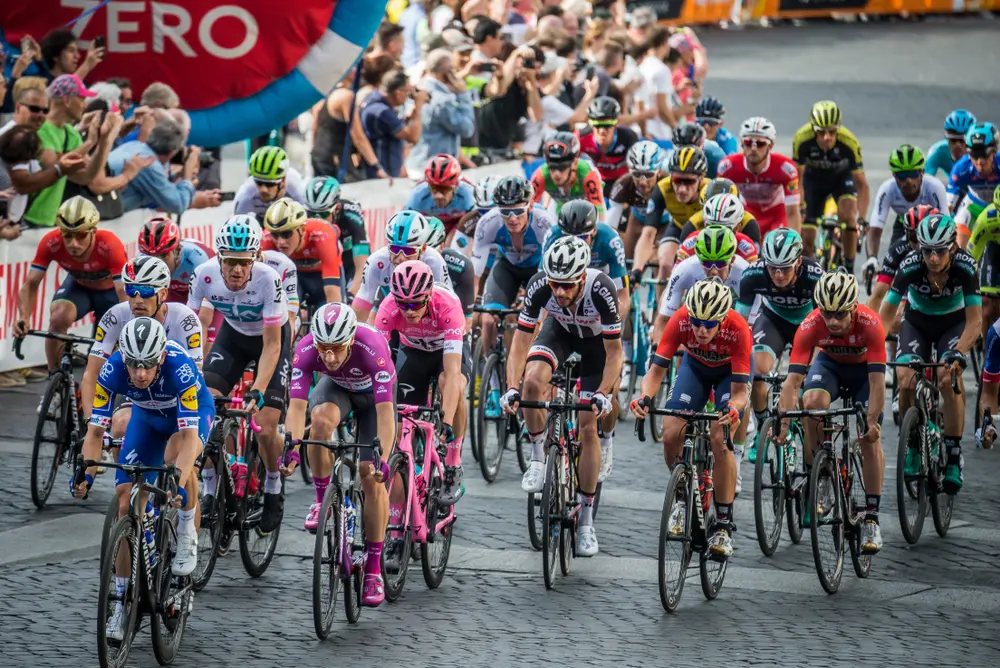
Giro d’Italia © Nicola Devecchi/Shutterstock
Giro d'Italia © Nicola Devecchi/Shutterstock
From the shores of the Adriatic to those of the Black Sea: following the 2025 start in Albania, this year’s Giro d’Italia – now in its 109th edition – sets off once again from the Balkans, this time from Bulgaria.
Twenty-three teams and 184 riders are set to gather today, 8 May, in Nessebar, the ancient Greek colony of Mesembria, the ‘Pearl of the Black Sea’ and a UNESCO World Heritage Site, where the ‘Grande Partenza’ of 2026 is scheduled to take place – the sixteenth overseas start in the competition’s history.
The Giro in Bulgaria
The arrival of the Giro d’Italia in Bulgaria was strongly championed by the Zhelyazkov government, which subsequently collapsed in a spectacular fashion last December following massive street protests against corruption, leading to the eighth snap election in five years, won in April by former president Rumen Radev.
“The Giro d’Italia will put Bulgaria on the world tourism map and make the country a recognisable destination,” declared the then Minister of Tourism, Miroslav Borshosh, in August 2025, upon the announcement of the agreement with RCS to bring the race to Bulgaria.
The Zhelyazkov government then allocated €15 million in early January 2026, by which time it had already tendered its resignation, thus handing over the task of preparation to the caretaker government led by Andrey Gyurov.
For a moment, the fate of the Giro in Bulgaria seemed to hang in the balance, with institutional chaos slowing down preparations and doubts over the transparency of the tenders reaching the floor of the Sofia parliament. In the end, however, despite the delays and expenditure figures that were never fully clarified, Bulgaria should be ready for today’s ‘Grande Partenza’.
“We expect that the start and the first three stages of the Giro will bring Bulgaria significant benefits in terms of both the economy and its image,” sources from the Ministry of Sport told OBCT.
Among the stated objectives are an increase in tourist numbers during the race, but also the opportunity to use the live television coverage as an advertisement and showcase to promote the country’s most promising tourist destinations.
The route therefore reflects these intentions: the first stage of the Giro, a large, fairly flat circuit, will take the race from Nessebar to Burgas, a port city that has regained its vibrancy in recent years. From there, the following day, the Giro will head inland, winding its way through the peaks of the Balkan Mountains to reach Veliko Tarnovo, the capital of medieval Bulgaria, perched around the spectacular, deep bends of the Yantra River.
On 10 May, the third and final Bulgarian stage will link the country’s two best-known and most representative cities: Plovdiv, the ancient Philippopolis, the beating heart of Thrace, and the capital Sofia, the political and economic nerve centre of modern Bulgaria, passing through the ski resort of Borovets, perched on the steep slopes of the Rila massif.
A troubled organisation
Although it has been organising its national race since 1924 (the Tour of Bulgaria is the third oldest stage race in Europe after the Tour de France and the Giro d’Italia, and has been open to professionals since 2000), the Balkan country has no previous experience in managing a complex cycling event such as the Giro d’Italia.
This lack of experience, combined with the country’s political turmoil, has caused moments of anxiety regarding the fate of the Bulgarian stages of the Giro. In early March, the new Minister for Sport, Dimitar Iliev, had expressed serious concerns during a parliamentary question time about the state of preparations, which were clearly behind schedule. The main cause for concern was the quality of the road surface on numerous sections of the route, with repair and safety works running behind schedule and costs rising rapidly.
The Giro and the Italian culture

In Bulgaria, the Giro also brings a slice of Italian culture. Of particular note is the exhibition ‘GIRO D’ITALIA. A Brief History of Italy on Two Wheels’, at the National Gallery / Kvadrat 500 in Sofia, which traces the history of cycling in Italy from the late 1940s to the present day, showcasing it not merely as a means of transport, but as a symbol of individual and collective rebirth. The exhibition, which features works by numerous contemporary artists, is open until 5 July.
In the end, however, everything should be ready for today’s start. “I never doubted we’d make it, even though the political crisis of recent months has certainly made things more complicated,” Simeon Kyuchukov, a sports journalist at Eurosport and one of the most passionate and knowledgeable voices on cycling in Bulgaria, tells OBCT. “I told many mayors of the towns along the Giro route, who were expressing concerns, to keep a positive attitude, and I reminded them that in Italy, too, many things tend to get sorted out at the very last minute.”
Whilst the route is now reportedly in order, questions remain regarding the final costs. In total, Bulgaria is estimated to have spent around thirty million euros on the Giro. Ten million euros were reportedly spent on road repairs alone, but at the end of March, the Minister for Regional Development, Nayden Naydenov, spoke of costs five times higher than the initial budget. “The organisation of the race is a prime example of the poor planning and organisation of the ‘Road Infrastructure’ Agency,” the minister concluded.
Hopes of athletes and fans
For Bulgarian athletes and cycling fans, the arrival of the ‘corsa rosa’ in the country is certainly a special event. “It’s a dream come true. Probably a once-in-a-lifetime opportunity, as we’re unlikely to see the Giro in Bulgaria twice in our lifetime,” says Kyuchukov, who describes the Bulgarian cycling movement as growing, especially for the amateurs, with a packed calendar of events.
The situation is less rosy among professionals: to date, the country has not produced professional riders capable of making their mark in international competitions. The only Bulgarian athlete to participate in the Giro was Nikolay Mihaylov, who competed in the 2015 edition.
2025 was also a particularly difficult year, as the International Cycling Union (UCI) suspended the president and vice-president of the Bulgarian Cycling Federation for two years for serious breaches of the code of ethics, including race-fixing.
“There are no magic formulas, but in Bulgaria, cycling needs to attract new fans if it is to make a qualitative leap,” concludes Kyuchukov. “From this perspective, the arrival of the Giro could have a huge effect, especially if we are able to play our cards right, bring young people closer to the sport and develop talented riders capable of making their mark in the professional world.”
Then some view the arrival of the ‘corsa rosa’ in Bulgaria not merely as a sporting event, but as an opportunity to reignite the debate on promoting the bicycle as an urban, eco-friendly and economical mode of transport.
“Sofia and Bulgaria in general are not currently very focused on promoting cycling or protecting cyclists on the roads. In the capital, for example, the network of cycle lanes is limited and fragmented. Many of the lanes are designed in a way that does not ensure the safety of cyclists,” Ognyan Bozhilov, one of the main organisers of “Sofenhagen” – an informal group that promotes cycling in the capital Sofia not only as a means of transport but also as a way to socialise and foster inclusion – told OBCT.
In recent years, the Sofia City Council has shown greater sensitivity, setting up a working group with representatives from civil society, but results have been slow to materialise: the latest cycle lane, for example, on the very central Patriarh Evtimii Boulevard, has sparked fierce controversy with those who – rather than space for bikes – preferred car spaces and parking lots.
To mark the arrival on 10 May, Sofia City Council is organising a cycle tour of the city – aimed at amateur cyclists, children and families – which will wind its way through the streets of the city centre to welcome the riders, led by the city’s mayor, Vasil Terziev. The hope is that the event will inspire the capital’s administration to take bolder decisions.
“An event like the Giro will certainly have a significant impact on promoting tourism in Bulgaria. I believe it could also provide a visible boost to reviving cycling as a sport. However, for Sofia and other Bulgarian cities to become bike-friendly, a change in mindset and long-term work are needed. The Giro is certainly not enough, but it can be a starting point for reopening the debate on the urban environment and alternative mobility,” concludes Bozhilov.
Found an error in this article? Please contact our editorial team at redazione@balcanicaucaso.org.
Tag: Sports
Featured articles
 Investigation
 students' protest
 Montenegro Pride 2026