Albania: Vjosa, a National Park still lacking protection
The Vjosa in Albania is one of Europe’s last wild rivers. Now a national park, it is, in theory, fully protected from source to mouth. Despite these safeguards, however, tensions soon arose, particularly between environmental activists and those who view the river as an economic and tourist resource
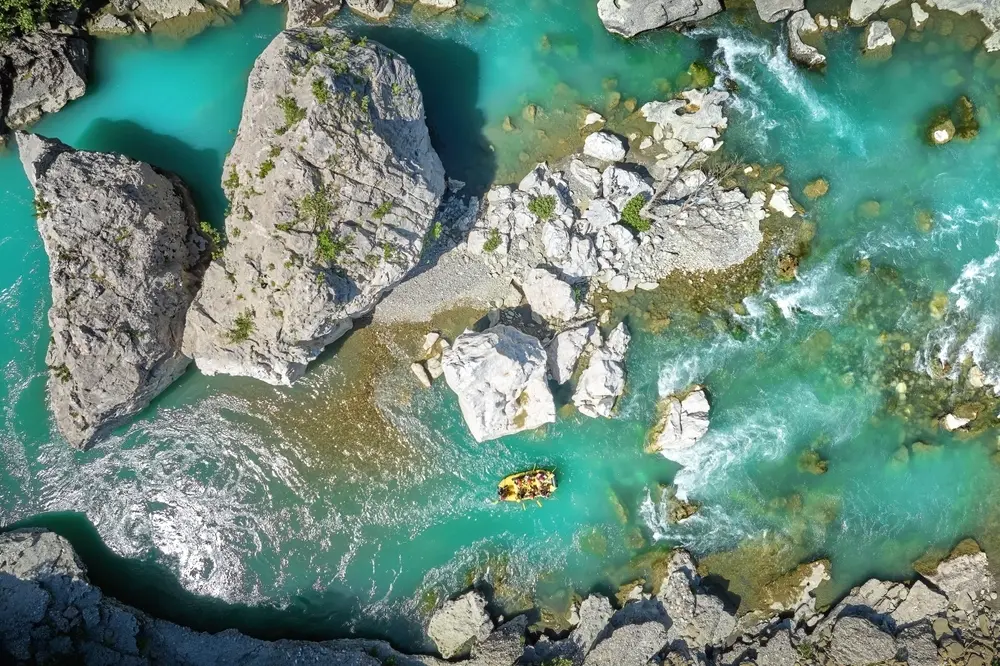
Rafting on Vjosa River
Rafting on Vjosa River, Albania. © Martin Mecnarowski/Shutterstock
The designation of the Vjosa River as a National Park was presented as one of the most significant milestones in Albania’s environmental policy. For the first time, a wild river in Europe was granted full protection status from its source to its mouth, placing it at the centre of a vision aimed at preserving it as a unique riverine ecosystem, in line with the highest international standards.
“Ensure full, including transboundary, protection of the Vjosa River from its source to the sea, preserving it as a free-flowing and wild river in a sustainable manner, in accordance with the highest international standards, for the benefit of nature and people,” states the Management Plan of the Vjosa National Park (AKZM).
Yet, while the legal status has been formalised and consolidated on paper, the question increasingly being raised in the field and in public debate is more straightforward: is the National Park effectively protecting the Vjosa River?
So far, the Vjosa National Park has been widely promoted as an environmental success story, often accompanied by a narrative that goes beyond technical and institutional debate. Presented as one of Europe’s last wild rivers, with an uninterrupted flow along its main course and no hydropower plants in its central stretch, the Vjosa has become a powerful symbol of nature protection in Albania.
In this sense, its designation as a national park has also functioned as a political and communication tool, allowing the government to project a greener image of its environmental policies in a context where such policies are frequently questioned by civil society and experts.
However, tensions on the ground emerged soon after the protected status was announced. One of the most visible concerns has been the clash with water-based activity operators, particularly rafting businesses, which view the river as an economic and tourism asset, while environmental organisations and parts of the scientific community call for clearer restrictions to avoid ecological impacts.
The recurring debate: rafting and the limits of the park
During April, the debate over the protection of the Vjosa was reopened, this time linked to rafting activities on the river.
Public attention was drawn to police intervention to halt rafting activities carried out outside the permitted season defined in the Park Management Plan (1 May – 15 October), which was established by experts as the allowed period for such activities.
Subsequently, the National Agency for Protected Areas (AKZM) became involved in a dispute with rafting tour operators, who were instructed to limit their activities along the river. Discussions were moved to the Ministry of Environment in a closed-door meeting, after which the parties independently announced that an agreement had been reached.
The scientific and environmental community has also been involved in the discussion. Aleko Miho, a lecturer at the Faculty of Natural Sciences and one of the early advocates for the protection of the Vjosa, explains that in March he was invited alongside local and international experts to discuss requests from rafting federations and operators in order to assess possible revisions to the Management Plan restrictions.
According to him, experts are not opposed to water-based activities in principle but stress the need for them to remain limited and controlled.
“Experts and global experience are not against water-based activities, but the more limited and controlled they are, the better it is for river ecology,” Miho said.
He adds that impacts are not limited only to river habitats and biodiversity but also affect the quality of life of local communities.
“Therefore, the unrestricted development of recreational water activities is never a positive innovation or a success story for tourism development and local prosperity,” he noted.
In this sense, he argues that the main issue is not the absence of rules, but the gap between vision and implementation on the ground.
On a broader level, the discussion on the Vjosa reflects a recurring issue in Albania’s environmental governance: weak enforcement of regulations and an often utilitarian approach to natural resources.
From this perspective, environmental degradation does not stem solely from a lack of legal frameworks but from how those frameworks are implemented in practice and from the often unclear balance between protection and economic use of resources.
At its core, the debate over the Vjosa remains a clash between two approaches: strict ecological protection and local economic development.
The Këlcyra Rafting Team told OBCT that rafting activity in the area is mainly family-oriented and cannot be considered a major source of economic profit.
“It should also be emphasized that the Vjosa has always been rich in biodiversity, and this is not a recent discovery. It creates the impression that the issues are being attributed mainly to rafting, which is not fair, especially in the absence of proper studies on the impact of this activity,” the group said.
According to them, rafting is a relatively recent activity, with only a few years of visible development, and any analysis requires time to be accurate and balanced. “It is important to identify problems, but also to understand that improvement comes gradually, not overnight,” they added.
Meanwhile, activist Besjana Guri, one of the most vocal advocates for the river’s protection, told OBCT that the designation of the Vjosa as a National Park is both a major achievement and a challenge.
“Certainly, the declaration of a national park has helped significantly, first by stopping more than 45 planned hydropower plants, and second by opening opportunities for alternative development in the area. A national park has a long-term vision,” Guri said.
Regarding discussions on extending the rafting season and expanding activities across the entire riverbed, she expressed concern over attempts to modify a recently adopted management framework.
“There is already an approved document regulating this activity to a certain extent. Attempts to change it before implementation has properly started set a bad precedent. The management plan is a 10-year document, although it foresees a review for necessary adjustments only in the fifth year of implementation,” she explained.
She added that rafting is indeed one of the lowest-impact activities, but still requires careful management, as its mass expansion could create pressure and disturbance for river biodiversity.
Found an error in this article? Please contact our editorial team at redazione@balcanicaucaso.org.