Kosovo, when memory and historical debate enter the court
An exhibition and a book on Serbian war crimes during the 1998-1999 Kosovo conflict reopen wounds, along with a criminal case against its curator, Shkëlzen Gashi. This case reignites the debate between historical memory and freedom of expression
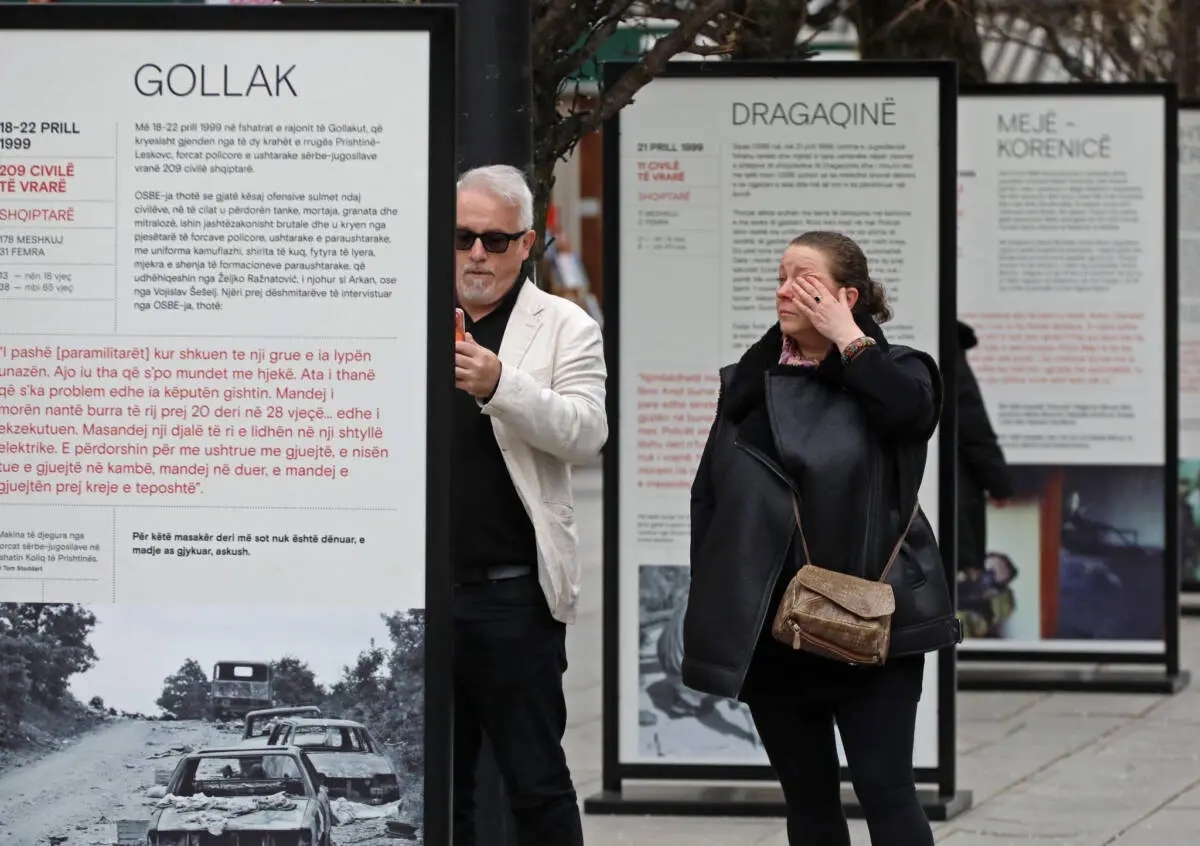
La mostra “Massacri in Kosovo 1999-99” – archivio personale Shkëlzen Gashi
La mostra "Massacri in Kosovo 1999-99" - archivio personale Shkëlzen Gashi
Almost two years after its publication, the book “Massacres in Kosovo 1998–1999” by the Pristina author Shkëlzen Gashi is sparking heated debates. The Kosovo Parliament raised doubts about its truthfulness in relation to the data presented in two accounts – the number of people killed in massacres such as the Dubrava Prison Massacre and their status as civilians or armed persons when they were killed by Serbian forces.
The state prosecution began an investigation into the author of the book, Gashi, suspected of “inciting division and intolerance”, a criminal offense in the country.
“I am still under investigation. There have been no new developments. Despite my request, my phone, laptop, and the confiscated book have not been returned to me yet,” Gashi told OBCT, while the prosecution did not wish to comment further.
The story, however, did not really start with the book itself.
It all began with an exhibition based on the book, which was presented in the main square in Pristina on the anniversary of The North Atlantic Treaty Organization (NATO) bombing campaign against the Federal Republic of Yugoslavia (FYR) in 1999. In total, 49 pictures with descriptions of massacres and horrific images were displayed, including some of the most tragic events that happened in Kosovo in 1998–1999.
According to the organizers, the book, the exhibition, and a website with the same topic are all part of a project to document massacres during the war in Kosovo.
The exhibition, which was supposed to last two weeks and was supported financially by the Parliament of Kosovo, was removed after only three days due to the heated debate. Criticism started toward the book, the author, and the two civil society organizations who published the book and are working toward creating the website through grant funding.
“The claim that 48 of those killed were Albanian armed individuals, while 58 were civilians, is completely untrue. In that genocidal massacre, there were no Albanians killed in the capacity of fighters. All of us were unarmed and defenseless,” wrote Enver Dugolli, a member of parliament from the Levizja Vetëvendosje party, as well as a survivor of the Dubrava Prison Massacre, on his Facebook account.
He added that this material can be used to reinforce Serbia’s false narrative about the alleged rebellion of Albanian prisoners at the time when this massacre happened.
While the book is based mostly on what the author calls desk research (foreign media reporting, reports of international human rights organizations, court decisions etc), it looks like one of its main shortcomings comes from the sources used, like the list provided by Belgrade-based Humanitarian Law Center (HLC).
Hence, the preface of the book states that “although the HLC list is an established source of reference, there are errors in some massacres, as individuals who were killed are registered as armed, although at the time of their murder they were unarmed civilians.”
A resolution in parliament to protect the historical truth of the war 1998–1999 was initiated by the Kosovo Democratic Party and, after being harmonized with the rest of the parties, was approved with 90 votes.
“We express deep concern over any initiatives, whether through public activities, publications, or other forms of communication, that aim to distort, relativize, or inaccurately and tendentiously interpret the events of the war in Kosovo, thereby undermining historical truth and the feelings of citizens,” reads the resolution.
“I have nowhere undermined the truth of the liberation war in Kosovo. In fact, this is the first book to present evidence of all massacres committed by Serbian and Yugoslav forces during the war in Kosovo in 1998–1999 in three languages (Albanian, Serbian, and English),” Gashi told OBCT, positing that all this undermines freedom of expression, academic freedom, and stifles the work of every independent scholar.
How did an academic and historical debate end up in court?
Talking to OBCT, associate professor Seb Bytyci mentioned prior lack of serious research on this sensitive topic, and the apparent lack of a structured academic response alongside the public pressure.
“Here, the absence of publications and clear positions from IKKL – the Institute of War Crimes, as well as the lack of a strategy for research standards from KKSH – the Kosovo Scientific Council, is also apparent,” he told OBCT.
Emphasizing the need to build a more sustainable system of academic evaluation and publishing, Bytyci said that what happened might create a self-censorship effect.
“When academic debates are handled through juridical or political mechanisms, authors may hesitate to address sensitive topics, especially those related to the war in Kosovo. However, the problem does not lie only in the institutional response, but also in the lack of a consolidated culture of scientific debate. Responsibility is shared among authors, institutions, and the academic community itself as well as the media that fuel the flames of populism,” he added.
Regarding academic freedom, a group of international academics circulated a reaction on the media.
“Our main concern is about the damage that could be caused to structural research conditions for researchers, the rule of law, and the culture of democratic debate in Kosovo”, reads a letter signed by international scholars, including Florian Bieber, Sir Noel Malcolm, and Oliver Jens Schmitt.
According to Shkëlzen Gashi, the inaccuracies regarding the number of those killed and their status, whether they were civilians or soldiers, are not a fault of the book but of the source to which the book refers: Nataša Kandić’s list, the HLC’s Kosovo Memory Book. therefore, he does not plan to edit the book.
“Because of these errors, it is essential for Kosovo to have its own official list in which all of the aforementioned inaccuracies are avoided. Once Ms. Kandić corrects her list, or better still, once Kosovo compiles its own official list, I will, by referring either to her corrected list or to Kosovo’s official list, correct the data on those killed in the book, the exhibition, and the website,” Gashi told OBCT.
The future of a publication
“Massacres in Kosovo 1998–1999” has traveled the world and received reviews from historians, academics, and journalists for its contribution to collective memory and the call for justice.
Similarly, the book has been promoted by Kosovo diplomacy, and copies of the book have been disseminated through the Kosovo government. However, nowadays it is not easy to find it, physically or online.
The author told OBCT that the book is not on sale because all (2,000) copies were sold between September 2024 and December 2025.
“We still have a few copies, but they are not for sale; they are reserved for our archive, as well as for independent researchers and human rights organizations”, he added.
“We had not planned to reprint the book, but due to the great interest shown in it, we are now considering the possibility of doing so,” Gashi told OBCT.
Found an error in this article? Please contact our editorial team at redazione@balcanicaucaso.org.
Featured articles
 Investigation
 students' protest
 Montenegro Pride 2026