Albania, the sun of the following day
“Art should shake, provoke thoughts, stop people even if only for a moment.” This is what artist Blerta Kambo had in mind when she decided to include the face of a bald woman in the famous mosaic at the National Museum of Albania in Tirana. The goal? To raise awareness about breast cancer
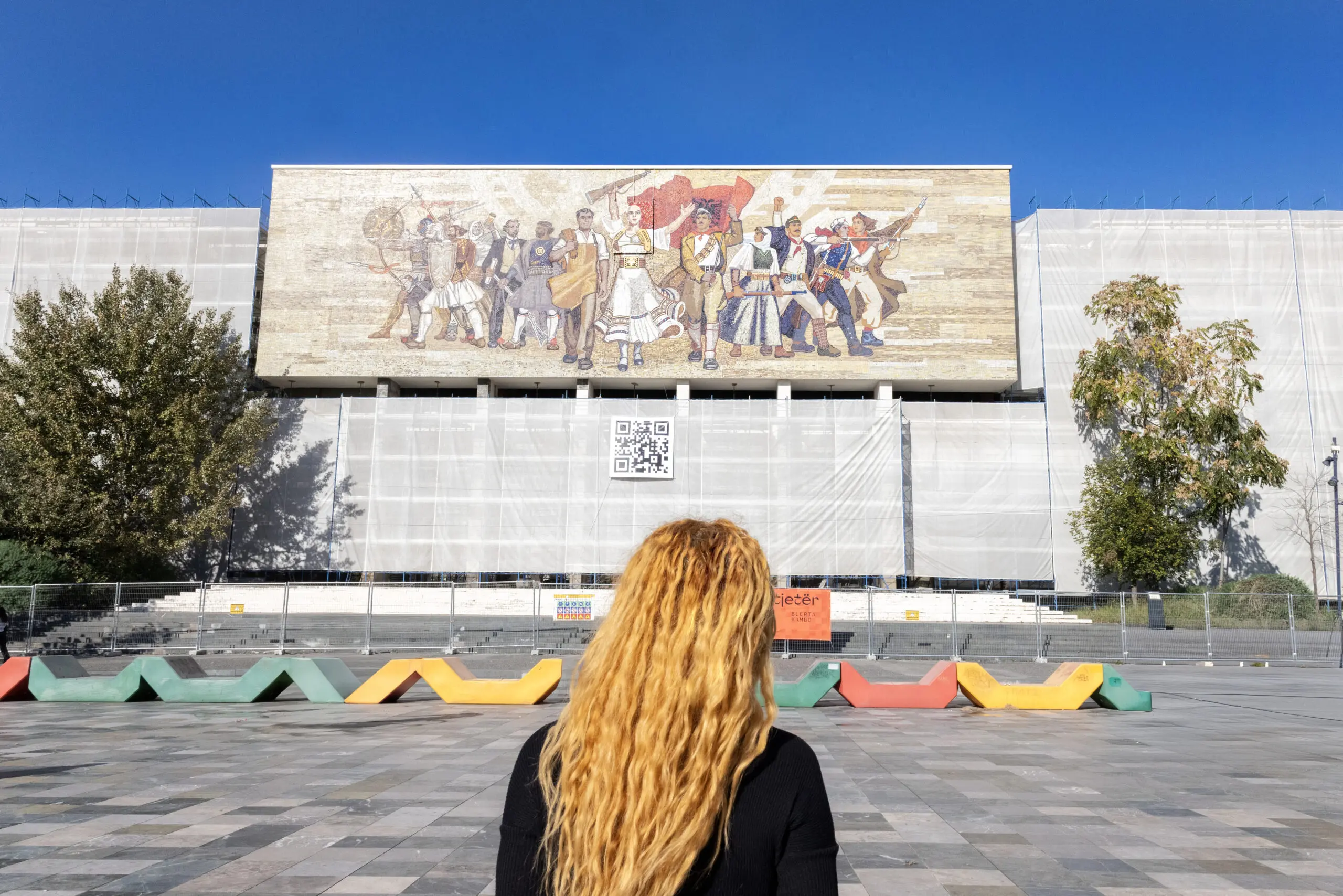
The installation on the mosaic of the National Museum of Albania
The installation on the mosaic of the National Museum of Albania. Photo © Klaudja Piroli
Last November, on the mosaic of the National Museum of Albania, an unusual installation caught the attention of passers-by. A female figure, bald, strong, and exposed to her fragility, was temporarily placed against a background familiar to anyone walking through Skanderbeg Square. The installation, titled “The sun of the following day” by artist Blerta Kambo, aimed to kick off an important debate on breast cancer and raise public awareness of a disease that affects 1 out of 12 women.
“Every time I discussed this [topic] with different people, I would encounter someone who would tell me a story, about their mother, cousin, sister, or someone affected by breast cancer and some of them spoke of a lost battle. That was the scariest part for me. I’ve heard it very often, which is an indication that women in Albania, in particular, are not catching it in time,” Blerta Kambo told OBCT.
But very quickly, the installation was misinterpreted, turning into a clear example of misinformation and hate speech in Albania’s public space.
An idea born from the need to respond
“The sun of the following day” was not a random artistic project. It emerged as a response to a concrete call for awareness. In May 2025, Blerta Kambo was contacted to create an artwork for the October breast cancer awareness campaign.
However, for the artist, this was not a topic that could be treated superficially. For more than two months, she held long conversations with women who had experienced breast cancer at different stages of the illness.
Some of them were in critical condition, and these conversations were emotionally intense.
“I couldn’t behave in a naive way,” Kambo explains. “I haven’t experienced it myself, and I couldn’t pretend to understand what it means to have breast cancer.”
These testimonies became the emotional foundation of the work.
“As in any creative process, I was thinking about a strong female figure, and during my frequent walks in central Tirana when I needed inspiration, I walked a lot, I eventually stopped in front of the mosaic,” Kambo says.
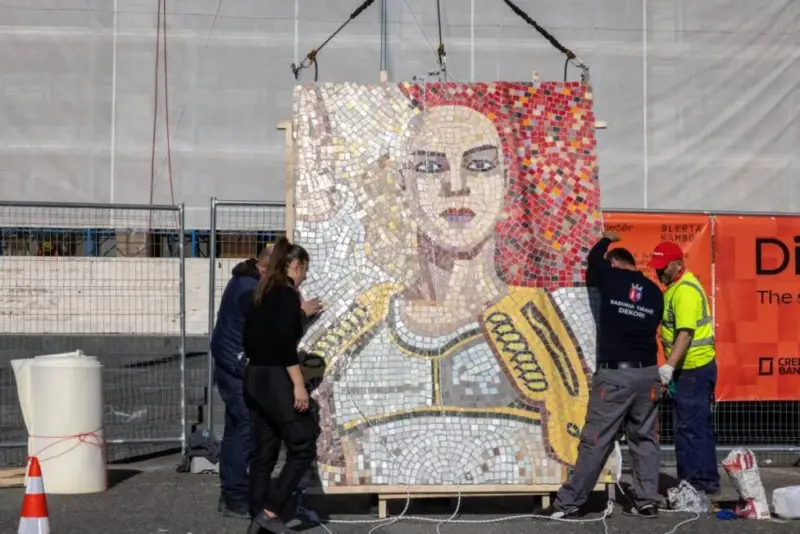
The installation on the mosaic of the National Museum of Albania. Detail. – Photo © Blerta Kambo
A public installation for a public message
Kambo aimed for an intervention in public space, far from the boundaries of galleries. “I’m tired of the white cube,” she says. “Art should shake, provoke thoughts, stop people even if only for a moment.”
Placing the installation in one of the most visible points in the city was no coincidence. It was a strategic choice to reach a wider audience and make the message unavoidable.
However, its realization required months of procedures and negotiations with institutions due to the protected status of the mosaic as a first-category cultural monument.
“From the idea in July to its realization, it took about 4–5 months, and most of that time was spent negotiating permits. Fortunately, the Minister of Culture liked the concept, and after it passed two technical commissions, the permit for artistic intervention was approved,” Kambo claims. She also ensured that the inserted part of the mosaic matched the original technically.
From empathy to misinterpretation
On 12 November 2025, the portrait of the bald woman was placed on the mosaic and received significant attention. But very soon, the narrative shifted. A wave of misinformation on social media distorted the message, portraying the female figure as a “transgender” symbol and linking it to alleged interference with national symbols.
This led to hate speech across social and national media.
According to Kambo, the absence of hair was not an act of victimization, but an attempt to show strength in the darkest moment. Hair loss, according to the women she spoke with, was one of the most painful experiences, a visible sign of transformation and loss of identity.
“Of course, the illness is very painful, but from my conversations with them, the loss of hair was often discussed because it was a visual manifestation of becoming someone else they no longer recognized,” she says.
A detail on the chest of the woman in the installation also represented a mastectomy, making the message even more direct.
Kambo admits she expected negative reactions, as the theme challenges traditional beauty standards and patriarchal norms. But she did not anticipate this level of misinterpretation.
According to her, this happened due to a combination of factors: lack of knowledge about public art, gender prejudice, homophobia, and fear of the unknown. “Most hatred comes from fear,” she emphasizes.
“It was an organized attack by far-right individuals with malicious intentions who had no real arguments. The fact that it was done in November instead of October, when most expected it, was one of the ridiculous arguments, as if we cannot talk about breast cancer in other months,” Kambo said, underlining the time it took to get approval for placing the installation.
Role of media and “clickbait” phenomenon
One of the most disappointing aspects for the artist was the role of the media. Initially, the project received little attention. But once it went viral for the wrong reasons, media outlets sought interviews often placing her alongside those who had spread misinformation.
“It saddened me greatly that the same media that showed no interest when I first contacted them, suddenly [they] wanted interviews when it exploded online, and they wanted to put me on the same panel as those who started the slander,” she said.
As a bitter example, she mentions a long interview she gave to the national television Top Channel, which was later fragmented.
“One of the most heartfelt interviews I gave had all the parts about breast cancer completely cut out, leaving only a few phrases that made it seem like I was criticizing Albanians in general,” she shared.
In some cases, the message was further distorted through selective editing that took her statements out of context.
“I think clickbait is a very frightening and harmful phenomenon. I have seen people transform online, so much hatred,” Kambo says about the misinformation narrative and hate speech that erupted on social media.
Despite all this, many women experiencing the disease reached out to her with support.
“Women wrote to me, thanked me, shared their stories, it touched me in ways I can’t describe,” she says, adding that her only concern at the time was that her family would not see the online comments.
“I was prepared even for attacks but I was shocked at how far the harshness could go. It didn’t affect me, except that my smartwatch kept telling me my heart rate was very high for a long period,” she shares about those intense November days.
For her, continuing the fight against misinformation was no longer just personal, but about all women suffering from breast cancer.
“The reason I fought and gave up to five interviews a day was that I didn’t want them to hijack the cause. I didn’t want women who lose their hair from chemotherapy to be re-victimized because when they lose their hair, they’re told they look like men. Hearing that from others makes them suffer twice,” Kambo explains.
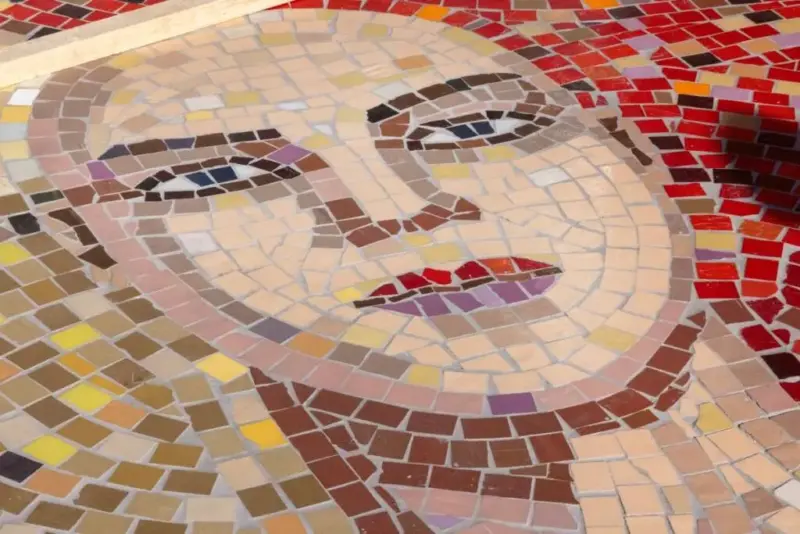
Detail of the installation “The Sun of the Following Day” – Photo © Blerta Kambo
Art and lack of support
Despite the public impact, the artist feels a lack of support, especially from the artistic community and institutions. Other socially focused projects of hers have been rejected.
This has led her to a difficult reflection: is there space in Albania for art that challenges and educates, or are “safer,” more entertaining projects preferred?
“You would assume that someone capable of delivering a project that affects and shakes society would receive some support but that’s not the case,” she says, adding that she has just received another rejection.
According to her, looking at the list of projects selected by the Ministry of Culture, it seems that decision-makers are influenced by their own prejudices and prefer safe choices.
“The role of the artist is seen as someone who should entertain, and very few projects aim to educate or go beyond that,” she says, expressing disappointment.
In this situation, four months after the installation, Blerta does not rule out leaving the country again, even though she had returned to contribute.
“That’s the sad part that has been weighing on me. I could choose to deal with the challenges of being an emigrant, but at least I wouldn’t lose my dignity and energy. When you’re a second-class citizen abroad, you’re limited in what you can do, but at least the energy you are allowed to use doesn’t go to waste,” she argues.
Today, the installation has found a new “home” at the Central State Film Archive. Even though it is no longer in public space, its message remains relevant.
“The sun of the following day” is an installation that represents both fragility and strength—a reminder of the invisible battles many women face every day.
It was a call for awareness, an act of solidarity, and proof of the power of art to spark debate. And despite the noise surrounding it, it achieved exactly that.
Found an error in this article? Please contact our editorial team at redazione@balcanicaucaso.org.
Tag:
Featured articles
 the students' voices
 Investigation
 students' protest