Twenty years after independence, Montenegro at the EU’s doorstep
Twenty years ago, on 21 May 2006, Montenegro separated from Serbia in a referendum. Today, the Balkan country is considered a frontrunner for EU accession. According to Podgorica, it will become the 28th member state in 2028. This is the third episode of the series “Winds of Independence” in which OBCT recounts Montenegro twenty years after independence
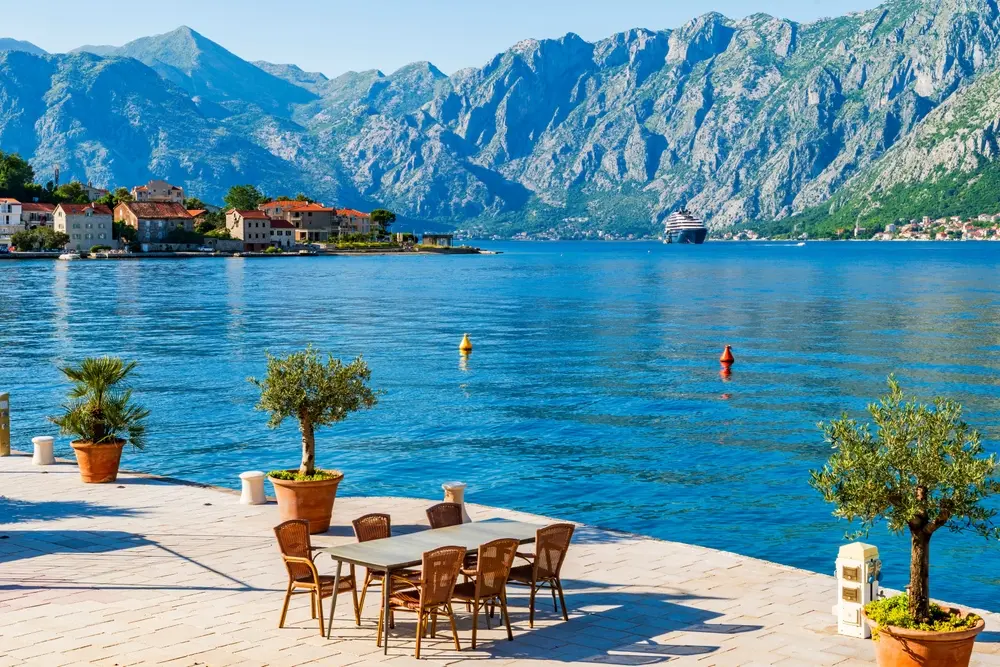
The Bay of Kotor, Montenegro © BBA Photography/Shutterstock
The Bay of Kotor, Montenegro © BBA Photography/Shutterstock
In Brussels’ corridors, when discussing European Union enlargement, Montenegro has long been referred to as a “frontrunner”. The small Adriatic country with a troubled history is said to be the most advanced candidate for membership in the twelve-star club. Prime Minister Milojko Spajić’s stated goal is for Montenegro to become the 28th member state by 2028.
The slogan “28 by 28” has become a categorical imperative for Podgorica, which – in addition to having created a dedicated website with this name – had it written on the fuselage of an aircraft in the fleet of Air Montenegro, the national airline.
To achieve this, the government has set itself an ambitious timetable: closing all negotiating chapters by the end of the year and completing the ratification process between 2027 and 2028 (in addition to Montenegro, all twenty-seven member states must give the green light).
Optimism in Brussels
Not exactly a walk in the park. Nevertheless, Brussels is displaying cautious optimism. Sources at the EU Delegation in Podgorica, interviewed by OBCT, praise the “Herculean efforts” made by the Balkan country, emphasising that, at the current pace, a 2028 or 2029 deadline could be a realistic one. On paper the progress is undeniable: since it opened negotiations in 2012, Podgorica has provisionally closed 14 of the 33 negotiating chapters of the acquis communautaire. Since 2023 alone, 11 chapters have been closed. Montenegro is the only Western Balkan candidate country to have received (as of June 2024) a positive assessment in the IBAR, an acronym for Interim Benchmark Assessment Report, a sort of mid-term review.
The first meeting of the Working Party responsible for drafting the Accession Treaty took place on 13 May. This body comprises representatives of the European Commission, the member states and Montenegro. The inaugural meeting, albeit symbolic (the group’s activities will only begin when negotiations are about to end) confirms that preparations are underway for the final push. The government in Podgorica promises a summer sprint, aiming to close at least ten chapters by autumn.
However, as EU sources emphasise, the chapters closed so far are the “easy” ones. The hard part starts now. Negotiations are reportedly well underway, especially regarding chapters 2 (free movement of workers) and chapter 8 (competition policy). Among the most difficult, however, are chapters 27 (environment and climate change), 23 (judiciary and fundamental rights) and 24 (justice, freedom, and security).
Chapter 27 poses great challenges considering the administrative effort and financial costs required to align national legislation with EU standards. From waste sorting to illegal landfills, from water management to decarbonising the economy, the list of challenges for Podgorica is long.
Chapters 23 and 24 constitute the cornerstones of the so-called “fundamentals”: the first chapters to be opened and the last to be closed, the true key to determining whether a candidate country is accepted or excluded. These chapters include justice, judicial independence, the rule of law, the fight against corruption and the protection of fundamental rights. While “great progress” has been made on the legislative level, as the EU delegation in Podgorica explains, on the administrative level there is a “chronic lack of resources”, which particularly affects the judiciary, despite recent improvements.
Recent changes to national security legislation could also prove problematic, having already sparked intense debate over the risks of tighter political control over the police and the potential incompatibilities with EU data protection rules. The laws in question currently remain in limbo between parliament and the Montenegrin president, who has refused to sign them.
Another critical issue is that of the controversial agreements signed in recent years with the United Arab Emirates. The first of these agreements, currently under review by the Constitutional Court for alleged procedural defects, concerns construction and tourism. The second one, even less transparent, aims to expand energy cooperation between Podgorica and Abu Dhabi. Critical aspects regarding public procurement and free competition cannot be ruled out, EU sources admit, but no one wants to worry prematurely about potential problems. When (and if) the agreements become effective, Brussels will analyse the texts and make its assessments, they explain.
Superficial reforms?
All that glitters is not gold. The real challenge remains turning reforms into concrete changes. For civil society, the Achilles heel behind the facade of technical progress concerns the actual implementation of the legislation hastily adopted in recent years (with peaks of around fifty legislative acts per day at the beginning of 2026). Chapters 23 and 24 are particularly in focus.
“Montenegro’s regulatory framework is already substantially aligned with the acquis, but there is still a wide gap between what is required by law and the reality on the ground”, explains to OBCT Nikoleta Đukanović, a professor at Donja Gorica University in Podgorica. At this stage, she observes, “there is no need for further legislation, but for institutional practice consistent” with the already codified norms.
This also means, as Đukanović specifies, “producing tangible results in high-level corruption investigations, strengthening the independence of the judiciary and freeing institutions from political interference”. For the professor, the priorities should be “electoral reform, strengthening institutional capacity and protecting fundamental rights, such as those of the LGBTQ+ community”, which remain largely unfulfilled.
For Daliborka Uljarević, director of the NGO Center for Civic Education (CCE), the crucial issue is the credibility of the reform process. “The authorities are pushing to advance negotiations at the technical level, but then crucial reforms, those that fundamentally change the functioning of the state, remain a dead letter. They know full well that if they were to implement them, they would lose their monopoly on power”.
The problem, according to Uljarević, is that “European liberal-democratic values are not yet fully rooted in Montenegro’s political culture”. “Respect for democratic standards, while reiterated in words, is not reflected in the actions of the ruling class”, explains the CCE director, noting that “these standards are often perceived more as technical requirements imposed by Brussels than as a necessity for Montenegro itself”. “Rather than as a guarantee for all, many politicians interpret the rule of law as their own right to govern”.
Strong EU action on this front is also lacking. “The EU pretends not to see the problems because it needs to demonstrate – both within and beyond its borders – that enlargement is still a success story”, says Uljarević, admitting that “Montenegro is certainly the easiest to integrate” among the candidate countries. Moreover, Podgorica has undeniably benefited from a favorable geopolitical situation, which has accelerated its progress towards the Union.
However, the CCE director warns, “this increases the risk that political momentum will overshadow the country’s democratic deficits and structural weaknesses”. Indeed, there is a widespread perception that the Commission is rushing to reach the finish line, perhaps turning a blind eye to any shortcomings. Some observers denounce serious superficiality in the conduct of the negotiations, to the extent that European officials are apparently keeping the Montenegrin public administration on a string.
Overall, as Nikoleta Đukanović observes, unlike previous enlargements, “the EU has lost its transformative power towards the candidate countries, that ability to generate positive changes in national societies, economies and political and institutional structures”.
“If Brussels accepts downward compromises on reforms, turning a blind eye to anti-democratic developments in Montenegro, the credibility of both sides will be undermined”, concludes the professor.