The unfinished 1991: Ukraine’s long road out of the Soviet Union
Unlike other post-Soviet republics, Ukraine has struggled to forge its own political and cultural identity following the collapse of the Soviet Union, a process which, in many respects, is still ongoing. Reflections by the former dissident Yosyf Zisels and Refat Chubarov, leader of the Crimean Tatar national movement
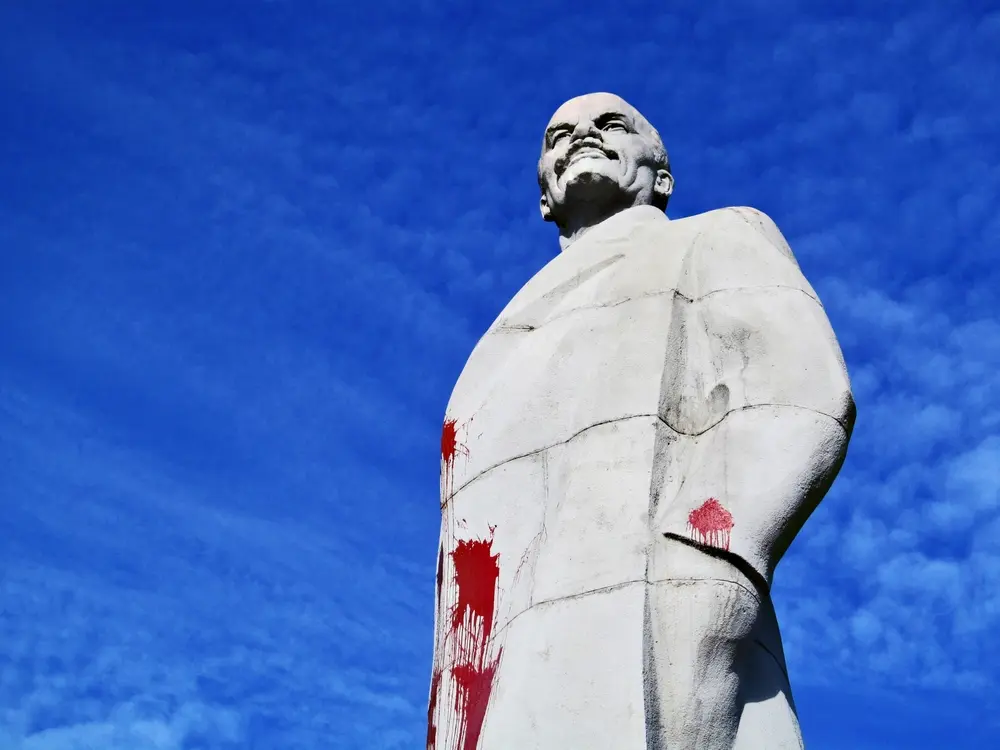
Odessa, red paint on the Lenin monument © Stanislaw1999/Shutterstock
Odessa, red paint on the Lenin monument © Stanislaw1999/Shutterstock
Ukraine became independent in 1991, but the country did not transform overnight. The Soviet Union ceased to exist as a political system; the institutions, social structures, demographic patterns and identities formed under it continued into the new state. Thirty-five years later, two people whose lives began in very different parts of that system describe this transition: Yosyf Zisels, a Ukrainian dissident and former political prisoner, and Refat Chubarov, a leader of the Crimean Tatar national movement in Ukraine whose parents were deported from their homeland in 1944.
“We got independence in 1991 without a critical mass of people who could lead the country,” Zisels says. He is speaking from his own experience as one of the tiny minority of dissidents in Ukraine during the Soviet era. As one of the members of Ukrainian Helsinki group and a human rights activist, he was imprisoned by the Soviet authorities in 1978 for three years, and then, again in 1984.
From 5% to 30%
“I am a dissident, I am a political prisoner twice, and I don’t think that the change from the whole Soviet government to the Ukrainian one happened thanks to our efforts,” Zisels continues, “Yes, we made efforts in this direction, but there were very few of us. Very few. Maybe 500 people for 50 million of the population. How can you change a country with 500 people? You cannot.”
In other words, one of Europe’s most populated countries entered independence without a large political class that had experience running an independent Ukrainian state. For Zisels, this partially explains why the post-1991 transition cannot be measured only by the creation of new institutions or the declaration of independence.
He compares Ukraine with Estonia, Latvia and Lithuania, which had been independent in-between the two world wars. By 1991, those countries had people who had been born and raised in an independent state.
“Twenty years is a short historical period,” Zissels says, “but it is still enough to lay certain foundations of collective identity. Millions of people were born in a new country – doesn’t even matter if it was good or bad. We, on the contrary, never had 20 years before 1991 when a whole generation of young people could be born and grow up in their own country.”
Zisels also recalls Poland’s Solidarity movement, which developed into a mass organisation during the final years of communist rule. Solidarity had nearly 9.5 million members by 1981.
“While Poland had millions of people willing to join the protest movement back in the eighties, we only had hundreds,” Zisels says. “It is a big difference.”
This difference became relevant when the Soviet system collapsed. Ukraine had inherited a large administrative structure, but the political institutions had been designed for a Soviet republic rather than an independent state. It had a population with different regional, linguistic, religious and historical experiences, but no previous generation-wide experience of independent Ukrainian citizenship.
“Ukraine is very diverse,” Zisels says, himself of Jewish origin and born in Uzbekistan. “There is a fragmented regional, sub-ethnic, subcultural, subreligious identity. There are very many pieces of identity, and we never had enough time for everything to be processed into one system of Ukrainian identity.”
Some of the changes since 1991 can be measured. A 2025 survey found that 94% of respondents identified as citizens of Ukraine, while 77% said they identified more with Ukraine as a whole than with their region. 52% described themselves as European, compared with 8% who described themselves as Soviet. Asked how they would vote on independence today, 95% said they would support it.
Language statistics show another long-term change. In a 2024 survey, 91% responded that they were proud of their Ukrainian citizenship as opposed to 62% in 2010. 78% of respondents identified Ukrainian as their native language, compared with 52% in 2006.
Zisels has his own estimate for the development of what he calls national consensus.
“In 1991, we probably had 5% of the population with a clear national, mass, collective Ukrainian political identity,” he says. “Now it is 30%.”
According to Zisels, Ukraine is still lacking a nation-wide consensus which he defines as a situation in which “75–80% of the adult population of the country has similar ideas about the past of the Ukrainian people, about the present and about the future.”
This does not mean agreement on every political issue.
“People may be left-leaning, right-leaning, not important,” he explains, “the main thing is that they all want the basic things to be ours. Our land, our independence, our sovereignty on this land, and that we choose our own government.”
“Our process of acquiring full independence, which we received formally, mechanically in 1991, is continuing,” Zisels adds. “It will take us a long time. We can’t achieve in a few decades what took our neighbors a few centuries to achieve.”
Back to 1944
“My parents, together with all the Crimean Tatars, were kicked out of Crimea on May 18, 1944,” Chubarov says. “My father was not yet 13, and my mom was 11.”
Chubarov was born in Uzbekistan in 1957. His family returned to Crimea in 1968, when he was not yet 11. The Soviet authorities prohibited the surviving Crimean Tatars from returning to the peninsula after Stalin’s death, but they could not keep everyone out.
“To fight off the wave of the Crimean Tatar national movement, but on the other hand, to state that everyone has a right to live in Crimea, including Crimean Tatars, they moved around 700–800 Crimean Tatar families back to Crimea,” Chubarov says. “After that, they shut Crimea off again, and thousands of people who were trying to return were once again pushed out of the peninsula.”
A 1967 Soviet decree referred to “Tatars who used to live in Crimea” rather than using the name Crimean Tatars. Chubarov recalls the effect of the policy on those who returned.
“Not a single Crimean Tatar family could return to those exact places from where they were deported,” he says. “Obviously, my parents really wanted to return to their village, but we were homed near the Kherson region, in Krasnoperekopsk county. It was a steppe part of Crimea.”
The families were deliberately dispersed, he says, a county would not have more than four or five Crimean Tatar families.
“This way, we would not be able to talk to each other,” he explains.
Chubarov says the returnees were also closely monitored. After the collapse of the USSR, he says, he saw archival documents describing plans to establish KGB units in areas where returning Crimean Tatars were settled.
His own experience of Soviet restrictions continued into adulthood. After studying history in Moscow and training as an archivist, he was assigned to work at the regional archive in Simferopol.
“I arrived, and they told me to my face that they would not hire me because I am a Crimean Tatar, and it is forbidden for them to live here,” he says. “All my arguments that my parents live here and that I graduated from high school there did not work. So in 1983, I was kicked out of Crimea again.”
Chubarov and his Latvian wife subsequently worked in Latvia’s state archive. He became involved in the Latvian independence movement, joined the Popular Front of Latvia and served as a deputy on the Riga city council. From 1989, he was also active in the Crimean Tatar national movement.
“Until 1991, I officially lived in Riga, but factually, since 1989, I was an active participant of the Crimean Tatar national movement,” he says, “In 1991, I returned to my home, and since then, all my life was linked with Crimea, with Ukraine.”
By then, the peninsula’s political status had already become an issue. Chubarov remembers that Crimean Tatars were demonstrating for return and restoration of autonomy in the late 1980s. In 1987, thousands travelled to Moscow, including to Red Square, to press their demands.
“They believed that autonomy that was stopped in 1945 after the deportation would give some mechanisms to guarantee the rights of the Crimean Tatars, to make them more involved in the Crimean life,” Chubarov explains.
The Soviet position changed during the next two years. In 1988, Moscow issued a decree saying the return of Crimean Tatars was impossible because there was insufficient land and Crimea was already settled. Later, the Soviet authorities acknowledged the deportation as criminal and illegal. The second decision, Chubarov believes, was made under pressure from the movement. Then came the referendum on Crimean autonomy.
“In 1990, the USSR supported the initiative of these pro-Russian movements about the autonomy of Crimea,” Chubarov says. “It was an attempt to limit Crimean Tatar political demands and increase Moscow’s leverage over Ukraine. The referendum took place on January 20, 1991, while the Soviet Union still existed. Crimean Tatars boycotted it.”
Chubarov estimates that approximately 80,000 Crimean Tatars had returned to Crimea by then while most were still outside the peninsula.
“The autonomy that was supported by Moscow in 1990 was an anti-Ukrainian and anti-Crimean Tatar project,” he says.
Ukraine became independent later that year, inheriting the autonomy arrangement and a population whose composition had been profoundly changed during the Soviet period.
The question of identity was visible in other parts of Crimea as well. Chubarov remembers Ukrainian-language signs and publications when he returned as a child in 1968.
“I would go to the local post office, and there was a signboard in Ukrainian,” he says. “I remembered that because I returned from Uzbekistan, and I studied in a Russian school, so I knew Uzbek, but Ukrainian was unusual for me.”
The local newspaper was published in Ukrainian and Russian.
“When I was in the fifth grade, I started learning Ukrainian language in a Russian-language school,” he continues. “So, you could not avoid learning Ukrainian back then. But then a few years passed, and the signboard disappeared, the newspaper stopped publishing its Ukrainian version, and the language disappeared.”
By the end of 2013, Chubarov says, Crimea had about 500,000 ethnic Ukrainians but only seven Ukrainian-language schools. There were 14 Crimean Tatar-language schools for 300,000 Crimean Tatars.
The political system that Ukraine inherited in Crimea was therefore shaped by several different Soviet-era processes: deportation, controlled return, demographic settlement, the establishment of Crimean autonomy that favored ethnic Russians or Russian-speakers, and the development of a predominantly Russia-oriented political environment. As Chubarov explains, Ukrainian politicians after 1991 largely avoided addressing these issues.
“The biggest group in Crimea is the Russian ethnic group, so there was this mental block among Ukrainian politicians toward Russia, these old ties, and Crimean Tatars were perceived as something new and hard to understand,” he says.
By early 2014, the institutional consequences were visible, Chubarov continues.
“When Russian forces took control of Crimea, only one of the peninsula’s 14 regional administrations publicly rejected the occupation, and that was only because it was led by a Crimean Tatar,” he adds, “Plus, Ukraine’s Security Service on the peninsula didn’t have a single Crimean Tatar.”
“For Russians, controlling Crimea has been indispensable ever since 1991,” Chubarov continues, “Through Russian minority, politicized autonomy, and constant pressure on the peninsula, Russia has used the peninsula to challenge Ukraine’s independence and try to bring the whole country to the pre-1991 order.”
Leaving 1991 behind
“It’s very difficult to explain the USSR and the pre-1991 system to young people,” Zisels says. “To be able to understand it, you would have to live through as much of that time as we did. The fact that I got rid of its legacy somewhere along the way is almost an accident. I am still a product of that Soviet system.”
However, the new generations born and raised after 1991 got the opportunity to live in their own state that underwent democratization and openness. This experience contributed to dramatic shifts in the way people see themselves, their country, and their history – and the way they no longer felt connected to the Soviet legacies of the past. Zisels sees this voluntary mass mobilisation around the Maidan protests of 2013–14 as evidence of a different Ukraine from the one that entered independence in 1991.
“During Euromaidan, I saw that in Ukraine, there were already millions,” he says. “Over the preceding decades of independence, and by 2014, we had reached somewhere between five and six million active citizens who shared a national, mass Ukrainian identity. In a way, we were like the Poles in 1981.”
“So, this process of acquiring full independence, which we received formally, mechanically in 1991, is continuing,” he concludes.
Found an error in this article? Please contact our editorial team at redazione@balcanicaucaso.org.
Tag:
Featured articles
 the students' voices
 Investigation