Italy: MFRR report highlights continuing media freedom backsliding
On 9-10 March 2026, the Media Freedom Rapid Response (MFRR) consortium conducted its third visit to Rome in five years.

MFRR delegation at the headquarters of the Federazione Nazionale Stampa Italiana (FNSI) Credit: MFRR
MFRR delegation at the headquarters of the Federazione Nazionale Stampa Italiana (FNSI) Credit: MFRR
The MFRR mission found that Italy has continued on a negative trajectory, resulting in a further erosion of media freedom. This report presents the findings from the mission and MFRR’s ongoing monitoring, offering an analysis of the four most urgent issues identified by the consortium.
The persistent political interference in Italy’s public broadcaster Radiotelevisione Italiana (Rai) epitomises the most concerning trend in the Italian media sector, its governance and funding models failing to comply with EMFA standards. Notably, the parliamentary committee responsible for overseeing public media duties has been effectively paralysed by a boycott by the majority party for two years, leading to mass resignation of the Committee in July 2026.
The recent sale of GEDI Group’s media assets has raised significant concerns about the future of editorial independence in Italy’s media landscape, a development that also highlights broader issues of media pluralism and concentration in Italy.
The prevalence of legal threats also testifies to the general drift of the state of media freedom in the country. Combined with the ongoing existence of criminal defamation laws that rank among the strictest in Europe, and a trend in which SLAPPs are often initiated by high-ranking public officials, Italian journalists face acute legal risks compared to colleagues in other EU countries. Despite the urgency of the issue, institutional actors in Italy appear to focus primarily on a minimal, symbolic transposition of the EU Anti-SLAPP Directive.
Finally, Italy has also emerged as one of the most worrying cases of state surveillance against journalists following the Graphite spyware scandal, while other forms of digital violations have also been monitored, including DDoS attacks and phishing attempts. Unfortunately, institutional actions aimed at improving the protections for journalists and their sources proved insufficient, while the national legal framework requires urgent reform in line with the EMFA.
The mission was joined by the following MFRR organisations: European Centre for Press and Media Freedom (ECPMF); European Federation of Journalists (EFJ); Free Press Unlimited (FPU); International Press Institute (IPI); Osservatorio Balcani e Caucaso. The local partners were: Amnesty International Italia; Federazione Nazionale Stampa Italiana (FNSI) and Unione Sindacale Giornalisti Rai (UsigRai).
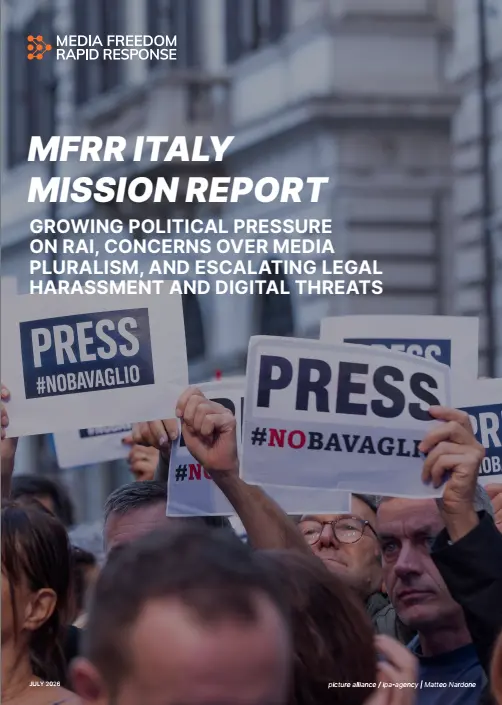
 Here the MFRR Italy Mission Report
Found an error in this article? Please contact our editorial team at redazione@balcanicaucaso.org.
This article was produced as part of the Media Freedom Rapid Response (MFRR), a Europe-wide mechanism which tracks, monitors, and responds to violations of press and media freedom in EU Member States and candidate countries.