Hungary-North Macedonia: Orbán falls, will Gruevski be extradited?
After Orbán’s defeat, the fate of former Macedonian Prime Minister Nikola Gruevski is once again in the balance. After several convictions in his homeland, he fled to Hungary, where he received political asylum. New Prime Minister Peter Magyar has called Gruevski “a criminal,” paving the way for a possible extradition
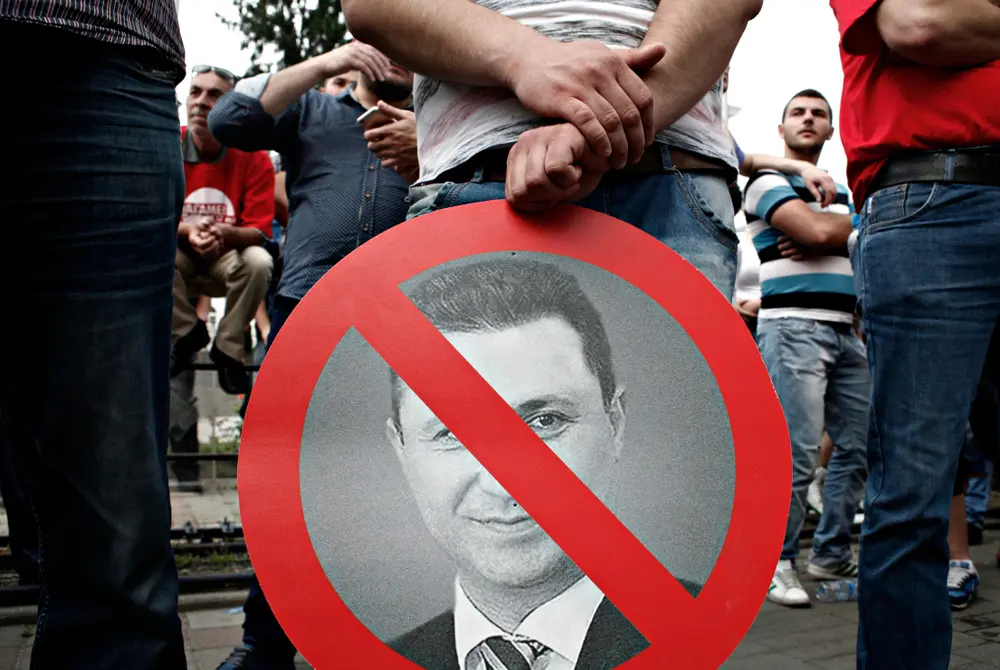
Proteste contro Gruevski nel 2018, Skopje © Alexandros Michailidis/Shutterstock
Proteste contro Gruevski nel 2018, Skopje © Alexandros Michailidis/Shutterstock
After Viktor Orbán lost the parliamentary elections in Hungary, almost every day in North Macedonia, a journalistic article has been published about what could happen in the country now, and especially about the former Macedonian Prime Minister, Nikola Gruevski, who received Hungarian asylum in 2018.
The winner of the elections, Peter Magyar, opposition leader of the Tisza party, said from Hungary that his country would no longer be a dumping ground for foreign criminals who were granted asylum by Orbán, mentioning namely Gruevski.
Eight years ago, when Gruevski was supposed to go to prison to serve a two-year sentence for the illegal purchase of an armored Mercedes official vehicle, he fled to Hungary.
From there, he posted on social media that his life was under threat, and that he had requested political asylum from the Hungarian authorities, which he received a week later. In later posts, he claimed that he was the victim of politically rigged trials by the then SDSM government and that there were no conditions for a fair trial in the country.
Macedonian authorities have repeatedly filed extradition requests for Gruevski to serve his prison sentence. However, in June 2019, a Hungarian court rejected the extradition request, stating that conditions were not met because Gruevski had already been granted asylum.
Since then, Gruevski has lived in Budapest, where he often shares political analyses and comments on the situation in North Macedonia via social networks.
In the meantime, the execution of the sentence has become statute-barred, and now two different arrest warrants are active for Gruevski – one for 18 months in prison (the statute of limitations expires on September 10, 2027) and one for nine years, which expires on February 11, 2043.
In North Macedonia, Prime Minister Hristijan Mickoski stressed that, if the fugitive former Prime Minister Nikola Gruevski returns from Budapest to the country, he will go to prison because he has a final verdict.
“All laws apply and a government must respect the laws and institutions of the state, and normally every person has the right to file complaints afterwards. As for whether and when he will return, I have no such expectations,” Mickoski said.
Venko Filipce, president of the now opposition SDSM, raised the question of Gruevski’s future “when he no longer has a protector in Budapest.” He asked whether this government has so far submitted a request for Gruevski’s extradition, and if such a request will be submitted.
“He has enjoyed hospitality for years. Will he flee to Russia or elsewhere or will he return to serve his sentence? I welcome the clear and unambiguous message from the new Hungarian Prime Minister from yesterday’s press conference that he will extradite those hiding on their territory and that he finally labeled Nikola Gruevski as a criminal. This is the end of the era when Budapest was a safe haven for all convicted criminals,” Filipce said at a press conference.
SDSM claims that Nikola Gruevski currently possesses both a Hungarian and a Serbian passport. “It is clear that Gruevski has powerful political allies and protectors: Viktor Orbán and Aleksandar Vučić, Mickoski’s political mentors, are behind this”, said the opposition party in a press release. “Obviously, the inaction of Mickoski’s government and the persistent refusal to send a new extradition request is a deliberate attempt to leave room for Nikola Gruevski and protect him”.
The government and the opposition also had verbal clashes in 2025 over the topic of Hungary, due to the one billion euro loan taken by North Macedonia from Hungary. While the government said that the money would help pay off old debts and restart the economy, the opposition criticized that the money actually comes from China and risks deepening Beijing’s influence on the country.
After the announced possibility of Gruevski’s extradition, which is in the hands of the Hungarian courts, the media in North Macedonia have been analyzing the possible scenarios.
According to the portal Collegium, extradition from Hungary is a two-stage process (judicial and ministerial) under a 1996 law, which includes a judicial review of legality and a ministerial decision to surrender, which generally requires double criminality (a penalty of up to one year). For EU member states, the process is simplified, as the role of the minister in making an extradition decision is removed.
“The competent authority for Hungarian extradition procedures is the Ministry of Justice, although investigations and arrests often involve the Budapest Regional Court. In doing so, the court first decides whether the legal conditions are met, and if so, the Minister of Justice decides on the surrender itself. Then there is a judicial assessment, during which the courts confirm compliance with international agreements.
The portal “360stepeni” interviewed Zsolt Szekeres, a lawyer at the Helsinki Committee of Hungary, who stressed that Nikola Gruevski’s asylum cannot be revoked easily or overnight, and until then he cannot be extradited.
“Refugee status is subject to periodic review, every three years. He also had the right to apply for Hungarian citizenship in 2021”, says Zsolt Szekeres.
On the topic of Hungary, the opposition SDSM has also filed criminal charges against Hungarian citizens whom they consider to be the owners of Alfa TV, with which leader Venkov Filipce is in constant conflict, due to suspicions of an organized scheme of money laundering, tax evasion and falsification of business books.
There are reasonable indications that in the period from 2017 onwards, around 2.85 million euros were transferred from abroad to Macedonia through an international network of transactions, which then ended up in Alfa TV. These funds were concealed through fictitious marketing and advertising contracts with companies that have no real business on the Macedonian market, say SDSM.
The Association of Journalists of Macedonia and the Independent Union of Journalists and Media Workers reacted to the public corruption accusations made by the president of SDSM against the journalists working for TV Alfa, stating that it is unacceptable and inappropriate for the president of a political party to publicly make serious accusations accompanied by rhetoric of discrediting journalists and media.
According to the organizations, this is not an isolated case, but political entities are increasingly trying to instigate campaigns and narratives to defame individual journalists and editorial offices.
Found an error in this article? Please contact our editorial team at redazione@balcanicaucaso.org.
Tag:
Featured articles
 the students' voices
 Investigation
 students' protest