Easter in Albania, between faith and memory
From candlelit vigils to the silence of the communist years, Catholic and Orthodox communities celebrate Easter in Albania as both a religious and cultural event shaped by interfaith coexistence and historical memory
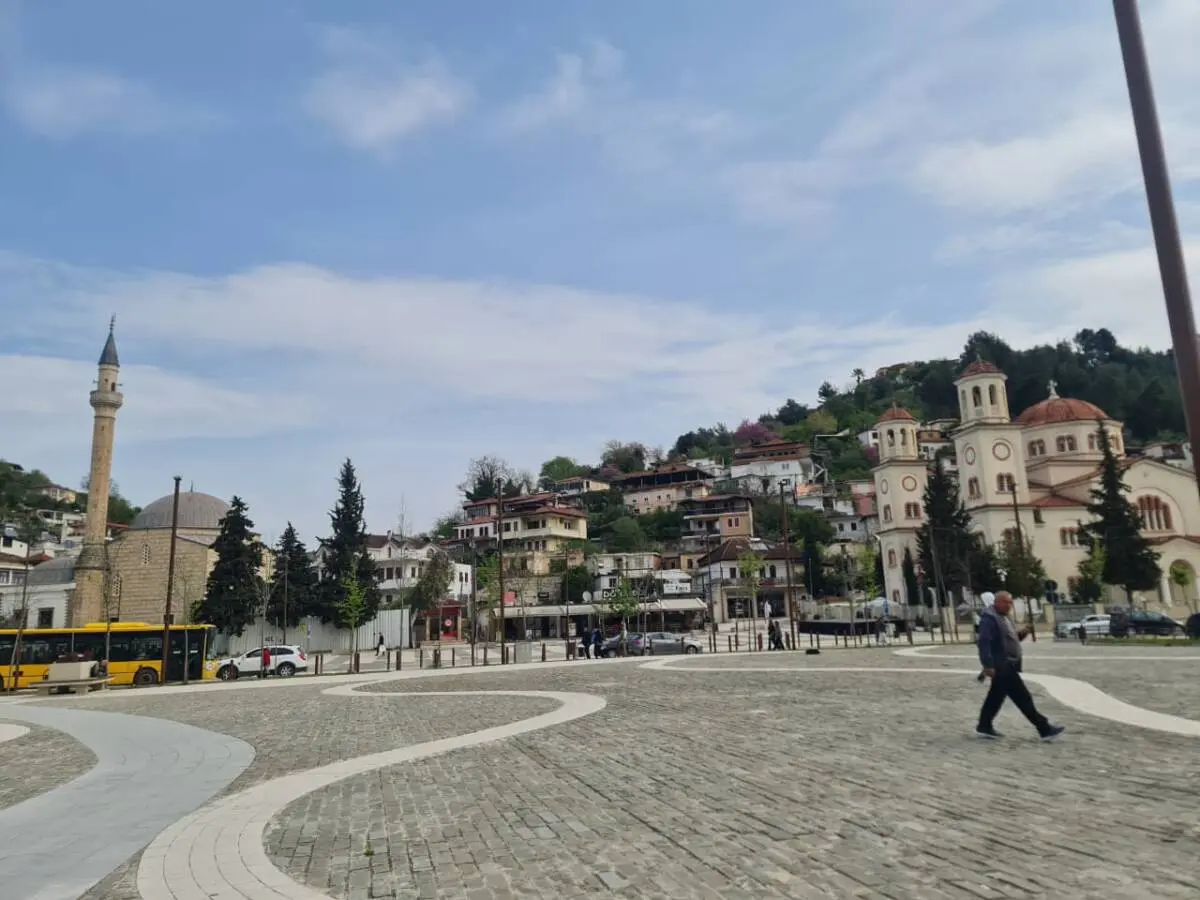
Orthodox church and the mosque in the center of Berat
Orthodox church and the mosque in the center of Berat © Arbjona Çibuku
In Albania, Easter is celebrated by Catholic and Orthodox communities, which represent a significant, though not majority, part of the population. Catholics reside in the northern part of the country, while the Orthodox Christians are mainly found in the center-south. According to the latest census data, around 8.38% of Albanians identify as Catholic and 7.22% as Orthodox, while the rest belong to other faiths or do not declare any religious affiliation. These figures show that, even though these communities are numerically small, their traditions have a visible cultural and public impact on the country’s social life.
Both Easter celebrations are official public holidays and receive equal institutional and media attention. In both traditions, the central moment is the midnight mass, when the resurrection of Christ is proclaimed. During this ceremony, believers light candles and receive the flame from the altar, carrying it home as a symbol of the light of resurrection. According to tradition, this flame represents the “tomb of the risen Christ” and is preserved as a sign of blessing.
The ritual of light is connected with the symbolism of moving from darkness to light, expressing the idea of spiritual rebirth. At midnight, believers greet each other with the traditional exchange “Christ is Risen” followed by “Indeed He is Risen.” Churches are filled with families, children holding candles protected by paper shields, and elderly people who remember when such gestures could only be performed in secret.
On the evening of April 4, Catholic believers began celebrations with masses held in cathedrals across the country. In Tirana, the Easter Vigil was led at St. Paul’s Cathedral by Archbishop Arjan Dodaj, who wished believers spiritual renewal and the triumph of hope. The vigil symbolizes the passage from darkness to light, bringing messages of peace, faith and reconciliation.
After forty days of Lent, Catholic families prepare festive tables including meat, dairy products and traditional foods that are often blessed the day before in church. Orthodox believers follow similar rituals, attending liturgies and gathering for family meals the following morning. Across Albania, churches in cities such as Lezha, Shkodër, Kruja and Vau i Dejës are filled with worshippers holding candles, while bells mark the announcement of the resurrection.
One of the most recognizable elements of Easter in Albania is the red coloured egg. It symbolizes life emerging from within the shell, while the red color represents Christ’s sacrifice and the victory of life over death. The tradition also includes Easter bread, often decorated with a red egg in the center, and lamb, symbolizing Christ as sacrificial offering. Candles placed on the table represent faith and resurrection. These elements are common to both Catholic and Orthodox traditions, creating a shared symbolic language.
A distinctive feature in Albania is that Easter is often celebrated beyond the Christian communities. Families of different faiths exchange greetings and visits, reflecting the country’s long-standing tradition of interreligious coexistence. This harmony, frequently noted by foreign observers, is part of Albania’s social identity, where religious holidays become occasions for shared participation rather than division.
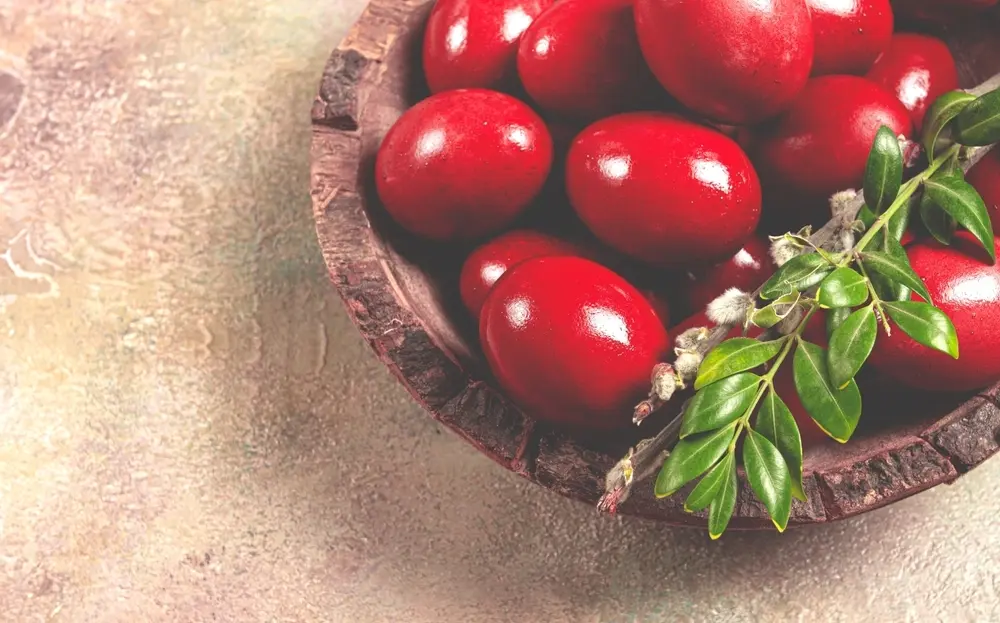
Easter Eggs © Didebashvili.GEO/Shutterstock
Easter under communism: a celebration in fear
The history of Easter in Albania cannot be understood without the period of communism, when religion was officially banned and any religious practice considered illegal. In 1967, the communist regime launched one of the most radical anti-religious campaigns in Europe. Within a few months, hundreds of churches, mosques and religious institutions were closed or destroyed, and Albania was declared the “first atheist state in the world.” Public expressions of faith were prohibited, and even private rituals could bring consequences, ranging from administrative warnings to severe punishment.
In this context, Easter disappeared from public space. There were no masses, church bells fell silent, and celebrations moved into private homes, practiced quietly and discreetly. Yet many families continued to preserve traditions in minimal forms.
Dedë Gjonpalaj, 80, from Peraj in Tropoja, recalls that Easter was no longer openly celebrated but reduced to symbolic gestures.
“It was more like observing it. We didn’t celebrate with meat, because we didn’t have any. We made fli or sometimes chicken. We celebrated secretly and dyed eggs. It wasn’t a real celebration. We said ‘happy Easter,’ but we didn’t visit each other because if they found out, it became a problem,” he says.
Fear of inspections was real. Local party structures and informants monitored communities, and any sign of religious celebration could be interpreted as opposition to the regime.
“They carried out checks. Informers came under other pretexts and looked to see whether we were celebrating. Sometimes the party official would ignore it, sometimes he would make trouble. If they caught you, there were consequences,” Gjonpalaj adds.
Visits, a central part of Easter traditions, were often avoided. Celebrations were limited to close family members and usually consisted of a modest meal. Zojë Gjonpalaj, 71, born in Palç, recalls that before collectivization families went to church openly. After the 1960s, everything changed.
“Before cooperatives and the ban on religion, we went to church and celebrated properly. Later it was no longer allowed; churches and mosques were destroyed, and we celebrated secretly,” she says.
Even traditional rituals were improvised.
“We made a dinner with fli and turkey, and eggs. We couldn’t dye them red, so we used onion skins and they took some color,” she remembers.
For Orthodox believers the situation was similar. Drita, 78, born in Lushnja and now living in Berat, recalls celebrating quietly.
“When I was young we celebrated and went to church… but when Enver banned religion, we did it secretly, dyed eggs, roasted meat, drank red wine when we had it.”
She also remembers a telling episode:
“My husband had managed to get a small lamb… we hid it in a chest for Easter. An informer came… the lamb made noise and they took it away. They left us without celebrating and without meat for the children.”
Without churches, symbolism was reduced to small gestures.
“We lit a candle, said ‘happy Easter,’ just as a sign,” she says.
These testimonies show that during communism Easter did not disappear entirely but transformed into a quiet family tradition. Lighting a candle, dyeing eggs, and sharing a modest meal became acts of cultural and spiritual resistance. After the fall of the regime in the early 1990s, public celebrations resumed, churches were rebuilt, and Easter returned as a visible symbol of religious freedom in Albania.
Found an error in this article? Please contact our editorial team at redazione@balcanicaucaso.org.
Tag: Traditional culture
Featured articles
 Political deadlock
 Economy and Dialogue
 Water shortage