
Republika Srpska’s creeping secession
The recent announcement of the establishment of an Office for International Cooperation, tasked with managing diplomatic relations with the Republika Srpska, suggests yet another move toward secession
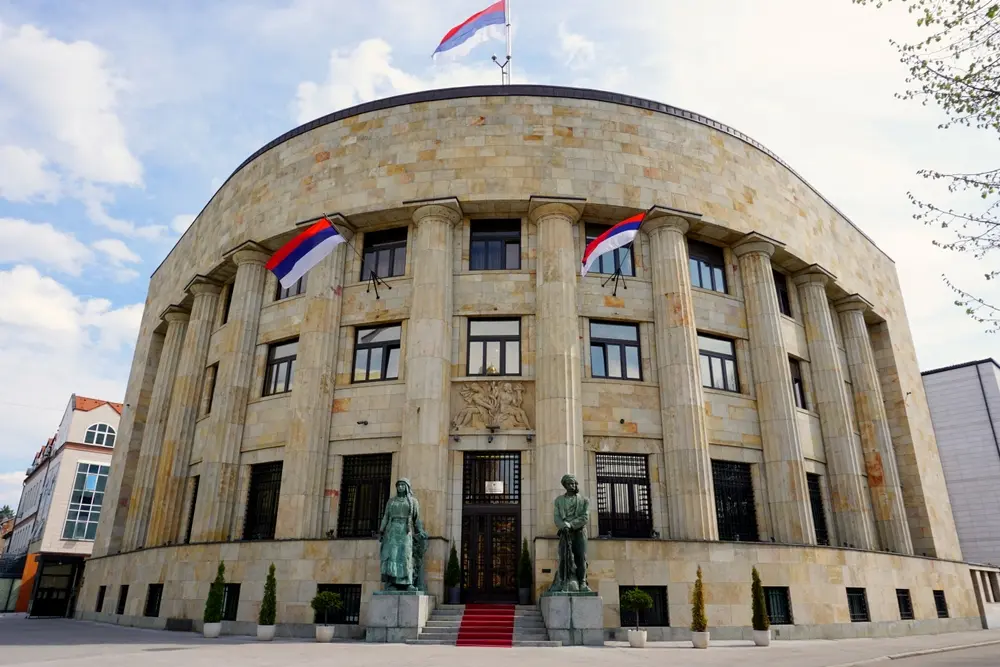
Banja Luka, Republika Srpska (BiH), Office of the President of the RS © Bngc/Shutterstock
Banja Luka, Republika Srpska (BiH), Office of the President of the RS © Bngc/Shutterstock
With the world distracted by events in the Middle East, Republika Srpska has announced the establishment of an Office for International Cooperation to spearhead the entity’s diplomatic relations. By directly challenging yet another state-level competence, the move constitutes a further creeping step towards de facto secession.
Under Bosnia-Herzegovina’s constitution, foreign policy is the exclusive domain of the country’s tri-partite presidency and the Ministry of Foreign Affairs. It is an often arduous process, which basically requires consensus between all three members. Whilst they all agreed to endorse President Trump for the Nobel Peace Prize, there are fundamentally different stances when it concerns Iran, with Republika Srpska siding with Israel. Diplomatic paralysis is a regular occurrence, or the presidency members express their own uncoordinated stances.
The establishment of an Office for International Cooperation is motivated by a desire to present Republika Srpska as a sovereign actor, capable of acting independently beyond Bosnia-Herzegovina’s borders. It facilitates the conduct of parallel diplomacy, advancing the entity’s interests in various areas and inevitably working to undermine the state, whilst endeavouring to legitimise Republika Srpska’s presence and symbols in international fora.
One challenge for Sarajevo is the growing number of capitals willing to embrace, whether enthusiastically or not, Republika Srpska as separate and distinct from Bosnia-Herzegovina. During a recent visit to Washington, Milorad Dodik, the entity’s ousted former president who continues to pull the strings, and Željka Cvijanović, the Serb member of the presidency, were received by senior members of the Trump administration, including (briefly) Pete Hegseth, the Secretary of War. Energy and economic investments in the entity were just some of the topics open for discussion.
Even within the EU, countries like Hungary and Slovakia have been enthusiastic supporters of Republika Srpska, with the former blocking initiatives at the EU level to enact sanctions against Dodik and his associates. If more right wing parties are elected across Europe, Republika Srpska can expect to find even more allies in European capitals. Whilst the Ministry of Foreign Affairs in Sarajevo frequently sends diplomatic notes to foreign governments hosting delegations from Republika Srpska, reasserting that only the state can enter into legally-binding bilateral agreements, the optics of such visits are damaging for Bosnia-Herzegovina.
Furthermore, the narrative that such unilateral moves constitute a violation of the Dayton Peace Agreement – and therefore demand intervention from the Office of the High Representative – has been undermined by the fragmentation of the international community. The lifting of US sanctions against Dodik and his inner circle has been interpreted in Banja Luka as a tacit endorsement of their anti-Dayton approach. The subsequent lack of deterrence has left many in Sarajevo deeply concerned.
The uncertainty of American policy towards Bosnia-Herzegovina only adds to the tensions, especially given the EU’s inability to act with a unified and assertive voice. Republika Srpska has engaged in an expensive, yet effective lobbying campaign in Washington (and Mar-a-Lago) designed to simultaneously push its secessionist agenda whilst advocating for a return to the ‘Original Dayton;’ namely, the Dayton structure stripped of all the subsequent measures to strengthen the state. Even Donald Trump Jr. found himself addressing audiences in Banja Luka and talking up investment opportunities in the entity (especially for companies connected to the Trump family).
The Office for International Cooperation is the latest part of a strategy to create institutions within Republika Srpska to which transferred competencies can be returned from the state to the entity. If full secession falls short, Banja Luka seeks a return to the levels of extreme autonomy that were enshrined in the original Dayton text, but diluted away by various international community interventions. Whilst the proposal of parallel institutions may appear empty at first, they are intended to demonstrate that the entity is ready to assume greater responsibility for managing its own affairs.
Though the constitutionality of the Office’s establishment will inevitably be appealed to the Constitutional Court, on the grounds that it challenges the country’s sovereignty, Republika Srpska will continue to pursue a parallel foreign policy at odds with the state of Bosnia-Herzegovina. Such manoeuvres will also spark retaliatory blockades by Republika Srpska politicians on important state-level legislation, including those related to the Reform Agenda and the adoption of state budget. Sarajevo finds itself caught between a rock and a hard place.
With keenly contested elections approaching this autumn, part of Dodik’s campaign revolves around demonstrating steps towards secession. He recently claimed that some fifteen countries were ready to recognise Republika Srpska if it declared independence. Whilst threats to withdraw from key institutions like the Unified Armed Forces or Indirect Taxation Authority will persist, the Office for International Cooperation provides a tangible and robust challenge to state-level authority. Though international pressure has largely contained such initiatives, there are concerns that it will only continue to wane.
Bosnia-Herzegovina’s standing on the world stage has long been undermined by an incohesive approach to foreign policy. As geopolitics becomes more complicated and cynical, Republika Srpska’s moves to chart its own course in international affairs will further destabilise the state. With Dodik (re)empowered by the Trump administration, the assertion of the entity’s sovereignty and the creation of infrastructure for future independence, de facto or otherwise, will create a constitutional crisis that the EU cannot ignore. Few in Sarajevo, however, will hold their breath waiting for a unified response.
Found an error in this article? Please contact our editorial team at redazione@balcanicaucaso.org.
Tag: Republika Srpska
Featured articles
 Political deadlock
 Economy and Dialogue