BiH: Lithium in Majevica, and the problem of land use violations
In September 2023, the residents of Majevica, by pure chance, learned that a multinational mining company was about to begin exploration for lithium deposits. This sparked a mobilization that involved the entire area. This is the first of four installments on environmental activism, a very dynamic phenomenon in Bosnia and Herzegovina today
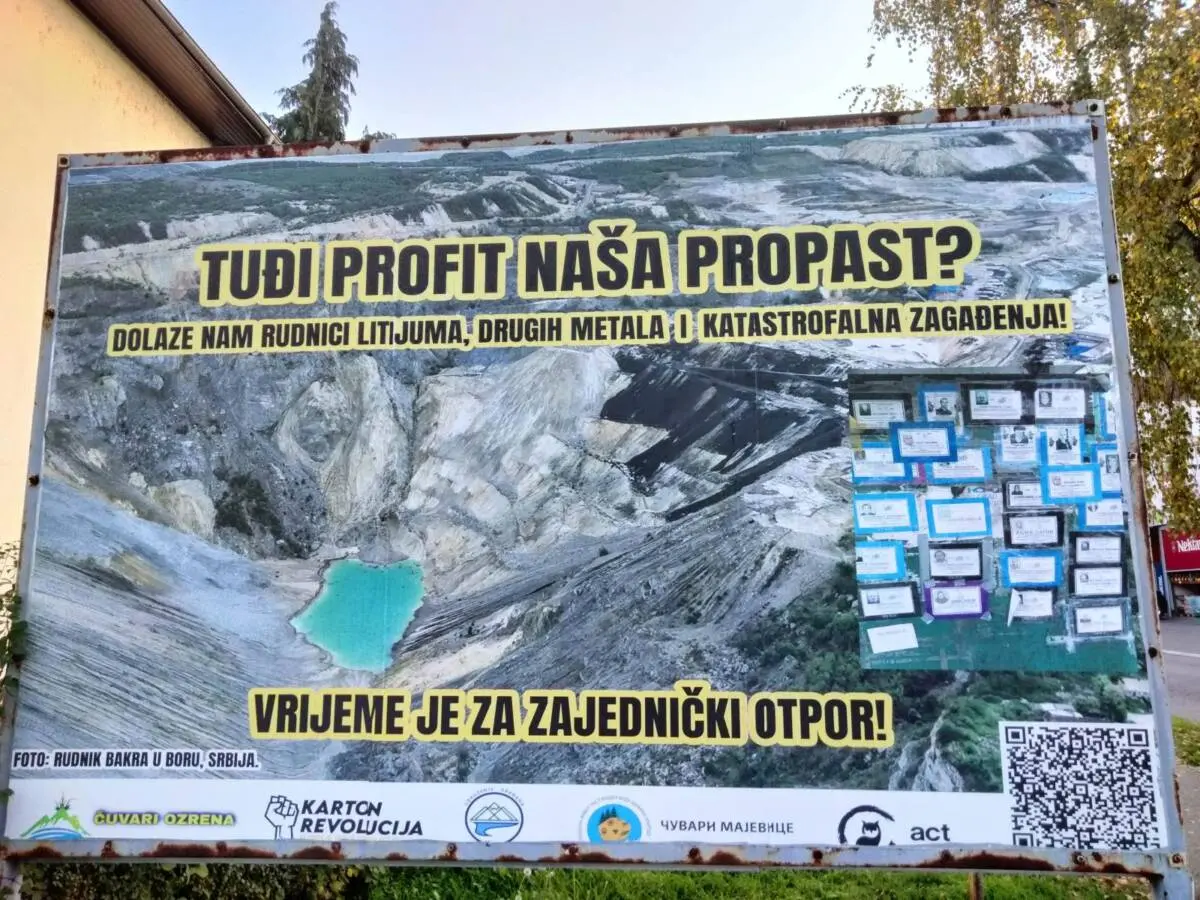
Anti-mining billboard in Lopare, Majevica – “Other people’s profit, our downfall?”. foto P. Lippman
Anti-mining billboard in Lopare, Majevica - "Other people's profit, our downfall?". foto P. Lippman
In a quiet and relatively poor corner of northeastern Bosnia and Herzegovina, there lies a low mountain range called Majevica. It is an area of gentle hills, where people grow strawberries, produce cheese, tend honeybees and distill a hard brandy called rakija. Majevica straddles the boundary between the two administrative territories, or entities, that compose postwar Bosnia and Herzegovina: the Serb-controlled Republika Srpska (RS) and the Croat/Bosniak-controlled Federation.
These pleasant hills are but a stone’s throw from Tuzla, in the southwest, and Ugljevik, in the northeast. From Majevica’s heights, on a clear day you can also see the more distant towns of Bijeljina and Brčko, as well as the Sava River, which forms the border between Bosnia and Herzegovina and Croatia. The Majevica region has been a popular recreation area all year ‘round, open to visitors from all directions. In spite of the 1990s war, which resulted in a partition of the country right through Majevica, people from both entities still hold the mountain dear.
The importance of Majevica extends beyond healthy farm produce and fond memories. It is a source of clean water for the immediate area, and its streams feed larger rivers, the Drina and the Sava. Given its geographical setting, what happens to the environment of Majevica affects all of the regions surrounding it: Semberija, Posavina, the Tuzla lowlands and all the cities therein, as far southeast as Zvornik.
In September 2023, the people of Majevica and its surroundings learned by chance that an international mining company was getting ready to prospect for lithium. In response, they raised an alarm throughout their communities and initiated an anti-mining campaign reaching to Bijeljina, Tuzla, Ugljevik and Zvornik. In Lopare, the main town of Majevica, Andrijana Pekić and her neighbors founded an informal organization to educate their community about the dangers of lithium mining. The Majevica-based group collaborated with the long-established environmental organization Eko Put, based in Bijeljina. The dynamic Tuzla-based Karton Revolucija provided information and moral support to the movement as well.
The activists understood that lithium mining on the mountain would be deadly. Tailings from the extraction process, containing sulfuric acid and other dangerous chemicals, cause contamination when runoff pollutes the streams, the underground water and the soil. The dust resulting from crushed rock further contaminates the air for miles around. These factors combine to damage people’s health, devastate agriculture, destroy animal habitats and create a wasteland.
The anti-mining campaigners began by calling well-attended public forums in Lopare, and they conducted two petition drives, in 2024 and 2025. The petitions called for the prohibition of lithium mining on Majevica and for the establishment of a nature reserve (Park prirode) on most or all of the mountain. Both petitions were dismissed by the Republika Srpska parliament.
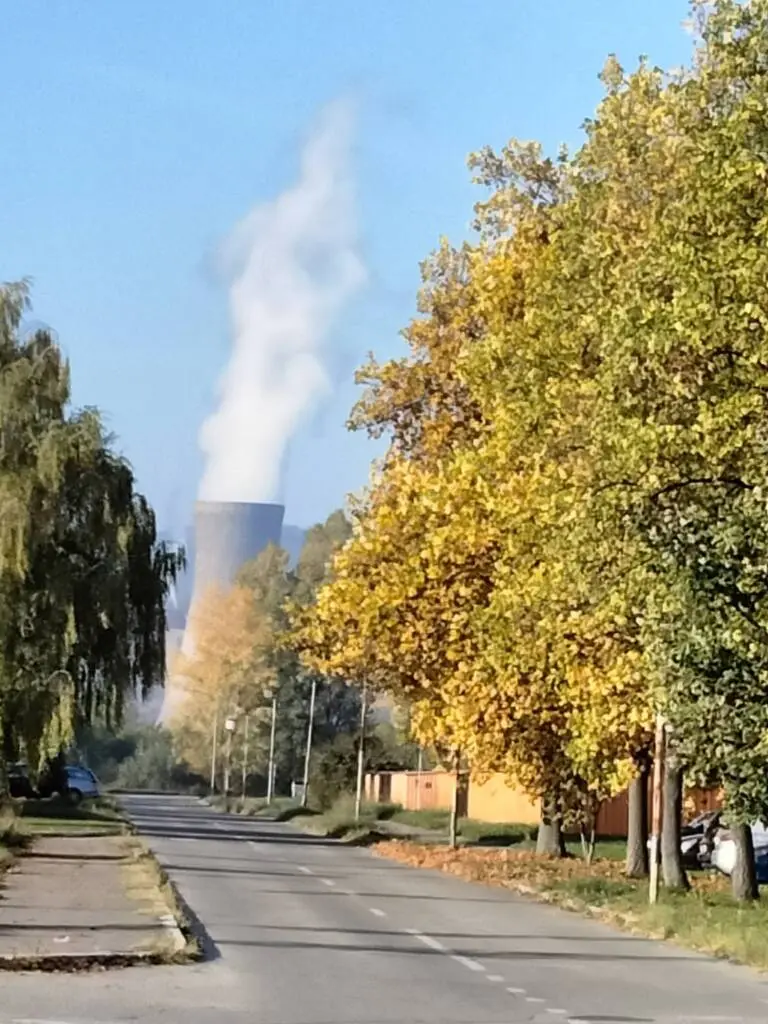
Coal-burning power plant, Ugljevik, BiH . Foto P. Lippman
At first, as is so often the case throughout Bosnia and Herzegovina, local authorities displayed disdain for the anti-mining movement that was brewing. However, gradually Mayor of Lopare, Rado Savić, and Mayor of Bijeljina, Ljubiša Petrović, came around to firm support of the campaign.
Andrijana Pekić and other activists have told me that there is “no such thing as clean lithium mining”, in spite of the promises of Arcore, the Swiss prospecting company that has begun exploratory drilling on Majevica. Arcore is one of many mining companies descending upon Bosnia and Herzegovina with the assurance that it planned to use only the “most modern”, the “greenest” and the “safest” mining techniques.
There are, in fact, significant lithium deposits within the European Union, where environmental laws are stricter. In both Portugal and Spain, for example, petition campaigns and demonstrations mobilizing thousands of people have managed at least to slow down the process of lithium mining. That such projects have been slow to get underway in the EU is not due to the fact that its farmers and activists know more than people in Bosnia and Herzegovina, but because rule of law is stronger than in this country ridden with corruption from top to bottom.
Over the last few years, Arcore has conducted drill tests on private land – in some cases, surreptitiously – already creating damage to land belonging to unsuspecting landowners. One well-known case involves the land of Jovan Krsmanović in the village of Vukosavci, not far from Lopare. Soon after the company undertook exploratory drilling, both Krsmanović’s well and that of his neighbor dried up. This is just one harbinger of the much vaster damage that inhabitants of the entire region fear if Arcore is allowed to go through with its planned excavation.
Majevica is just one of many examples of localities throughout Bosnia and Herzegovina that are under threat from international mining companies coveting critical raw materials for the “green transition” which is seen, in the European Union, as an environmentally safe solution to the problem of greenhouse gases and climate change. The critical minerals are essential ingredients of our car and telephone batteries, as well as for wind turbines and other technology that operates without fossil fuels.
However, communities under threat in Bosnia and Herzegovina have a different perspective on the green strategy. Bijeljina activist Snežana Jagodić-Vujić and leader of Eko Put tells me: “Our entire country is being attacked. The ‘green transition’ is clean there, but dirty here”.
You may also like:
Bosnia and Herzegovina: environmental resistance continues
BiH: Environmental movements beyond division
Bosnia and Herzegovina: The international corporate invasion is everywhere
Mining concessions that violate state property law
Lithium, magnesium, copper, nickel, cobalt and other minerals that are found on the European Union’s critical raw materials list of 2024 have been discovered in Bosnia and Herzegovina. Numerous prospecting operations are underway, with international mining companies awarded concessions in less-than-transparent circumstances. Much of the exploration and mining is taking place on property that belongs to the state. This violates a long-standing law that prohibits the sale or “change of usage” of state property, for example, from forestry to construction or mining, until an all-encompassing ownership dispute can be resolved at the state level.
This dispute, and the resulting moratorium on the sale of state-owned military property, airports, forests and agricultural land, stems from the unresolved process of succession after the breakup of Yugoslavia in the 1990s. While the resulting economic transition and the privatization of state property took place more smoothly in neighboring former Yugoslav republics, the clumsy and dysfunctional Constitution contained in the Dayton agreement set up permanent contention between the two entities.
The Republika Srpska, with its leaders’ secessionist tendencies, aspires to full ownership of all public land, leading to possible sale and privatization. Leaders of the Federation, on the other hand, advocate continued control of these properties at the state level.
In fact, both entities violate the restriction when it benefits favored investors. At the same time, construction of an important roadway can be stalled because it may cross 200 meters of state land.
In order to prevent wanton privatization of state properties without regulation, in 2005 the High Representative (an international “governor” established by the Dayton agreement) decreed a temporary ban on the sale or privatization of state land. This decree was expanded in subsequent years. However, the restriction has been violated brazenly in the Republika Srpska and, at times, somewhat less openly in the Federation. The temptation to exploit lucrative public lands is just too strong to withstand.
In the Federation, in 2018 a concession for the use of land near the central Bosnian town of Vareš was granted to the company Eastern Mining, which established a mine for silver, zinc, lead and barite. Adriatic Metals later acquired the concession and expanded it. A significant portion of the land controlled by Adriatic Metals lay on state-owned property, and this has proved to be a very controversial point due to numerous cases of flagrant abuse of the land. Adriatic Metals was guilty of clear-cutting forest land. Even more damaging, mining activities at Rupice mine have polluted the drinking water for the downstream town of Kakanj.
Bosnian officials appear to be dazzled by the possibilities for profit stemming from cooperation with international mining companies. While little or no benefit has reached the pockets of ordinary people like Jovan Krsmanović, municipal, canton and entity leaders continue to grant concessions to industrialists in violation of the restriction on use of public property. In 2024 Federation Prime Minister Nermin Nikšić disparaged environmentalists’ wish to protect the land around Vareš, saying: “Some apparently think that it is better for scrubland that they call ‘state property’ to lie useless, rather than for it to become a valuable investment”.
In his support of Adriatic Metals’ exploitation of state land, Nikšić asserted that High Representative Christian Schmidt approved the usage. Excavation at Rupice mine was allowed to move forward despite a July 2024 ruling by the Constitutional Court of Bosnia and Herzegovina that found the Federation’s granting of state-owned land use unconstitutional.
Resistance continues against the expansion of mining in Vareš municipality, as international companies continue to set up prospecting operations in other parts of Bosnia and Herzegovina.
Found an error in this article? Please contact our editorial team at redazione@balcanicaucaso.org.
Featured articles
 History and politics
 Human rights