Going Hunting and Fishing in Yugoslavia
Socialist Yugoslavia was for decades a favored destination for Italian hunters and anglers. A territory they came to know well and where they formed many bonds. A study explores the origins of this phenomenon, beginning with the border region
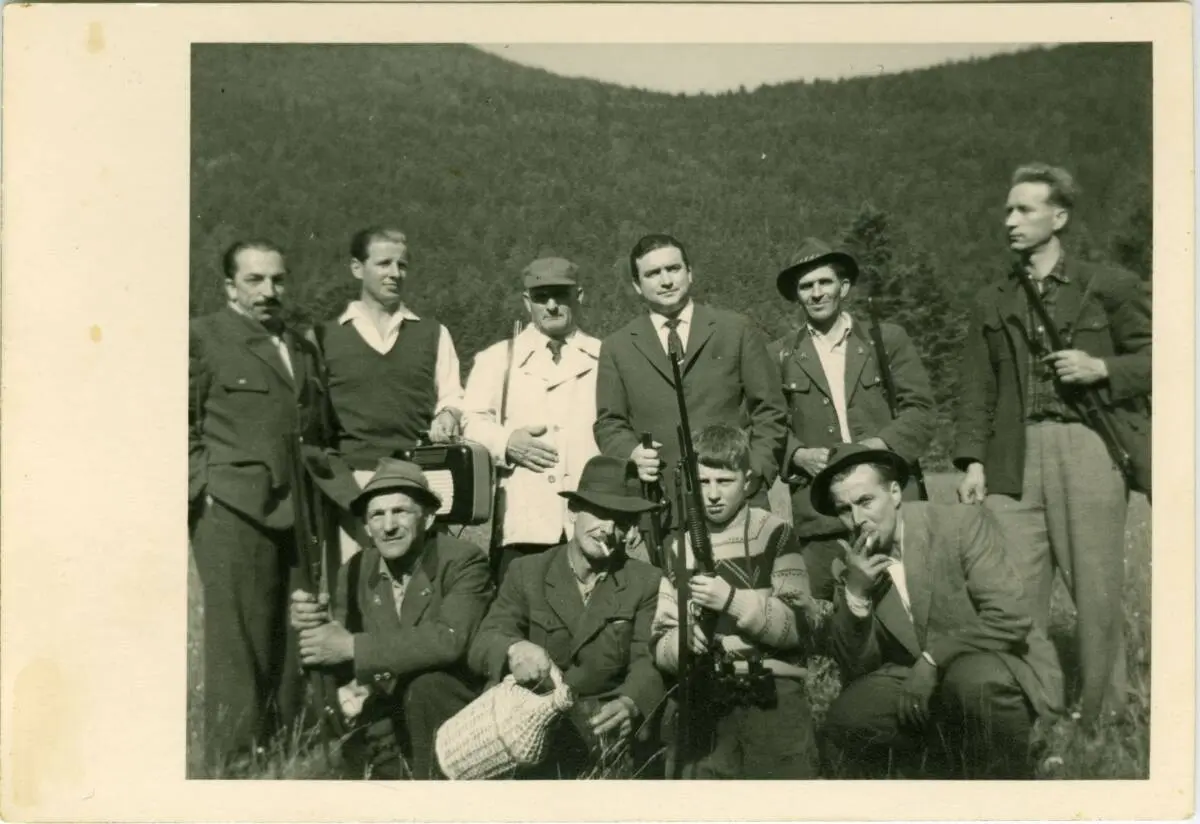
Hunting with Italian guests near Cerknica in 1959. © Silvana Orel Kos http://stareslike.cerknica.org/
Hunting with Italian guests near Cerknica in 1959. © Silvana Orel Kos http://stareslike.cerknica.org/
From the early 1960s onwards, when Yugoslavia legalized a broad spectrum of cross-border practices, travelling and working abroad became significantly easier for its citizens. Historical documents, however, demonstrate that “Westerners” entering Yugoslavia were an even earlier phenomenon, as tourists from Western countries were already registered in Yugoslav tourist resorts in the early 1950s.
This text bypasses conventional tourist destinations and instead focuses on Cold War hunting and fishing tourism. It examines the territory of the Alps-Adriatic region, today encompassing Slovenia (the northernmost part of the former Yugoslavia), Italy, and Austria. While the border between Yugoslavia and Austria had remained unchanged since 1920, the boundary between Yugoslavia and Italy was redrawn in 1947 and 1954. The Yugoslav state border with Italy and Austria marked not only the limits of sovereign states but also a demarcation line between the post-war East and West, between the socialist and capitalist worlds.
The turbulent chronology of the twentieth century Alps-Adriatic region – shaped by two devastating world wars, multiple regime changes, and extensive demographic transformations – influenced sociopolitical images in which conflicting international relations predominated. They were additionally petrified with the post-war concept of the Iron Curtain, an expression popularized by Winston Churchill in 1946, referring to the rigid East–West division stretching from Szczecin/Stettin on the Baltic Sea to Trieste/Trst on the Adriatic. Dominant Cold War narratives, marked by strong nationalisms and ideological confrontations, shaped both public opinion and historical memory, while simultaneously obscuring vibrant practices of cross-border cooperation. When examined within a broader spatio-temporal framework and through less politicized perspectives, however, a far more flexible and interconnected historical image of the borderlands emerges. A clear example of such cross-border cooperation can be observed in the history of international hunting and fishing tourism in the Alps-Adriatic.
In the modern era, hunting and fishing in Europe were largely privileges of the upper social classes. At the turn of the twentieth century, both activities witnessed the growth of leisure clubs that gathered members of political, economic, religious, and intellectual elites. The right to hunt or fish was associated with prestige, and networks among hunters and fishers resembled transnational aristocratic circles that often crossed borders of the European states. Hunting and fishing often provided opportunities for informal discussions within various spheres of decision-making, serving as settings in which political and economic agreements were initiated or developed.
In socialist Yugoslavia, part of the hunting and fishing community consisted of members of the intellectual elite, although the right to hunt and fish was formally extended to any citizen who passed the hunting exams and obtained a firearms licence. As Josip Broz Tito himself was an enthusiastic hunter and fisherman, his personal interest was translated into strong political support. Consequently, hunting and fishing were organized under state supervision with long-term planning and wide-ranging strategic goals. Hunting and fishing were no longer perceived solely as leisure activities but developed into economically and politically significant sectors. State protocol archives demonstrate hunting and fishing events were frequently organized for important foreign guests from political and economic circles.
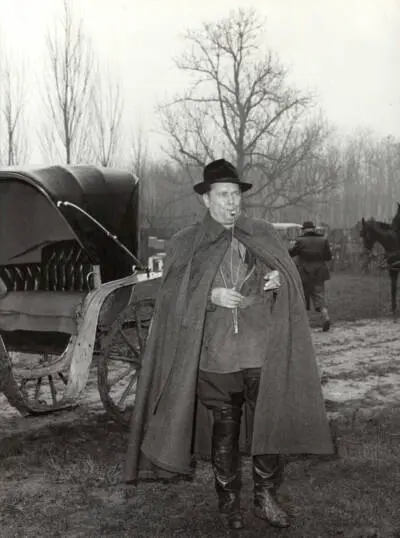
Hunting for members of the diplomatic corps in Karađorđevo, December 11, 1960. (Photo archive of Josip Broz Tito, Museum of Yugoslavia)
The Third Federal Hunting Act of 1955, unlike those of 1946 and 1949, also allowed non-Yugoslav citizens to hunt. This legislative change coincided with the warming of relations between Yugoslavia and its capitalist neighbours, Austria and Italy, following Tito’s split with Stalin in 1948 and Yugoslavia’s political reorientation away from the Eastern Bloc toward the South and West. The first bilateral agreements with Italy (1949 and 1955) and Austria (1954) enabled various forms of cross-border mobility, particularly benefiting populations living in border regions.
Most hunting and fishing guests came from Italy and Austria, followed by visitors from Germany, and France. Archival documentation related to fishing indicates vibrant cross-border activity already in 1955, when fishermen from the Italian border regions of Udine, Gorizia, and Trieste began fishing in the Soča River and other rivers within Yugoslavia. Archival sources concerning hunting reveal a similar practice emerging somewhat later, in the mid-1960s, which is understandable given the greater organizational complexity of hunting. In 1963 the first edition of Hunt in Yugoslavia appeared in Serbo-Croatian, Italian, German and French. The book was written and edited by one of the most prominent political journalists from Belgrade, Bogdan Pešić, further contextualizing the socio-political meaning of hunting in post-war Yugoslavia.
Personal narratives provide additional insight into these developments, revealing that social networks in both fields were primarily formed through friendships, kinship ties, and minority communities, extending across the borderland. Many hunters from the border regions began visiting Yugoslavia. While the Yugoslav hunting and fishing regime immediately after the war was oriented toward long-term planning, no comparable systematic measures had yet been implemented in Italy by the mid 1960s. After the widespread destruction of the Second World War, the lack of coordinated reflection at the interface between forestry, agriculture, hunting and fishing had an impact on the drastic reduction of wildlife species in Italy. Early Italian hunting guests disseminated information on good hunting opportunities in Yugoslavia and encouraged others to follow.
However, a closer examination of the interwar period characterized by a different political map provides new perspectives of post-war cross-border hunting practices. Such a temporal extension suggests that some social networks surrounding hunting and fishing of Italians in post-war Yugoslavia were rooted in pre-war personal connections. Many post-war Italian hunting tourists had previously been Italian state employees (police officers, soldiers, notaries, teachers etc.) or entrepreneurs, who had settled in the border region during the interwar period, when it formed part of Italy. While dwelling in the region, they had become acquainted with (and even befriended) the (mainly Slovenian) locals, including hunters. After the war, when the region became part of Yugoslavia, they had to leave. The political thaw between Italy and Yugoslavia a decade later also managed to revive some personal relationships formed in the interwar, although dominant narratives portraying relations between individuals of different nationalities were usually described as antagonistic.
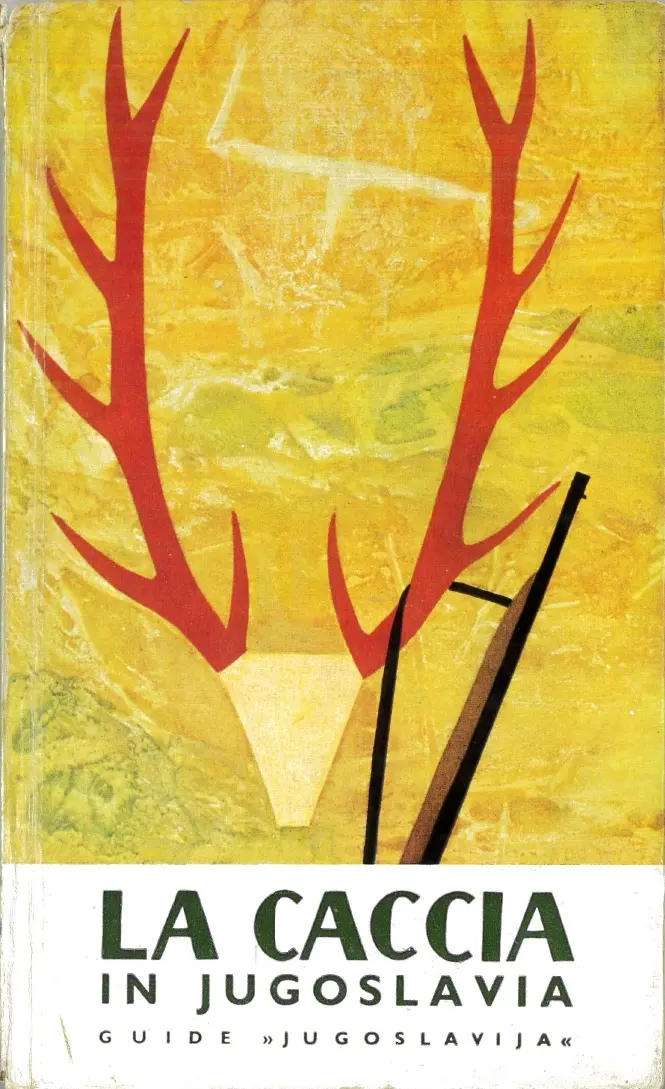
Bogdan Pešić, “La Caccia in Jugoslavia” , Belgrado, Izdavački Zavod “Jugoslavija”, 1963
To understand how international hunting and fishing networks were shaped, we can go even deeper into the past. Since the late nineteenth century, the Slovenian countryside experienced high levels of emigration of men and women to urban areas of Italy, Austria, Germany, France and overseas. Many hunters from Italy and Austria who decided to hunt in Yugoslavia in the post-war period were, in fact, distant relatives of these labour migrants. This continuity suggests that cross-border hunting mobility during the Cold War cannot be understood solely as a product of contemporary political détente but must also be situated within longer-term migratory and familial connections.
Moreover, migration patterns in the border region, marked by pronounced demographic fluctuations during the political and economic crises of the twentieth century [in general → ], thus functioned not only as processes of separation but also as integrative forces. Personal ties between emigrants and those who remained frequently endured across generations, sustaining informal transnational networks that later facilitated cross-border encounters. These family-based connections also became visible in the sphere of hunting and fishing tourism, where leisure practices operated as socially acceptable frameworks for maintaining kinship ties, cultural belonging, international friendships and cross-border communication despite the ideological divisions of the Cold War.
A considerable proportion of Italian and Austrian citizens who hunted or fished in Yugoslavia were members of the Slovenian minority in these states. Hunting and fishing provided opportunities to reconnect with their country of origin, establish new friendships in Slovenia, and communicate in the Slovenian language. Slovenian minority hunters have served as important links among hunters across the Alps–Adriatic region. They may also be understood as agents fostering cooperation between national hunting organizations in Italy, Austria, and Slovenia, a process that had already begun in the 1950s and continues to the present day. Namely, the Working Community of Hunting Associations of the South-Eastern Alpine Region (Arbeitsgemeinschaft der Jagdverbände des Südostalpenraumes), formed in 1952, united hunters from southern Austria and Slovenia. Italian hunters joined the Community in 1956, after the acute political crisis surrounding the Trieste question had been resolved. This historical development demonstrates that hunters were among the first actors to conceptualize the Alps–Adriatic region as a coherent and interdependent natural, cultural and social space, thereby challenging the rigid bordering characteristic of the Cold War.
The growth of hunting and fishing tourism in Yugoslavia was also connected to the broader acceleration of human mobility after the Second World War. In the post-war era, tourism expanded rapidly worldwide. From the late 1950s onwards, Yugoslav spas, seaside resorts, and mountain lodges hosted increasing numbers of international visitors. In 1963, Yugoslavia participated in the United Nations Conference on International Travel and Tourism in Rome, marking the beginning of a relaxation of tourist visa policies. Although tourism infrastructure remained underdeveloped at the time, visitors were attracted by the country’s unspoiled natural environment. Tourism – including hunting and fishing tourism – was actively promoted by Yugoslav authorities as a means of securing foreign currency income and presenting Yugoslavia as an open and hospitable socialist state.
Found an error in this article? Please contact our editorial team at redazione@balcanicaucaso.org.
Tag: Yugoslavia