Training MOST
Training MOST in Kraków
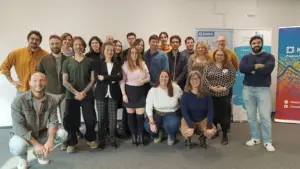
Training MOST in Kraków
The first training on Media Viability was held in Kraków from 26 to 28 February 2025, organised by New Eastern Europe and The Fix Media, in partnership with the City of Kraków. Twenty-nine members of the consortium organisations took part, along with 11 other media professionals linked to the CIJI project. Over three days of work, the group addressed topics such as sustainable business models, revenue diversification and new technologies for newsrooms, with hands-on exercises on growth plans, audience engagement strategies and artificial intelligence tools. Participant feedback was very positive thanks to its highly practical approach, and the event enabled MOST project members to launch mentoring pathways for the development of personalised financial sustainability strategies.
Training MOST in Berlin
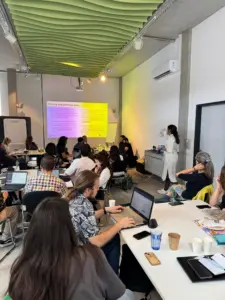
Training MOST in Berlin
On 7–8 July, a two-day training on digital automation technologies (DAT) in journalism was held in Berlin, organised by partners Tactical Tech and BIRN, with 36 participants from various European countries. Designed on the basis of a preliminary survey aimed at gathering participants’ needs and wishes, the programme alternated technical content (predictive models, LLMs, RAG, hands-on exercises with ChatGPT and Ollama, building a chatbot) with discussions centred on the relationship between professional ethics, new technologies and European regulatory frameworks such as the AI Act and GDPR. The training was led by two professionals from Maldita.es, a Spanish organisation, together with Camila Reed, mentor for the development of guidelines on the editorial use of DAT for MOST project partners.
MOST Guidelines on Digital Automation Technologies (DAT)
Following the training on Digital Automation Technologies (DAT) in non-profit journalism held in Berlin, MOST partners developed and updated their own DAT guidelines. OBCT published its guidelines here. Thanks to the mentoring support provided by Camila Reed, a specialist in DAT guidelines and one of the trainers of the Berlin training, the six journalistic organisations developed and implemented rules for integrating DAT into their journalistic workflows. By December 2025, all six organisations had completed their mentoring meetings, during which they discussed their DAT-related needs in greater detail, taking into account the ethical, technical, financial and other perspectives relevant to each outlet. The first drafts of the guidelines were finalised by the end of 2025, while in 2026 MOST newsrooms tested them in their editorial activities. The guidelines were published in their final version in June 2026. A special session dedicated to this MOST journey was held in September 2026 at the Breakwater Festival in Gdańsk, Poland.
MOST Guidelines on Cultural Biases in International Journalism
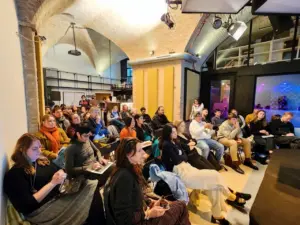
Training Most at the International Journalism Festival in Perugia
These guidelines are the fruit of the MOST consortium’s initiative to establish an editorial tool for addressing cultural biases in international journalism. The primary objective of these guidelines is to improve the quality, inclusiveness and credibility of international reporting. By equipping journalists, editors and newsrooms with internal mechanisms to identify and mitigate cultural biases, the project aims to promote a more ethical and representative news production. The development of these guidelines was based on a collaborative and participatory methodology. The document draws on extensive dialogue among journalists affiliated with the MOST project who, while coming from diverse geographical and professional backgrounds, shared a commitment to integrity and excellence in international affairs. This dialogue was subsequently opened up to other members of the journalistic community at multiple public events, such as the International Journalism Festival in Perugia, in order to increase the openness and inclusiveness of the final results.

These activities are part of MOST – Media Organisations for Stronger Transnational Journalism, a Journalism Partnership co-funded by the European Union and focussed on independent media specializing in international reporting. Views and opinions expressed are however those of the author(s) only and do not necessarily reflect those of the European Union or the European Education and Culture Executive Agency (EACEA). Neither the European Union nor EACEA can be held responsible for them.