
A dangerous spiral of violence against journalists in Serbia
Serbia MFRR report 2026
Serbia MFRR report 2026
Record levels of physical violence against journalists, death threats and online smear campaigns, entrenched impunity, and tight political control over the media landscape: a report outlines the deteriorating situation for media freedom and safety of journalists in Serbia.
Source: Media Freedom Rapid Response
Record levels of physical violence against journalists, death threats and online smear campaigns, entrenched impunity, and tight political control over the media landscape – media freedom in Serbia is in a deepening crisis with a rapidly closing window for independent journalism to operate.
OBCT, the Media Freedom Rapid Response (MFRR) partners and the Council of Europe’s Safety of Journalists Platform present a report which outlines the deteriorating situation for media freedom and safety of journalists in Serbia. The report is a result of an international mission to Belgrade that took place in March 2026, during which the delegation met with journalists, editors, media associations, civil society organisations, law enforcement, the Parliamentary Speaker, and the Chief Prosecutor, among others.
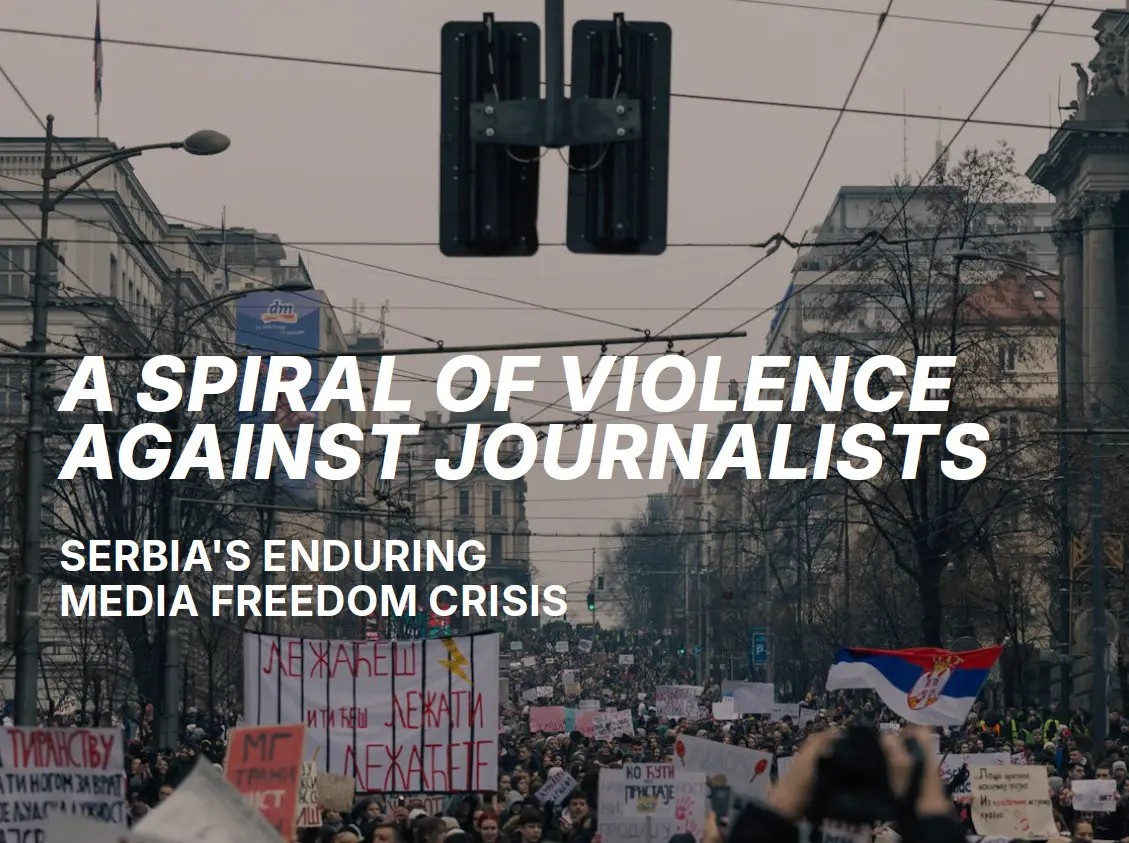
Since the deadly collapse of the Novi Sad railway station canopy in November 2024, which triggered the largest protests in Serbia’s history, attacks on journalists covering demonstrations have surged. Law enforcement has not only failed to protect journalists, but police officers have increasingly acted as perpetrators themselves.
In 2025, Serbia recorded 209 press freedom violations – more than double the 84 documented in 2024 – affecting 359 media workers and entities. As of 16 June, 100 cases affecting 170 media workers have been recorded since January 2026. At least 38 of these attacks were committed by the police.
In addition, media pluralism is under severe pressure. The majority state-owned Telekom Srbija has expanded its media holdings, consolidating pro-government narratives across the media landscape. Serbia’s media regulator, the REM Council, has been non-functional for over 18 months, making Serbia the only EU candidate country without a functioning media regulatory body. Coordinated bot attacks and spyware, including NSO Group’s Pegasus, have emerged as tools of digital censorship against journalists and media outlets.
The government has launched several legislative initiatives, including efforts to incorporate provisions of the European Media Freedom Act (EMFA) into domestic law. However, journalists and civil society actors have largely stopped engaging with these processes, citing a lack of transparency, rushed timelines, and most prominently a profound absence of trust in the government’s intentions.
The international community has a critical role to play to safeguard swiftly deteriorating press freedoms in Serbia and stem the wider democratic decline. The full report includes detailed recommendations to Serbian authorities, including the government, parliament, police, and prosecution, on the concrete steps needed to counter this crisis. The partners further call on the European Union to publicly and unequivocally condemn attacks on journalists in Serbia, and to make direct funding to Serbia in strategic areas conditional on measurable improvements in journalist safety and media freedom standards.