Croatia: the Karlovac Library, a flagship sustainability project
The Ivan Goran Kovačić Public Library in Karlovac will soon be adding another eco-sustainable feature: a biosolar roof. This is the first project of its kind adopted by a public institution in Croatia, combining an existing green roof with a new photovoltaic system
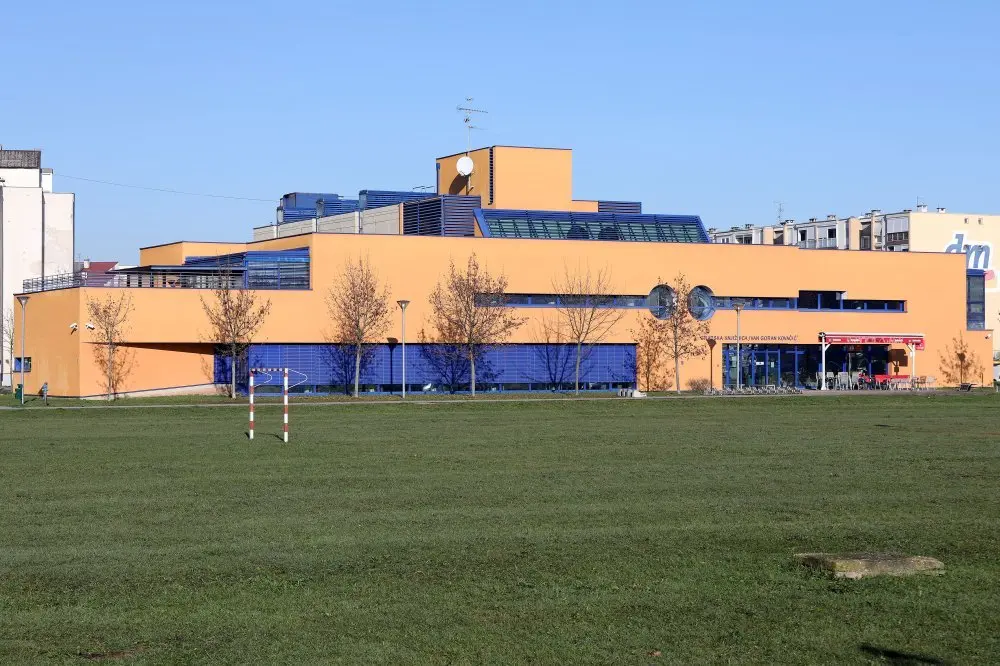
The Ivan Goran Kovačić City Library in Karlovac, Croatia – Source Karlovac City Library/Dinko Neskusil
The Ivan Goran Kovačić City Library in Karlovac, Croatia - Source Karlovac City Library/Dinko Neskusil
(Originally published by our project partner EuSEE Tportal)
The plants on the roof of the Karlovac Library, which received the prestigious IFLA Green Library Award in 2025, have been growing since 2007, the year the building was renovated and expanded. Now, the green roof will be complemented by solar panels, which should help generate energy, increase energy resilience, reduce the heat island effect, and preserve biodiversity.
The project is implemented under the European initiative INFIRE (Innovative financing solutions for climate planning of resilient and carbon-neutral living areas), co-financed by the transnational program INTERREG Euro-MED 2021-2027.
The Municipality of Karlovac, one of ten Mediterranean partners involved in the project, has chosen the library as a pilot site to test an innovative solution to make the city, located on four rivers, a model for the application of advanced and sustainable technologies in public infrastructure.
“The municipality recognized the potential of the library’s green roof and its growing electricity needs, so we joined this project in collaboration with the Regional Energy Agency of Northwest Croatia (REGEA). The library was proposed as a pilot site for one of eight innovative solutions aimed at testing the biosolar roof as an optimal model for financing climate and energy investments,” explains Robert Vodopić, acting director of the Office for Economy, Urban Development and EU Funds of the Municipality of Karlovac.
The overall value of the INFIRE project is almost €2.77 million, 80% of which is co-financed by the EU, with the Municipality of Karlovac contributing €165,800. The goal of the project, which will end in June 2026, is to transform the Municipal Library into the first public institution in the country with such an innovative system.
What is a biosolar roof?
“A biosolar roof is a combination of two technologies: a green roof and a photovoltaic system,” explains Kristina Čunović, director of the Library. “This means that beneath the solar panels is a layer of vegetation — usually low, hardy plants — which, together with the panels, creates a functional, energy-efficient, and environmentally sustainable system.”
Unlike a traditional roof with solar panels, a biosolar roof leverages synergy: the plants cool the roof surface and the surrounding courtyard, contributing to the efficiency of the solar panels, which, in turn, protect the vegetation from extreme weather conditions.
As Kristina Čunović emphasizes, the advantages of this system are numerous: energy savings, a more comfortable microclimate, long-term protection of the building, and a positive impact on the environment.
“The building becomes more resistant to heat waves and heavy rainfall, and users benefit from more comfortable conditions for working and enjoying their time in the library. Beyond its practical effects, the roof also has strong symbolic and educational value, making the library a modern and sustainable public institution.”
The project involves temperature testing on sections of the roof with biosolar coverage, sections with a traditional solar system, and sections without solar panels, to precisely determine the system’s benefits in terms of energy production and reducing building heating.
The library’s green roof, installed in 2007, formed the basis for a modernization with a biosolar solution.
“Over the years, the green roof has proven to be a reliable and functional solution, especially in terms of thermal insulation of the building and regulation of the microclimate,” emphasizes the library director. “In summer, it significantly reduces heating of the upper floors, while in winter it contributes to heat retention, ensuring more comfortable working and living conditions for users.”
The main benefits of a green roof, as Čudović emphasizes, include rainwater retention, which reduces the burden on the drainage system, and the contribution to biodiversity in the urban space. Employees and users often also highlight an “intangible” value: the feeling of being in a well-maintained, pleasant, and environmentally friendly space.
Of course, there are some challenges. A green roof requires regular maintenance, especially in the years immediately following installation, until the vegetation becomes lush.
“Furthermore, it is necessary to ensure good waterproofing and the structure’s load-bearing capacity right from the design stage. We adequately addressed these aspects beforehand, so no critical issues has arisen over the years”, the director explains.
Energy savings
The project for the library’s biosolar roof is, as our interlocutors explain, in the “preparation for tender and construction” phase.
“The project has been developed and is currently undergoing special checks to initiate the tender and construction process, which is being carried out by the Municipality of Karlovac as a project partner,” they emphasize.
The project involves rehabilitating part of the roof using counterbeams in the flat roof areas to physically separate the new biosolar roof from the existing green roof. This section of the roof will be further rehabilitated and renovated by installing mineral wool/XPS thermal insulation of the required thickness and finishing it with a TPO membrane, in addition to installing new green roof layers on the section of the future biosolar roof.
First of all, to conduct tests and obtain reference results, a small solar system should be installed, up to 15 kW. The biosolar roof is scheduled for installation by the end of April this year. It is estimated that this system could cover up to 20% of the library’s annual electricity consumption.
“It is realistic to expect that a biosolar roof could cover a significant portion of the library’s annual electricity consumption, up to 20%,” the project managers point out. “Furthermore, the green roof further reduces the need for cooling in summer and heating in winter. Therefore, the overall energy savings come not only from the electricity produced, but also from the reduced energy consumption needed to maintain a comfortable internal temperature.”
“Ultimately,” the managers conclude, “a biosolar roof not only results in financial savings through lower energy bills, but also in greater energy independence, more stable working conditions for employees, and a more pleasant experience for library users.”
Challenges
As Čunović and Vodopić emphasize, the most challenging aspect of the project was harmonizing different systems and interests: from the technical solutions for the biosolar roof to the building’s static and safety requirements, not to mention the administrative and legislative regulations that are not yet fully adequate for such complex solutions.
“Although the project preparation process itself was very challenging, the results obtained will be very useful for the planning and preparation of similar projects in the future, once official confirmation of all the benefits offered by the biosolar roof has been received. Since this is a public building with a large number of users, coordination among numerous partners is necessary,” the project leaders explain.
“It is also crucial to find a balance between objectives and actual possibilities. For this very reason, the pilot project is of great importance not only for the Karlovac Library, but also as a model that can inspire other cities and public institutions considering similar sustainable solutions.”
Projects like this help raise the profile of the city of Karlovac in Europe, testing innovative solutions, and reducing pressure on the municipal budget.
“We believe that projects implemented under European Territorial Cooperation programs, such as INTERREG and Horizon, are necessary and essential to contribute, on the one hand, to greater visibility for the city of Karlovac at the European level and, on the other, to reducing pressure on the municipal budget and testing innovative solutions and examples of good practices already successfully implemented elsewhere. We wish to participate as fully as possible in the future (subject to the financial and human resources available to the municipality) in the preparation and implementation of various European projects,” our interlocutors conclude.
Found an error in this article? Please contact our editorial team at redazione@balcanicaucaso.org.
This article was produced as part of the EuSEE project, co-funded by the European Union. However, the views and opinions expressed are solely those of the author(s) and do not necessarily reflect those of the granting authority, and the European Union cannot be held responsible for them.
Tag: EuSEE