Valery Poshtarov: if a photo is holding hands
A father, a son, and a gesture as simple as it is profound and revealing: holding hands. With his latest project, Bulgarian photographer Valery Poshtarov explores complex themes such as fatherhood, identity, and masculinity with a delicate yet penetrating touch. Our interview

1 (1)
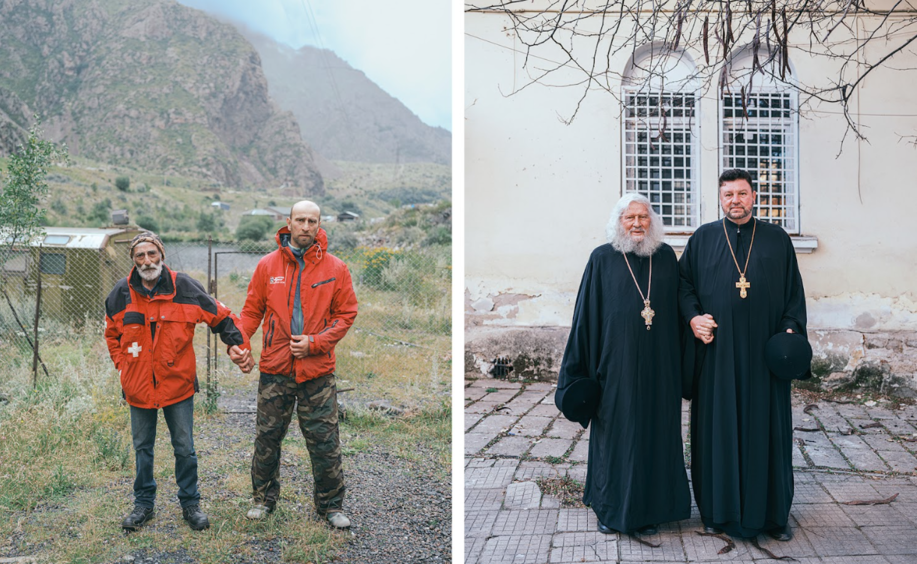
Father and Son © Valery Poshtarov
How did your “Father and Son” project come about?
As a father of two growing boys, I became acutely aware of how quickly the day would come when they would no longer need me to hold their hands. That simple, everyday gesture suddenly felt fragile and finite. At the beginning I simply set out to photograph my 95-year-old grandfather and my father holding hands. What began as a very intimate family portrait slowly expanded into a wider research process. I started inviting other fathers and their adult sons to stand side by side and hold hands in front of the camera.
What is the central idea behind this photographic research of yours?
The project opened up not only the theme of fatherhood and human connection, but also the singularity of identity shaped by family, religion, customs and gender norms. In these interactions, we see individual identities emerging within shared familial narratives, illustrating how deeply personal and culturally influenced by tradition our life paths are. In the end, the project is not only about the photographs, but about what happens before and during the exposure – the hesitation, the resistance, the sudden emotion when, in a world that is already growing apart, fathers and sons hold hands for the first time in years, sometimes decades. The images are just a trace of that encounter.
With your project, you touch on an intimate and almost taboo topic in many societies: physical contact between fathers and sons. What reactions and emotions did you observe in the eyes of the fathers and sons involved?
For some cultures and participants, holding hands is completely natural, and people from all around the world write to me asking if I can take a portrait with their fathers. For others, however, it feels off-limits and becomes a challenge beyond their comfort zone, especially where masculinity is linked to the suppression of emotions and physical distance between men. In that sense, the portraits are full of small visible hesitations and tensions, but also moments of obvious tenderness: the images evoke long-repressed emotions while confronting deeply rooted social expectations with one simple gesture.
Did you encounter resistance? More from the fathers or the sons?
I can’t really say whether resistance comes more from fathers or from sons, because each relationship is different and I try to avoid such generalisations. What I do notice, especially when working in different countries, is that the resistance is often linked less to the individual father–son bond and more to the cultural gap between generations. In societies that have undergone dramatic social and political changes in recent decades, the differences between generations can be frighteningly large. In that context, coming together is not just a matter of family affection, but also a difficult and courageous way to bridge those gaps and overcome our differences.
© Valery Poshtarov
“Father and Son” is being developed in many different countries, from the Balkans to Italy, from Georgia to Turkey, and of course, Bulgaria. Have you noticed any substantial cultural differences in the reactions to your project?
For me, taking “Father and Son” to new countries is a journey in itself – a kind of cultural and anthropological expedition – whose true outcome is contained in the portraits. This is why I pay so much attention to the background: I always place people in their personal or working space and invite the public to explore all these small details and discover the cultural differences on their own. After all, the viewer is never a passive observer – they are invited to enter the scene, to compare, to recognise themselves, and to reflect on their own cultural landscape.
What does “Father and Son” tell us about the societies in which you took the portraits?
The theme of fatherhood is as universal as the sacred theme of motherhood – wherever there are people in the world, there are fathers. What inspires me most is the feeling that we all come from somewhere in this constantly evolving world, as if we are building a cathedral that takes several generations to complete. None of us starts or finishes it alone: we inherit something from our ancestors and carry it forward to future generations. For me, the project is a reminder that we can look at each society from this larger, intergenerational perspective, not only through its present conflicts and tensions.
How do you search for and identify fathers and sons willing to hold hands?
I usually find fathers and sons in two main ways. I come across some pairs through chance encounters – meeting them in everyday situations – and others through social media, where people contact me because they’ve seen the project and want to take part.
These two approaches create very different dynamics. In the first case, I often catch people a bit off-guard and invite them to hold hands, placing them in a spontaneous, sometimes vulnerable situation that can bring out very raw emotions and even provoke strong reactions. In the second case, when they reach out or agree in advance, they have more time to reflect on their relationship, so the encounter often goes beyond the simple act of being photographed. That’s what allows a deeper connection to emerge before we ever press the shutter.
Behind each of your portraits are hidden human stories. Is there one you’d like to share with OBCT readers?
I believe the power of photography lies in a kind of quiet anonymity: each viewer can project their own family history into the images without being guided by one official narrative. So yes, behind each portrait there is a very concrete human story – sometimes beautiful, sometimes painful – but I feel my role is to protect those stories rather than publish them.
You’ve currently thrown yourself into a new project with great passion: the photo encyclopedia. Can you briefly tell us what it’s about?
It was actually very difficult for me to develop my own vision as a photographer, simply because I didn’t have real access to the great projects from the history of photography. Even today, in a world that looks “fully accessible” online, so much of the important work is still scattered: hidden in rare, out-of-print books, or locked in temporary exhibitions. You often see single images on social media, but not a sufficiently complete representation of the work in series, not its context, not the intent behind it.
PhotoAnthology was born out of this frustration. It is an online encyclopedia and knowledge base dedicated to the art and history of photography, whose mission is to unify this fragmented narrative. We document significant photographic projects and present them with rich contextual information, foregrounding the connections and lineages between bodies of work so that we can finally navigate photographic history as a living, interconnected map rather than as a collection of isolated images.
One of the features of the photo anthology is the ability to compare the work of one photographer to that of others, finding similarities and affinities. Which photographers do your shots compare to?
At this stage, my own work is not yet included in PhotoAnthology. As the person leading this new institution, I feel it’s important to keep a certain distance from my personal projects. Once the platform is more mature – our contributing curators from different countries and partner institutions fully shape its direction – my work may eventually find its place there as well. In a way, it’s the same ethic I follow in my photography: the people in front of the camera should come first, not me.
It seems to me that your work in general has an anthological, almost encyclopedic character, from the one on the Rhodopes to “Father and Son.” Do you identify with this definition?
I think that’s a very perceptive observation, and I have to admit that I am, in a way, collecting worlds. In this sense, PhotoAnthology is not so different from my long-term projects: beyond simply bringing images together, what matters most to me is bringing forward meaning.
Does your photographic research have a conscious purpose? To describe? To provoke? To narrate?
Photography, through the work of many different eyes, can assemble a far more diverse image of the world – one that reflects multiple perspectives without imposing any single vision as the truth. This attitude of inclusivity and acceptance allows us to keep looking forward and to embrace the world in all its complexity, as wide as our understanding can reach.
Tag: Photography
Featured articles
Valery Poshtarov: if a photo is holding hands
A father, a son, and a gesture as simple as it is profound and revealing: holding hands. With his latest project, Bulgarian photographer Valery Poshtarov explores complex themes such as fatherhood, identity, and masculinity with a delicate yet penetrating touch. Our interview

1 (1)
Father and Son © Valery Poshtarov
How did your “Father and Son” project come about?
As a father of two growing boys, I became acutely aware of how quickly the day would come when they would no longer need me to hold their hands. That simple, everyday gesture suddenly felt fragile and finite. At the beginning I simply set out to photograph my 95-year-old grandfather and my father holding hands. What began as a very intimate family portrait slowly expanded into a wider research process. I started inviting other fathers and their adult sons to stand side by side and hold hands in front of the camera.
What is the central idea behind this photographic research of yours?
The project opened up not only the theme of fatherhood and human connection, but also the singularity of identity shaped by family, religion, customs and gender norms. In these interactions, we see individual identities emerging within shared familial narratives, illustrating how deeply personal and culturally influenced by tradition our life paths are. In the end, the project is not only about the photographs, but about what happens before and during the exposure – the hesitation, the resistance, the sudden emotion when, in a world that is already growing apart, fathers and sons hold hands for the first time in years, sometimes decades. The images are just a trace of that encounter.
With your project, you touch on an intimate and almost taboo topic in many societies: physical contact between fathers and sons. What reactions and emotions did you observe in the eyes of the fathers and sons involved?
For some cultures and participants, holding hands is completely natural, and people from all around the world write to me asking if I can take a portrait with their fathers. For others, however, it feels off-limits and becomes a challenge beyond their comfort zone, especially where masculinity is linked to the suppression of emotions and physical distance between men. In that sense, the portraits are full of small visible hesitations and tensions, but also moments of obvious tenderness: the images evoke long-repressed emotions while confronting deeply rooted social expectations with one simple gesture.
Did you encounter resistance? More from the fathers or the sons?
I can’t really say whether resistance comes more from fathers or from sons, because each relationship is different and I try to avoid such generalisations. What I do notice, especially when working in different countries, is that the resistance is often linked less to the individual father–son bond and more to the cultural gap between generations. In societies that have undergone dramatic social and political changes in recent decades, the differences between generations can be frighteningly large. In that context, coming together is not just a matter of family affection, but also a difficult and courageous way to bridge those gaps and overcome our differences.

© Valery Poshtarov
“Father and Son” is being developed in many different countries, from the Balkans to Italy, from Georgia to Turkey, and of course, Bulgaria. Have you noticed any substantial cultural differences in the reactions to your project?
For me, taking “Father and Son” to new countries is a journey in itself – a kind of cultural and anthropological expedition – whose true outcome is contained in the portraits. This is why I pay so much attention to the background: I always place people in their personal or working space and invite the public to explore all these small details and discover the cultural differences on their own. After all, the viewer is never a passive observer – they are invited to enter the scene, to compare, to recognise themselves, and to reflect on their own cultural landscape.
What does “Father and Son” tell us about the societies in which you took the portraits?
The theme of fatherhood is as universal as the sacred theme of motherhood – wherever there are people in the world, there are fathers. What inspires me most is the feeling that we all come from somewhere in this constantly evolving world, as if we are building a cathedral that takes several generations to complete. None of us starts or finishes it alone: we inherit something from our ancestors and carry it forward to future generations. For me, the project is a reminder that we can look at each society from this larger, intergenerational perspective, not only through its present conflicts and tensions.
How do you search for and identify fathers and sons willing to hold hands?
I usually find fathers and sons in two main ways. I come across some pairs through chance encounters – meeting them in everyday situations – and others through social media, where people contact me because they’ve seen the project and want to take part.
These two approaches create very different dynamics. In the first case, I often catch people a bit off-guard and invite them to hold hands, placing them in a spontaneous, sometimes vulnerable situation that can bring out very raw emotions and even provoke strong reactions. In the second case, when they reach out or agree in advance, they have more time to reflect on their relationship, so the encounter often goes beyond the simple act of being photographed. That’s what allows a deeper connection to emerge before we ever press the shutter.
Behind each of your portraits are hidden human stories. Is there one you’d like to share with OBCT readers?
I believe the power of photography lies in a kind of quiet anonymity: each viewer can project their own family history into the images without being guided by one official narrative. So yes, behind each portrait there is a very concrete human story – sometimes beautiful, sometimes painful – but I feel my role is to protect those stories rather than publish them.
You’ve currently thrown yourself into a new project with great passion: the photo encyclopedia. Can you briefly tell us what it’s about?
It was actually very difficult for me to develop my own vision as a photographer, simply because I didn’t have real access to the great projects from the history of photography. Even today, in a world that looks “fully accessible” online, so much of the important work is still scattered: hidden in rare, out-of-print books, or locked in temporary exhibitions. You often see single images on social media, but not a sufficiently complete representation of the work in series, not its context, not the intent behind it.
PhotoAnthology was born out of this frustration. It is an online encyclopedia and knowledge base dedicated to the art and history of photography, whose mission is to unify this fragmented narrative. We document significant photographic projects and present them with rich contextual information, foregrounding the connections and lineages between bodies of work so that we can finally navigate photographic history as a living, interconnected map rather than as a collection of isolated images.
One of the features of the photo anthology is the ability to compare the work of one photographer to that of others, finding similarities and affinities. Which photographers do your shots compare to?
At this stage, my own work is not yet included in PhotoAnthology. As the person leading this new institution, I feel it’s important to keep a certain distance from my personal projects. Once the platform is more mature – our contributing curators from different countries and partner institutions fully shape its direction – my work may eventually find its place there as well. In a way, it’s the same ethic I follow in my photography: the people in front of the camera should come first, not me.
It seems to me that your work in general has an anthological, almost encyclopedic character, from the one on the Rhodopes to “Father and Son.” Do you identify with this definition?
I think that’s a very perceptive observation, and I have to admit that I am, in a way, collecting worlds. In this sense, PhotoAnthology is not so different from my long-term projects: beyond simply bringing images together, what matters most to me is bringing forward meaning.
Does your photographic research have a conscious purpose? To describe? To provoke? To narrate?
Photography, through the work of many different eyes, can assemble a far more diverse image of the world – one that reflects multiple perspectives without imposing any single vision as the truth. This attitude of inclusivity and acceptance allows us to keep looking forward and to embrace the world in all its complexity, as wide as our understanding can reach.
Tag: Photography