Ivana Kobilca, painting against taboos

On the occasion of the centenary of the death of Ivana Kobilca (Ljubljana 1861-1926), a look at the life and works of the greatest Slovenian painter who was able to overcome taboos in a male-dominated environment such as that of Europe between the 19th and 20th centuries
06/03/2026, Božidar Stanišić
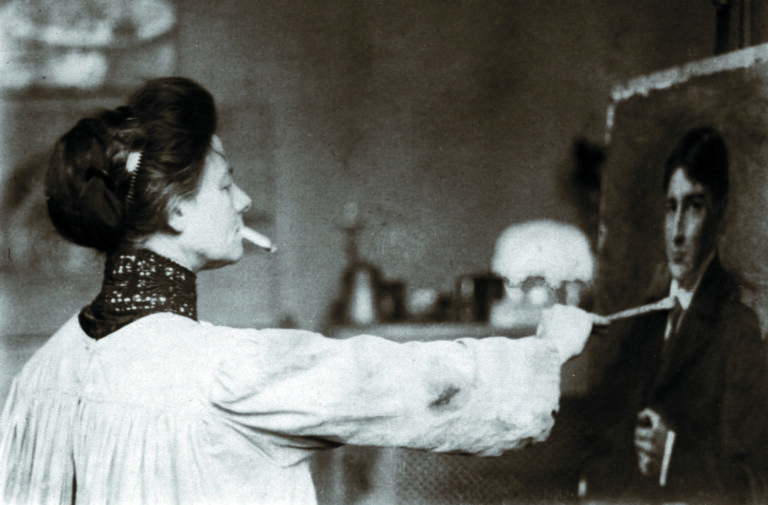
Ivan Kobilca in his studio, 1912. Archive of the Zarja magazine

Ivan Kobilca in his studio, 1912. Archive of the Zarja magazine

Ivan Kobilca in his studio, 1912. Archive of the Zarja magazine

In 2018, to celebrate its hundred years of activity, the National Gallery in Ljubljana organised an exibition dedicated to the painter Ivana Kobilca (1861-1926). The monograph, published for the occasion, includes 391 works.

Who was the greatest Slovenian painter who, at the beginning of her career and never again, signed her paintings “I. Kobilca” so that a potential buyer would not think that the works were created by a woman?

A biographical note

I consider it more important than the names of all the European cities where Kobilca exhibited his works (Munich, Berlin, Trieste, Paris, Budapest, Lucerne, Lübeck, Prague, Venice, Sarajevo, Regensburg, Dresden, Wroclaw, Leipzig, Vienna).

It revolves around the pivotal role of her father, Jakob, an umbrella and awning dealer from Ljubljana. From a young age, Ivana dreamed of painting the walls and domes of churches and the interiors of the few palaces in Ljubljana, which at the time resembled a village. When Ivana was sixteen, her father granted her wish: a trip to Vienna. For the young student at an Ursuline institute, who had taught herself French and Italian, visiting the museums and galleries of the imperial capital was crucial to her final decision to devote herself to painting.

Jakob knew what it meant to choose the profession of a painter – let alone a woman painter! – in a provincial city like Ljubljana and in a social environment where women’s role was relegated to the triad of mother-wife-housewife. They rarely became postwomen, seamstresses, housekeepers, factory workers or shop assistants. Jakob Kobilca and his wife Marija supported their dreamer daughter. Thus, the future artist spent her adolescence in a positive atmosphere, in a family that spared no expense in raising their children (two girls and a boy), leaving them free to choose their own path.

Ljubljana, Vienna, Munich

Born and died in Ljubljana, Kobilca spent most of her life outside her hometown. She usually returned there for a rest before leaving again.

After a modest education through private painting lessons and self-taught studies in Ljubljana, Kobilca’s first European stop was Vienna in 1879. There she continued her studies, persistently copying the great masters of the past. However, she soon realised that Viennese cosmopolitanism was a matter of men. The dominant ideas of the time, those of Nietzsche and Schopenhauer, were not unrelated to theses on the intellectual and creative supremacy of men over women. These ideas acquired a more radical connotation in the book “Sex and Character” (1903) by the eccentric, controversial and fundamentally unhappy young philosopher Otto Weininger (1880–1903).

It is true that Kobilca had long since left Vienna by the time the book was published, but during her two years in Vienna she certainly grasped some of Weininger’s “arguments” about women as imperfect and inferior. The young philosopher, in tune with the zeitgeist, labeled women engaged in “male professions” as “hysterical bisexuals”.

Despite belonging to the “lower category” of human beings, Kobilca realised this “normality” almost a quarter of a century before the publication of “Sex and Character”. In cosmopolitan Vienna, she understood the derogatory terms: Malweiber, Damenmaler, Ölschwestern. I tried, with the help of a friend, to understand their meaning. Malweiber – women to be painted, Damenmaler – female decorator, Ölschwestern – oil sisters, also with a derogatory connotation. Yes, they had the courage to practice that technique too.

In 1881, Kobilca arrived in Munich, which at the time was more liberal than Vienna regarding the social role of women, the presence of foreign artists and the importance of art. However, until 1900 in Germany, only men could enter state-run academies of fine arts. And, as is well known, you do not joke with the state.

In 1882, Kobilca enrolled in a women’s painting school run by the master of realism, Alois Erdtelt. She discovered the importance of photography, photographing nude models with her camera so she could paint even without them. She became increasingly enthusiastic about figurative painting, which suited her nature better, later deciding to attend a course taught by the sculptor Christoph Roth, who had been criticised for his nudes. (This is one of the facts that emerge from the painter’s correspondence, particularly rich in emotion and reflection in the letters addressed to her sister Fani. Most of the correspondence is preserved in the National Gallery in Ljubljana. I thank Mateja Krapež, curator of the National Gallery, for this and other useful information.)

In Munich, she met two female painters: the wealthy Rosa Pfäffinger and Maria Slavona, with whom she became friends, even if this long friendship later turned out to be complicated. There, he exhibited his paintings independently for the first time: Holandka [A Dutchwoman, 1886], Slovenska citarica [The Slovenian Citharist, 1887], and two portraits. Scholars of Kobilca’s painting believe that the years she spent in Munich were crucial to her artistic development.

To the malicious questions of those in Ljubljana who wondered why the daughter of an umbrella merchant studied abroad for so long, Ivana Kobilca responded with a solo exhibition in her hometown (1889). Reports speak of around seven hundred visitors and great critical interest. All the reviews were positive, except one, written by an incurable conservative who criticised the painter for low-cut neckline and bare hands in the portrait of her sister Fani. It was the first solo exhibition held in Slovenia. The painting Kofetarica [Woman Drinking Coffee, 1888] made the greatest impression on the public.

Paris, Florence, Sarajevo

After the Munich exhibition, Kobilca received a letter from Pierre-Cécile Puvis de Chavannes, president of the jury of the Paris Salon. Not only were her two paintings – Poletje [Summer, 1889–90] and Likarice [Ironing Women, 1891] – exhibited at the Salon of the Société Nationale des Beaux-Arts, but the painter was elected an associate member of the Society, then the most important artists’ organisation in the world. Ivana Kobilca arrived in Paris in March 1891.

In her interesting docufiction “Ivana Kobilca – Portret slikarke” [Ivana Kobilca – Portrait of a Painter] from 2008, director Marta Frelih (1967-2025) presented the painter as a self-confident, innovative and courageous woman.

Frelih also devoted attention to the painter’s Parisian period, particularly her three exhibitions at the Salon. I will not dwell on Ivana Kobilca’s complex love affairs, her German friends or Willy Gretor, a Danish painter dedicated to the art trade and skilled at seducing women. Instead, I emphasise that during her stay in Paris, and later in Barbizon, Kobilca’s palette, thanks to plein air painting, moved away from the muted tones of realism and naturalism.

How courageous her decision to live and work in the world’s art center was is also demonstrated by the information contained in a very detailed essay by Mojca Šorn, published in 2022, entitled “Ljubljančanka Ivana Kobilca” [Ivana Kobilca, the Ljubljana native]. The book reveals that 7,232 artists were active in Paris at that time, and 1,289 were foreigners.

After two years in France, Kobilca spent a few months in Florence. “I did not paint at all. I simply observed the world around me. Who would paint in Florence!”, she wrote in a letter. Upon returning to Ljubljana, although she had never had any prejudices about her hometown, she felt as if she had returned to a deserted place.

Completely unexpectedly, she was given the opportunity to travel to Sarajevo, where, as one of her letters states, “the East had just begun to merge with Central Europe”. During her time in Sarajevo (1897–1905), she created illustrations for the magazine Nada and commissioned paintings, including portraits of Josip Stadler, Archbishop of Sarajevo, and Josip Juraj Strossmayer, Bishop of Đakovo, for the Ljubljana City Hall. She also decorated the walls of several Sarajevo churches. She was the only female member of the Sarajevo Painting Circle.

A tip for anyone planning to visit the National Museum in Sarajevo: Ivana Kobilca had a studio in that building. During her stay in Sarajevo, she received the sad news from Ljubljana of the death of her mother, father, sister Fani and brother Josip.

At that time, Ivan Hribar, the mayor of Ljubljana, asked her to paint the composition “Slovenija se klanja Ljubljani” [Slovenia Bows to Ljubljana] for the town hall. (After the great earthquake of 1895, Hribar personally committed to giving Ljubljana a European face with a new urban plan.) Rihard Jakopič (1868–1943), the first Slovenian modernist painter, criticised the work, a criticism which the painter interpreted as a sign of the modernists’ rejection of her painting.

Some say that despite stoically enduring Jakopič’s criticism, it was the painter’s harsh words that pushed Kobilca to move to Berlin in 1905, where she remained until the outbreak of World War I. She earned her living by tutoring students and painting commissioned portraits. She continued to write letters to loved ones. This correspondence is so interesting that I am surprised it has not yet been published.

She spent the World War I in Ljubljana. She later returned to Berlin, only to reclaim her belongings. She died in Ljubljana in 1926. She was considered the greatest Yugoslav painter, and therefore not just a Slovenian one.
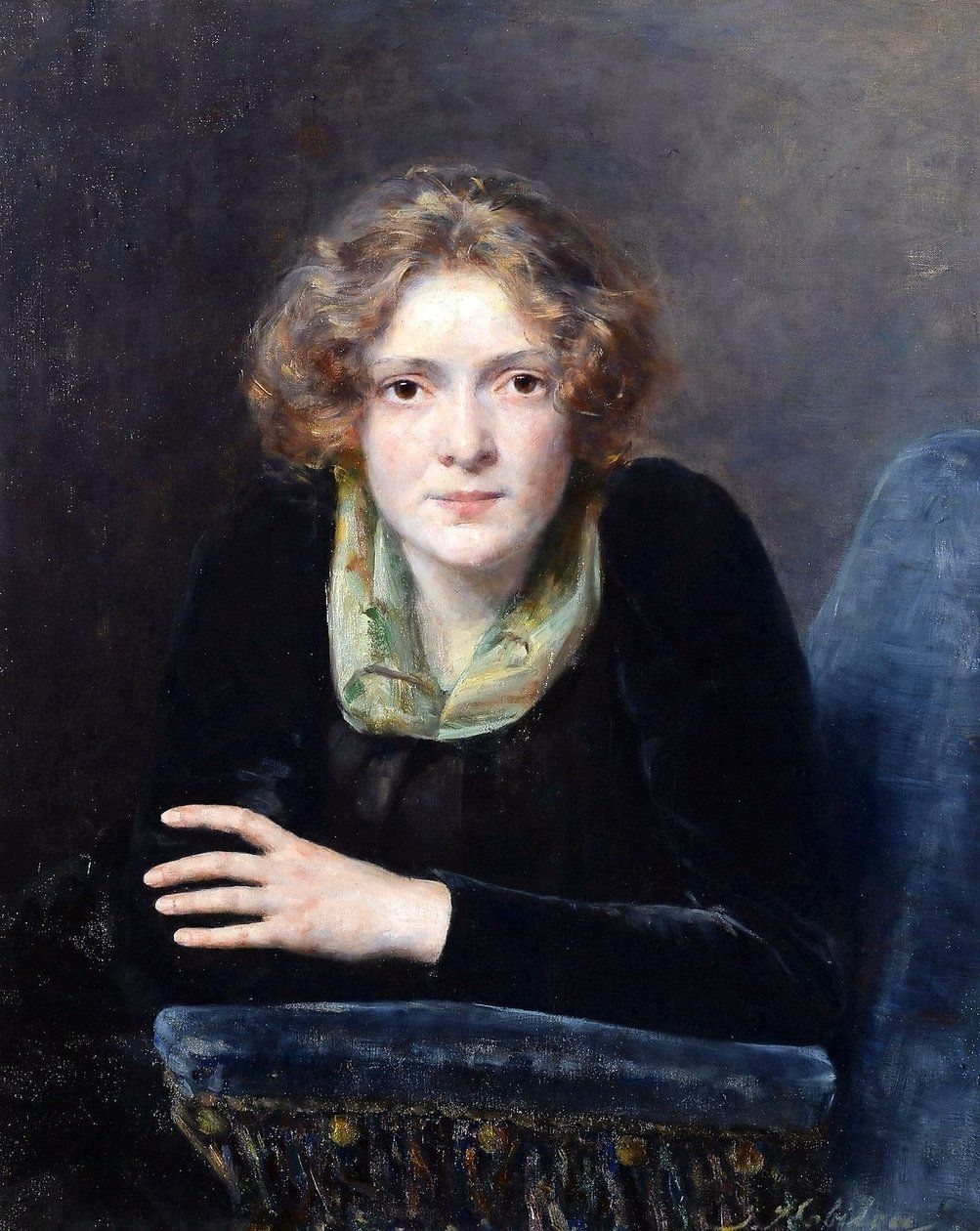
Parisian Woman/Girl in an Armchair, 1892 (Oil on canvas, 73 x 60 cm)

Parisian Woman/Girl in an Armchair, 1892 (Oil on canvas, 73 x 60 cm)

Portrait of a Parisian Woman

The National Gallery in Ljubljana holds 42 paintings by Ivana Kobilca and 218 photographs. In the gallery’s room dedicated to the painter, one portrait particularly draws attention. Dekle v naslonjaču [Girl in an Armchair, 1892] was painted during her French period. The young woman in the portrait looks us directly in the eyes. It is a gaze that everyone can interpret in their own way, perhaps asking themselves to what extent the painted face reflects the painter’s state of mind during her French period, which was not only about painting en plein air. The gaze, which exudes a young woman’s self-awareness, perhaps also hides sadness and a vague sense of uneasiness?

Interestingly, Emperor Franz Joseph wanted to purchase this portrait, exhibited in Vienna in 1893, but the painter refused. She offered the emperor another painting, which he gladly purchased.

This painting, purchased in 1902 by the Museum of Fine Arts in Budapest, has been on display at the National Gallery in Ljubljana since 2016 thanks to film director Marta Frelih, who rediscovered the painting in Budapest. Watching her film also reminded me of a detail from Mojca Šorn’s essay. The author points out that, at an exhibition organised in 1910 in the Jakopič Pavilion in Ljubljana to celebrate the eightieth anniversary of Slovenian painting, not a single painting by Kobilca was on display.

Jakopič was a kind and open person, according to popular belief. Why, then, did he behave this way toward Kobilca? Perhaps it was due to envy, a sentiment as ancient as it is contemporary among artists? It seems plausible, considering that Kobilca exhibited three times at the Paris Salon and once at the Venice Biennale. In any case, envy is always a green swamp.

Perhaps the film’s ending will capture your attention? Enough to make you want to watch it several times. In the role of Kobilca, Nataša Matjašec recites the lines from the seventh poem in the cycle “Obrazi” [Faces] by the Slovenian poet Simon Jenko (1835–1869):

Tell me, ruin, / darkened by the sun! / What is the power of man / what are his works? / And our life, / which goes so fast / is only a dream? / – The dream – an echo answers me.

By quoting these verses, was Marta Frelih perhaps also trying to reveal to us the anxiety of an artist who wonders what fate her works may have after her death?

I do not want to end this commemorative article on a pessimistic note, so I will add one final consideration. As I wrote, I had a reproduction of a photograph on my desk showing Ivana Kobilcha with a cigarette in her hand. It seemed to me that the face staring back at me was conveying a silent but clear message: the painter cared nothing for social norms and taboos. And for art? She loved it, I am convinced, as much as the Japanese people love Mount Fuji.

Tag: Arts

Ivana Kobilca, painting against taboos

On the occasion of the centenary of the death of Ivana Kobilca (Ljubljana 1861-1926), a look at the life and works of the greatest Slovenian painter who was able to overcome taboos in a male-dominated environment such as that of Europe between the 19th and 20th centuries

06/03/2026, Božidar Stanišić
Ivan Kobilca in his studio, 1912. Archive of the Zarja magazine

Ivan Kobilca in his studio, 1912. Archive of the Zarja magazine

Ivan Kobilca in his studio, 1912. Archive of the Zarja magazine

In 2018, to celebrate its hundred years of activity, the National Gallery in Ljubljana organised an exibition dedicated to the painter Ivana Kobilca (1861-1926). The monograph, published for the occasion, includes 391 works.

Who was the greatest Slovenian painter who, at the beginning of her career and never again, signed her paintings “I. Kobilca” so that a potential buyer would not think that the works were created by a woman?

A biographical note

I consider it more important than the names of all the European cities where Kobilca exhibited his works (Munich, Berlin, Trieste, Paris, Budapest, Lucerne, Lübeck, Prague, Venice, Sarajevo, Regensburg, Dresden, Wroclaw, Leipzig, Vienna).

It revolves around the pivotal role of her father, Jakob, an umbrella and awning dealer from Ljubljana. From a young age, Ivana dreamed of painting the walls and domes of churches and the interiors of the few palaces in Ljubljana, which at the time resembled a village. When Ivana was sixteen, her father granted her wish: a trip to Vienna. For the young student at an Ursuline institute, who had taught herself French and Italian, visiting the museums and galleries of the imperial capital was crucial to her final decision to devote herself to painting.

Jakob knew what it meant to choose the profession of a painter – let alone a woman painter! – in a provincial city like Ljubljana and in a social environment where women’s role was relegated to the triad of mother-wife-housewife. They rarely became postwomen, seamstresses, housekeepers, factory workers or shop assistants. Jakob Kobilca and his wife Marija supported their dreamer daughter. Thus, the future artist spent her adolescence in a positive atmosphere, in a family that spared no expense in raising their children (two girls and a boy), leaving them free to choose their own path.

Ljubljana, Vienna, Munich

Born and died in Ljubljana, Kobilca spent most of her life outside her hometown. She usually returned there for a rest before leaving again.

After a modest education through private painting lessons and self-taught studies in Ljubljana, Kobilca’s first European stop was Vienna in 1879. There she continued her studies, persistently copying the great masters of the past. However, she soon realised that Viennese cosmopolitanism was a matter of men. The dominant ideas of the time, those of Nietzsche and Schopenhauer, were not unrelated to theses on the intellectual and creative supremacy of men over women. These ideas acquired a more radical connotation in the book “Sex and Character” (1903) by the eccentric, controversial and fundamentally unhappy young philosopher Otto Weininger (1880–1903).

It is true that Kobilca had long since left Vienna by the time the book was published, but during her two years in Vienna she certainly grasped some of Weininger’s “arguments” about women as imperfect and inferior. The young philosopher, in tune with the zeitgeist, labeled women engaged in “male professions” as “hysterical bisexuals”.

Despite belonging to the “lower category” of human beings, Kobilca realised this “normality” almost a quarter of a century before the publication of “Sex and Character”. In cosmopolitan Vienna, she understood the derogatory terms: Malweiber, Damenmaler, Ölschwestern. I tried, with the help of a friend, to understand their meaning. Malweiber – women to be painted, Damenmaler – female decorator, Ölschwestern – oil sisters, also with a derogatory connotation. Yes, they had the courage to practice that technique too.

In 1881, Kobilca arrived in Munich, which at the time was more liberal than Vienna regarding the social role of women, the presence of foreign artists and the importance of art. However, until 1900 in Germany, only men could enter state-run academies of fine arts. And, as is well known, you do not joke with the state.

In 1882, Kobilca enrolled in a women’s painting school run by the master of realism, Alois Erdtelt. She discovered the importance of photography, photographing nude models with her camera so she could paint even without them. She became increasingly enthusiastic about figurative painting, which suited her nature better, later deciding to attend a course taught by the sculptor Christoph Roth, who had been criticised for his nudes. (This is one of the facts that emerge from the painter’s correspondence, particularly rich in emotion and reflection in the letters addressed to her sister Fani. Most of the correspondence is preserved in the National Gallery in Ljubljana. I thank Mateja Krapež, curator of the National Gallery, for this and other useful information.)

In Munich, she met two female painters: the wealthy Rosa Pfäffinger and Maria Slavona, with whom she became friends, even if this long friendship later turned out to be complicated. There, he exhibited his paintings independently for the first time: Holandka [A Dutchwoman, 1886], Slovenska citarica [The Slovenian Citharist, 1887], and two portraits. Scholars of Kobilca’s painting believe that the years she spent in Munich were crucial to her artistic development.

To the malicious questions of those in Ljubljana who wondered why the daughter of an umbrella merchant studied abroad for so long, Ivana Kobilca responded with a solo exhibition in her hometown (1889). Reports speak of around seven hundred visitors and great critical interest. All the reviews were positive, except one, written by an incurable conservative who criticised the painter for low-cut neckline and bare hands in the portrait of her sister Fani. It was the first solo exhibition held in Slovenia. The painting Kofetarica [Woman Drinking Coffee, 1888] made the greatest impression on the public.

Paris, Florence, Sarajevo

After the Munich exhibition, Kobilca received a letter from Pierre-Cécile Puvis de Chavannes, president of the jury of the Paris Salon. Not only were her two paintings – Poletje [Summer, 1889–90] and Likarice [Ironing Women, 1891] – exhibited at the Salon of the Société Nationale des Beaux-Arts, but the painter was elected an associate member of the Society, then the most important artists’ organisation in the world. Ivana Kobilca arrived in Paris in March 1891.

In her interesting docufiction “Ivana Kobilca – Portret slikarke” [Ivana Kobilca – Portrait of a Painter] from 2008, director Marta Frelih (1967-2025) presented the painter as a self-confident, innovative and courageous woman.

Frelih also devoted attention to the painter’s Parisian period, particularly her three exhibitions at the Salon. I will not dwell on Ivana Kobilca’s complex love affairs, her German friends or Willy Gretor, a Danish painter dedicated to the art trade and skilled at seducing women. Instead, I emphasise that during her stay in Paris, and later in Barbizon, Kobilca’s palette, thanks to plein air painting, moved away from the muted tones of realism and naturalism.

How courageous her decision to live and work in the world’s art center was is also demonstrated by the information contained in a very detailed essay by Mojca Šorn, published in 2022, entitled “Ljubljančanka Ivana Kobilca” [Ivana Kobilca, the Ljubljana native]. The book reveals that 7,232 artists were active in Paris at that time, and 1,289 were foreigners.

After two years in France, Kobilca spent a few months in Florence. “I did not paint at all. I simply observed the world around me. Who would paint in Florence!”, she wrote in a letter. Upon returning to Ljubljana, although she had never had any prejudices about her hometown, she felt as if she had returned to a deserted place.

Completely unexpectedly, she was given the opportunity to travel to Sarajevo, where, as one of her letters states, “the East had just begun to merge with Central Europe”. During her time in Sarajevo (1897–1905), she created illustrations for the magazine Nada and commissioned paintings, including portraits of Josip Stadler, Archbishop of Sarajevo, and Josip Juraj Strossmayer, Bishop of Đakovo, for the Ljubljana City Hall. She also decorated the walls of several Sarajevo churches. She was the only female member of the Sarajevo Painting Circle.

A tip for anyone planning to visit the National Museum in Sarajevo: Ivana Kobilca had a studio in that building. During her stay in Sarajevo, she received the sad news from Ljubljana of the death of her mother, father, sister Fani and brother Josip.

At that time, Ivan Hribar, the mayor of Ljubljana, asked her to paint the composition “Slovenija se klanja Ljubljani” [Slovenia Bows to Ljubljana] for the town hall. (After the great earthquake of 1895, Hribar personally committed to giving Ljubljana a European face with a new urban plan.) Rihard Jakopič (1868–1943), the first Slovenian modernist painter, criticised the work, a criticism which the painter interpreted as a sign of the modernists’ rejection of her painting.

Some say that despite stoically enduring Jakopič’s criticism, it was the painter’s harsh words that pushed Kobilca to move to Berlin in 1905, where she remained until the outbreak of World War I. She earned her living by tutoring students and painting commissioned portraits. She continued to write letters to loved ones. This correspondence is so interesting that I am surprised it has not yet been published.

She spent the World War I in Ljubljana. She later returned to Berlin, only to reclaim her belongings. She died in Ljubljana in 1926. She was considered the greatest Yugoslav painter, and therefore not just a Slovenian one.

Parisian Woman/Girl in an Armchair, 1892 (Oil on canvas, 73 x 60 cm)

Parisian Woman/Girl in an Armchair, 1892 (Oil on canvas, 73 x 60 cm)

Portrait of a Parisian Woman

The National Gallery in Ljubljana holds 42 paintings by Ivana Kobilca and 218 photographs. In the gallery’s room dedicated to the painter, one portrait particularly draws attention. Dekle v naslonjaču [Girl in an Armchair, 1892] was painted during her French period. The young woman in the portrait looks us directly in the eyes. It is a gaze that everyone can interpret in their own way, perhaps asking themselves to what extent the painted face reflects the painter’s state of mind during her French period, which was not only about painting en plein air. The gaze, which exudes a young woman’s self-awareness, perhaps also hides sadness and a vague sense of uneasiness?

Interestingly, Emperor Franz Joseph wanted to purchase this portrait, exhibited in Vienna in 1893, but the painter refused. She offered the emperor another painting, which he gladly purchased.

This painting, purchased in 1902 by the Museum of Fine Arts in Budapest, has been on display at the National Gallery in Ljubljana since 2016 thanks to film director Marta Frelih, who rediscovered the painting in Budapest. Watching her film also reminded me of a detail from Mojca Šorn’s essay. The author points out that, at an exhibition organised in 1910 in the Jakopič Pavilion in Ljubljana to celebrate the eightieth anniversary of Slovenian painting, not a single painting by Kobilca was on display.

Jakopič was a kind and open person, according to popular belief. Why, then, did he behave this way toward Kobilca? Perhaps it was due to envy, a sentiment as ancient as it is contemporary among artists? It seems plausible, considering that Kobilca exhibited three times at the Paris Salon and once at the Venice Biennale. In any case, envy is always a green swamp.

Perhaps the film’s ending will capture your attention? Enough to make you want to watch it several times. In the role of Kobilca, Nataša Matjašec recites the lines from the seventh poem in the cycle “Obrazi” [Faces] by the Slovenian poet Simon Jenko (1835–1869):

Tell me, ruin, / darkened by the sun! / What is the power of man / what are his works? / And our life, / which goes so fast / is only a dream? / – The dream – an echo answers me.

By quoting these verses, was Marta Frelih perhaps also trying to reveal to us the anxiety of an artist who wonders what fate her works may have after her death?

I do not want to end this commemorative article on a pessimistic note, so I will add one final consideration. As I wrote, I had a reproduction of a photograph on my desk showing Ivana Kobilcha with a cigarette in her hand. It seemed to me that the face staring back at me was conveying a silent but clear message: the painter cared nothing for social norms and taboos. And for art? She loved it, I am convinced, as much as the Japanese people love Mount Fuji.

Tag: Arts
Comment and share

OBCT's Newsletter

To your inbox every two weeks