Turkey and the Kurds, is “positive peace” possible?
The peace process with the Kurds in Turkey continues: after the announced dissolution of the PKK, paths are being sought that can lead to a “positive peace”, capable of addressing the root causes of the conflict
shutterstock_1634027173
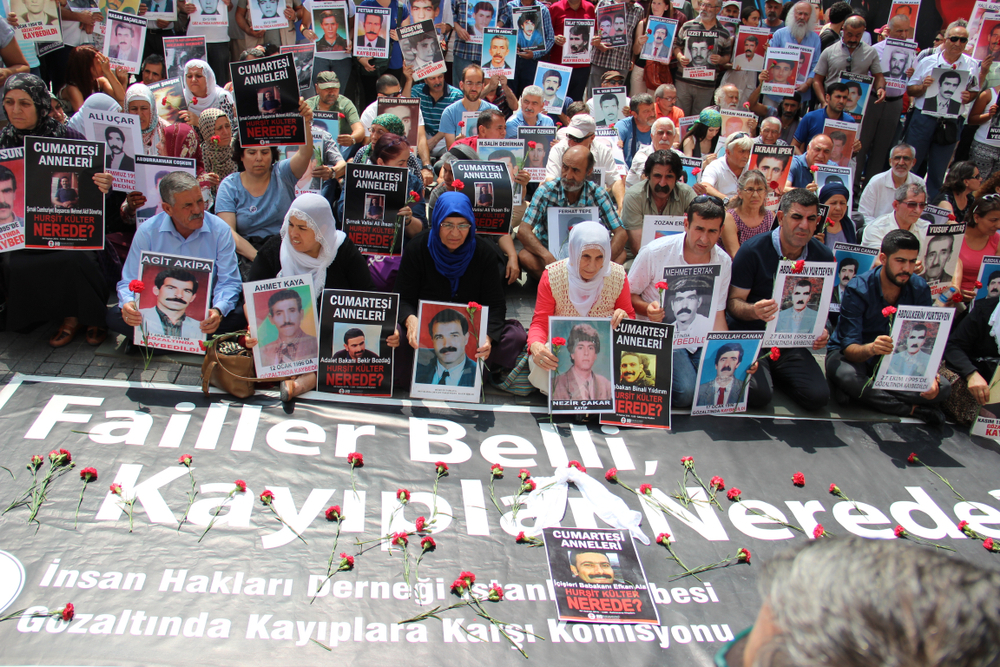
Saturday Mothers © Alfa Net/Shutterstock
As war engulfs the Middle East, the Turkish state continues to insist on pursuing peace with the Kurds.
A Turkish parliamentary commission established as part of the peace process has completed its work, with its final report approved in recent days after lawmakers voted overwhelmingly in favor. Yet, critics contend that the report overlooks key issues such as past human rights violations, and the broader social and political grievances that remain at the heart of the conflict.
The Commission’s report outlines three core objectives: a “Terror-Free Turkey,” the strengthening of democracy, and increased development and economic prosperity. The Pro-Kurdish DEM Party voted in favour of the report while attaching a dissenting note outlining its objections. The party’s reservations stated that the Kurdish question cannot be defined in terms of “terror” and should instead be recognized as a rights and freedoms issue.
The report said that a broad consensus was reached on the need to enact the necessary legal arrangements for the Kurdish militant group PKK’s full dissolution and the process of disarmament and surrender of weapons. Turkey’s political parties agreed that there is a need for a distinct, temporary legal framework to manage the disarmament process and its aftermath.
From the very beginning, the Commission has adopted an approach based on safeguarding “the dignity of the Kurd” and “the pride of the Turk”. Following the publication of the final report, legal regulations are expected to be implemented within this framework after Ramadan.
Although legal regulations on disarmament and the return of PKK militants are in the pipeline, doubts remain about whether the process can move from “negative” peace to “positive” peace, one that addresses the root causes of conflict and builds lasting social trust and equality.
Dr. Nisan Alıcı, lecturer at the University of Derby, believes that a transition to positive peace is not possible under the current circumstances. She emphasizes that recognizing the Kurds’ right to receive public services and education in their mother tongue is still treated as a radical demand.
According to Alıcı, author of “Transitional Justice and the Kurdish Conflict: A Grassroots Approach”, positive peace requires the meaningful implementation of equal citizenship in practice, the inclusion of peace education in school curricula, and the development of broader societal programs.
“Confronting past crimes and grave human rights violations, including delivering truth and justice for victims of enforced disappearances is a fundamental condition. However, it is difficult to argue that the government is currently demonstrating the political will to eliminate the root causes of the 40-year conflict,” she says.
Turkish President Tayyip Erdogan’s AK Party and its nationalist ally MHP emphasized that the Commission was established to ensure that the PKK would lay down the arms unconditionally and permanently. However, the opposition has consistently argued that disarmament alone would not be sufficient to achieve lasting peace.
Turkey’s Kurds demand overcoming security-focused discourse and opening up a path to rights-based democratisation. The Turkish state’s policies of the 1990s, marked by forced disappearances, extrajudicial killings, and mass graves, remain a painful legacy that the country has yet to fully confront and reckon with. Several of these violations were later condemned in rulings by the European Court of Human Rights, which held the state accountable for failing to protect the right to life and to properly investigate these abuses.
The Commission held 20 meetings, the first of these taking place on August 5, 2025, over the course of which it heard from 137 people, including members of the “Saturday Mothers” group, relatives of the victims of enforced disappearances in Turkey.
The Saturday Mothers issued a statement criticising the absence of their demands in the report. “In a report prepared under the banner of democratisation and social peace, denying serious, systematic and ongoing human rights violations such as enforced disappearances is in clear contradiction to that very claim,” the statement read.
According to a barometer prepared by the “We Live Together Education and Social Research Foundation” (BAYETAV) in the city of Izmir on Turkey’s Mediterranean coast, 63% of respondents support the statement “I believe that past human rights violations must be investigated in order to find a lasting solution to the Kurdish issue”.
This figure rises to 90% among Kurdish participants, though there is clear opposition among nationalist voters. The barometer shows that, while the demand to confront the past is not limited to Kurdish political identity, it has not yet turned into an inclusive social consensus.
Dr. Serkan Turgut, academic studies coordinator at the BAYETAV, says the figures show that public support for peace has not entirely collapsed and that a potential still exists which could, in the future, nurture positive peace. “In the long term, this potential should not be underestimated. In the short term, however, the picture is far more complex and pessimistic,” he states.
According to the barometer, while a majority appears open to peace, many expect it to be based on the Kurds abandoning their claims to a collective identity. Turgut says for Kurds, however, the core issue is precisely achieving equal recognition together with their identity. “This divergence in expectations makes the construction of positive peace particularly challenging,” he adds.
Serkan Turgut believes the longing for peace is genuine, but the conditions required for positive peace are not yet in place.
“At best, the process may result in active conflict being suspended while structural problems are put on hold. This should not be dismissed lightly. The removal of weapons from the equation is, in itself, significant.”
Found an error in this article? Please contact our editorial team at redazione@balcanicaucaso.org.
Tag: Kurds | Minorities
Featured articles
 the students' voices
 Investigation
 students' protest