History on Sale: Greece’s Unseen Witnesses of War
Images from one of Greece’s darkest hours, the Kaisariani massacre, offered for sale eight decades later: within minutes, they escaped the marketplace and entered the public conscience, igniting a national reckoning over memory
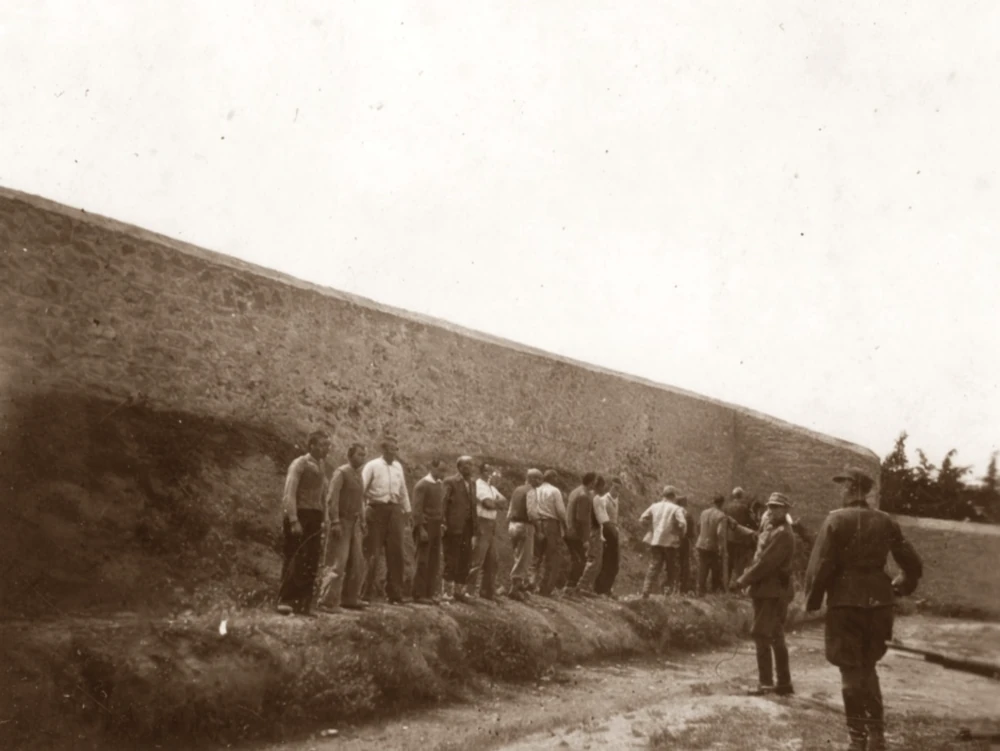
Foto degli ostaggi a Kaisariani vicino ad Atene, in Grecia, prima dell’esecuzione il 1° maggio 1944 – © Ebay/ Greece at WW2 archives
Foto degli ostaggi a Kaisariani vicino ad Atene, in Grecia, prima dell’esecuzione il 1° maggio 1944 – © Ebay/ Greece at WW2 archives
Opening Pandora’s Box
It was not an archive that revealed them.
Not a dusty box, not a state vault, not a forgotten drawer in a provincial museum.
It was a screen.
Late at night on Saturday, 14 February 2026, somewhere between routine and habit, Pegasus (the pseudonym used by the founder of the Facebook community Greece at WWII Archives), was scrolling; not searching for anything in particular, only drifting through the endless digital afterlife of history. Then the images appeared.
Men standing in formation. Faces caught between resignation and disbelief. A place unmistakable to anyone who knows Greek history: Kaisariani. And a date that never stops bleeding: May Day, 1944.
“I froze,” Pegasus told OBCT. “I knew immediately there was something different about these pictures.”
The photographs had just been uploaded to eBay. Minutes earlier, they had existed only as commodities: Objects with a price, a description, a seller. Within minutes, Pegasus reposted two of them to his Facebook group, an online historical community he founded more than twelve years ago.
For Pegasus, the group has never been about clicks or profit. “I’ve never earned a cent from it,” he said. “It exists out of unconditional love for history.” The page itself was born from memory: Pegasus recalls listening to his father recount life under occupation in Florina, of fear, hunger and acts of resistance that left indelible marks on his childhood.
A few hours later, members of the online community would share three more photos, this time, faces showing clearly. Pegasus shared them on the group. This instinctive, almost reflexive repost ignited a storm. Screenshots multiplied. Journalists started calling. Politicians issued statements. Accusations flew. The word profane appeared next to historical.
The next day, the National Resistance Memorial in Kaisariani would be vandalised. Marble plaques broken, leaving a scar that mirrored the nation’s shock. In the hours that followed, Greek media outlets covered the story, emphasising the unprecedented nature of the photographs and the ethical debate over their circulation. Politicians and historians engaged into loud, painful arguments over who owns the images of its dead.
The Greek Ministry of Culture quickly stepped in, initiating legal and archival procedures to investigate the photographs. Authorities stressed that acquisition by the state will proceed only if authenticity is verified. An expert task force was set up immediately on Monday 16th to travel to Belgium and investigate the originality of the archives. Political parties of different ideologies and local institutions have called for the images to be preserved as historical evidence rather than kept in private hands.
“It turned out my instinct was right,” Pegasus said. “These pictures were unique.”
And once they were out, there was no putting them back.
Photographs the Dead never meant to leave behind:
“Photographs … are a way of imprisoning reality, understood as evidence.”
Susan Sontag, Regarding the Pain of Others (2003), p. 15.
The photographs, whether fully authenticated or still under scrutiny, have sparked a moral reckoning as much as a historical one. Unlike written documents, they frame the condemned not as abstractions, but as human beings in their final moments. For Greece, the images are not curiosities. They are evidence; potentially the first visual confirmation of one of the darkest and most emblematic war crimes of the occupation.
Kaisariani holds a singular place in Greek memory. On 1 May 1944, two hundred Greek communists and resistance fighters were led from the Haidari detention camp to the firing range of Kaisariani and executed by Nazi occupation forces in retaliation for the assassination of a German general.
It is a symbol of both barbarism and resistance, a site that has been memorialised in literature, oral testimony and public consciousness, yet until now, no photographs had documented the execution itself. Historian Mark Mazower notes that “the executions at Kaisariani became emblematic of the terror imposed by occupation forces and of the courage of the Greek Resistance” (Inside Hitler’s Greece, Yale University Press, 1993, p. 148).
The photographs had reportedly been taken by a German officer, though provenance remains unverified, and were being offered by the Belgian collector Tim de Craene, who specializes in World War II memorabilia through his business, Crain’s Militaria. Following the viral Facebook post, de Craene suspended the eBay auction, citing the sensitivity of the material and the public reaction in Greece, while remaining open to dialogue with authorities.
Who Were the “200 of Kaisariani”?
The executions at the Kaisariani shooting range on 1 May 1944 are among the most horrific single reprisals carried out by Nazi occupation forces in Greece. Ordered in retaliation for the killing of a German general and three officers by Greek resistance fighters days earlier, the executions were intended as a brutal message of deterrence (Mazower 1995: 226).
Most of the condemned were political prisoners and resistance fighters, chiefly members of the Communist Party of Greece (KKE) and the Greek People’s Liberation Army (ELAS), the armed wing of the National Liberation Front (EAM). Many had been incarcerated under the pre-war Metaxas dictatorship and later transferred to German custody following the Axis occupation.
One of the best-known figures among the executed was Napoleon Soukatzidis, a communist trade unionist born in 1909 in Bursa, a city in today’s modern Turkey. Soukatzidis served as a translator in the Haidari camp. He was one of the ‘invisible mediators of occupied Greece’ as researcher Nadia Georgiou would say in her homonymous paper (2024).
He was chosen in the lottery that selected the 200 for execution; a death he reportedly faced with stoic courage, refusing an offered reprieve for another prisoner. Soukatzidis’s story has taken on symbolic resonance in Greek memory and culture. His life and final hours were dramatised in the 2017 film The Last Note (To Teleftaio Simeioma) directed by Pantelis Voulgaris, which portrays not only his fate but that of his fellow prisoners as they walked toward the firing squad.
Whom does memory belong to?
Until the recent public emergence of photographs purported to depict some of these men in their final moments, historians and relatives had access only to written testimony, official records, and memorial accounts, but not visual documentation.
That absence has shaped decades of how the executions were remembered: powerful in memory, elusive in imagery. These photos are possible primary visual evidence of a state-sponsored reprisal that cost 200 lives; a moment repeatedly memorialized in literature, film, and collective memory, but until now lacking photographic documentation.
As the discussion intensified, families began recognising individuals in the frames. One man, the tall figure in a white shirt among the prisoners, was publicly identified by relatives as Vasilis Papadimas, an engineer from Pylos and brother of a noted publisher, who had been arrested in 1941 and later executed in Kaisariani.
The potential identification of individuals in the newly surfaced photos is historically significant not simply for names on a list, but for restoring faces and lived humanity to an event that, for generations, was known almost solely through text.
The debate sparked by the Kaisariani photographs is not unique in the broader history of visual evidence of atrocity. Throughout the twentieth and twenty-first centuries, photographs of mass violence have repeatedly resurfaced outside official archives: from images taken by Nazi perpetrators that entered museum collections only after private circulation to the iconic liberation photographs of Auschwitz, Buchenwald, and other camps, which were first disseminated by press agencies to be later absorbed into institutional repositories of memory (see Susan Sontag, Regarding the Pain of Others, 2003; Barbie Zelizer, Remembering to Forget, 1998).
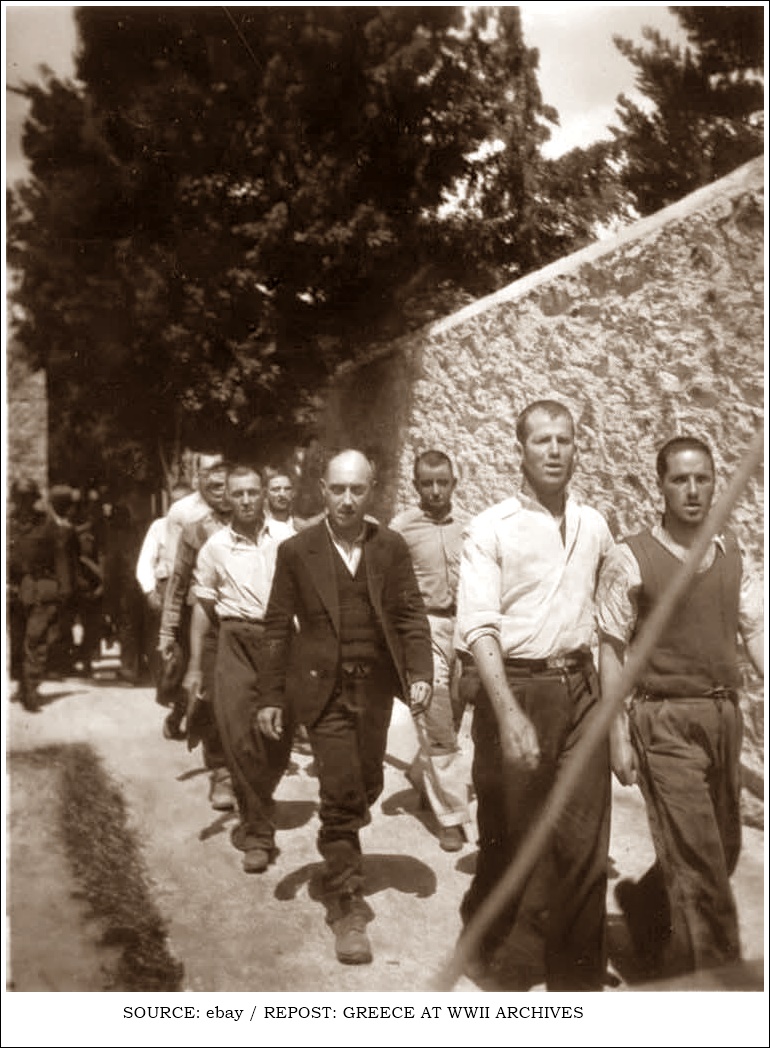
© Ebay/ Greece at WW2 archives
More recently, the circulation of the Abu Ghraib photographs in 2004 raised global debates over ownership, legality, and the ethics of public access to disturbing images of abuse (Burgin, Victor, The Remembering-Image, 2010). Nevertheless, John Tagg has shown how photography’s social and institutional uses are deeply political, asserting that images of injustice are not neutral records but “methodologies with political implications” that influence how societies see power and subjugation (Tagg, The Burden of Representation, 1988).
From a legal perspective, photographs are generally treated, under property and copyright law, as private creations unless transferred to an archive or released under specific rights agreements. Greek and European copyright law, for example, protects the rights of image creators and owners for decades after creation, absent formal acquisition by a public institution (see EU Copyright Law: A Commentary, 2019).
Unlike cultural patrimony such as archaeological artifacts, which can sometimes be subject to restitution under UNESCO conventions, there is no equivalent international treaty mandating the transfer of atrocity images to state or public archives simply because of their historical significance (UNESCO Convention for the Protection of Cultural Property, 1954).
Yet scholars argue that when photographs document crimes against humanity, their function transcends private ownership. As Marianne Hirsch has noted in her work on postmemory , images of trauma often become part of collective memory precisely because they enable societies to bear witness when textual accounts alone are insufficient (Hirsch, Marianne, Family Frames: Photography, Narrative, and Postmemory, 1997).
“An important question is under which conditions a photo is perceived as a historic(al) document”, says to the OBCT attorney and social rights advocate Fatma Yazici. “This is an interesting and complex topic, especially if this item is treated as a family heirloom”.
Eleni Ioannou, a lawyer specialising in criminal law, specifies that different rules apply to historic items in the possession of private individual:
“Ancient coins are considered important monuments, regardless of who has them in their possession. By law, they belong to the Greek State, although under certain circumstances a private individual may lawfully possess them. Special authorisation is required; otherwise, possession is punishable and constitutes a criminal offence. As for photographs, private or family photographs unquestionably belong to the individual, unless they form part of the cultural heritage; in such cases, specific rules and restrictions may apply”.
This tension between legal ownership and moral stewardship has played out in complex court cases and archival disputes. For example, the United States Holocaust Memorial Museum’s archives include albums such as the the Höcker Album, a privately held photographic record from an SS officer that was donated and accessioned into the museum’s collection, illustrating how images of Nazi-era activity can transition from private ownership into public institutional care.
International efforts to address displaced archives, including files and photographic documentation scattered by conflict, colonization, or political upheaval, have been the subject of reports and discussions by bodies such as the International Council on Archives and UNESCO, underscoring that archival heritage, photographs included, is shaped not only by the imperative to preserve, but by enduring disputes over custody, authority and the right to remember.
Acknowledgments: Many thanks to Nina Portolan and Marina Gavrilaki for liaising the author with the legal experts who were interviewed for this article.
Found an error in this article? Please contact our editorial team at redazione@balcanicaucaso.org.
Tag: Fotografia | Photography | World War II | World War II
Featured articles
 Montenegro Pride 2026
 Political deadlock