The Balkans, history as a tool for understanding and dialogue
The “Joint History Project”, winner of the CESPIC Award, is the largest civil society project in the Balkans, bringing together over one hundred experts from thirteen countries. The idea is to transform history, often used as a tool of division, into a space for learning, understanding, and dialogue. We interviewed project manager Zvezdana Kovač
ZvK
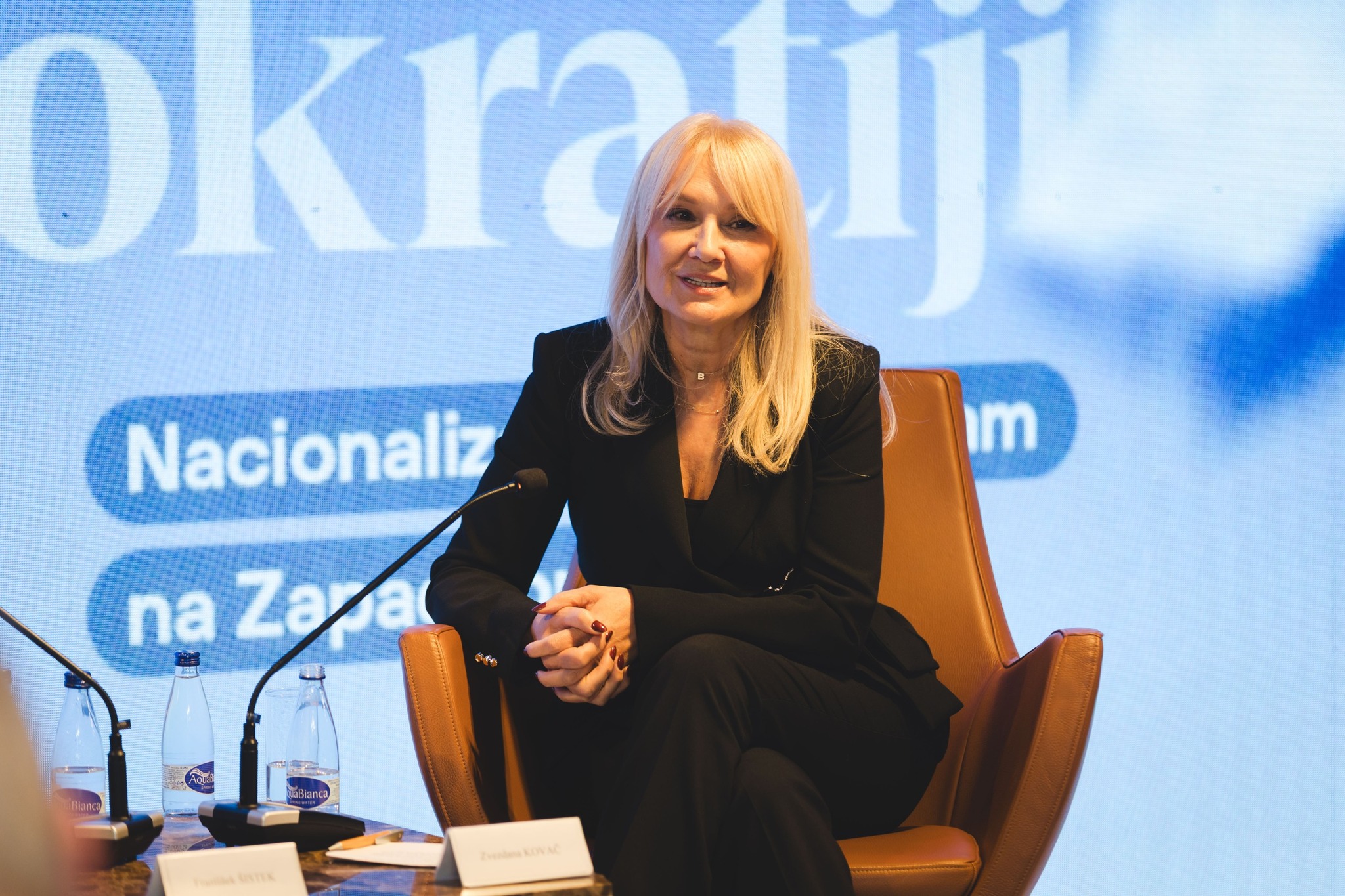
Zvezdana Kovač © JHP
The Joint History Project celebrates over twenty years of activity with this award. Can you remind us how it all began and what the project’s original goal was?
It all began exactly twenty-eight years ago. In the late 1990s, at a time when the conflicts in the former Yugoslavia were not yet over and the region was still grappling with the aftermath of violence, destruction, and deep social divisions, a group of intellectuals and entrepreneurs from Greece and other European countries decided to join forces.
During that period, it became increasingly clear that conflicts did not arise overnight. They were the result of a long process in which nationalist narratives, often supported by education systems and public discourse, shaped the way younger generations understood their own history and relationships with their neighbors. If the region wanted true reconciliation and democratic development, it was clear that change had to begin in schools.
Democratic societies cannot be built on unilateral interpretations of the past, but on the ability to observe history from different perspectives. This belief led to the creation of the Center for Democracy and Reconciliation in South Eastern Europe (CDRSEE), an organization with the primary goal of improving the way history is learned and understood in the region.
One of the first steps was an in-depth study of how history was taught in Southeast European countries. The results were largely similar. History teaching in most countries was highly ethnocentric, with a highly biased and uncritical attitude toward one’s country’s role in historical events. Narratives that presented one’s own community exclusively as the victim prevailed, while responsibility was almost always attributed to others. There was rarely room for critical review, analysis of diverse sources, and an honest assessment of the complexity of historical processes.
However, the authors of that study did not stop at merely diagnosing the problem. The message was clear: if we know how things are, we have a duty to try to change them. This idea stemmed the initiative to create Common Historical Reading Books, a collection of teaching materials that would offer students and teachers a different approach to history. Rather than telling a single national story, the textbooks sought to present historical events from multiple perspectives, using different sources, documents, and interpretations.
The idea was simple, but in this context extremely courageous: history, rather than a tool of division, had to become a space for learning, understanding, and dialogue.
The Joint History Project is the largest civil society project in the region, bringing together over one hundred experts from thirteen countries. However, experts from different countries often have different academic and professional backgrounds. How did the cooperation develop, taking these differences into account?
First, a team of historians-editors from all the countries in the region was formed, and Professor Christina Koulouri, a renowned Greek historian, was appointed as the initiative’s coordinator. The team was chosen primarily based on expertise, academic credibility, and personal integrity. This was a key criterion, as it was important for the project to include people who represented their profession and their scholarly approach to history, rather than the political or national narratives of their countries of origin. All participants were aware that the integrity of historical scholarship had to be defended first and foremost.
Naturally, as expected, there were differences of opinion. However, the project was never intended to reach a “definitive” version of history. On the contrary, the idea was to demonstrate that historical events could be interpreted in different ways. Therefore, where full agreement on positions could not be reached, textbooks presented different historical sources, explaining historical events from multiple perspectives.
It is important to emphasize that every source cited in the books had to be accepted with the consent of all editors. This approach required much discussion, argumentation, and mutual respect.
The historian-editors also had their own teams in their countries of origin, including university professors, researchers, and even school history teachers. It was this combination of diverse academic and professional experiences that gave the project its special value, making the textbooks scientifically sound and, at the same time, suitable for teaching. The goal was to offer students a space for critical thinking and understanding the past from multiple perspectives.
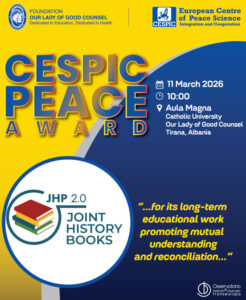
On March 11, the inaugural CESPIC Peace Award ceremony took place in Tirana. The award is sponsored by the Our Lady of Good Counsel Foundation (NSBC) of Tirana, coordinated by the European Centre for Peace Science, Integration and Cooperation (CESPIC), in collaboration with OBC Transeuropa/CCI. The Joint History Project was awarded the prize “for its long-term educational work to promote mutual understanding and reconciliation.”
Multi-perspective is the main approach of this project, which differs somewhat from previous attempts to write transnational history textbooks in conflict zones. Your books compare different sources relating to the same events, raising questions to foster debate. How does this approach actually work in teaching? It undoubtedly requires great dedication from teachers. What is their role?
Multi-perspective is indeed a key approach of the Joint History Project, but it is important to emphasize that our books are not intended to replace existing textbooks, but rather as auxiliary teaching materials. They are designed to offer teachers and students additional historical sources and perspectives, often not found in domestic textbooks.
In class, students work directly with historical sources: documents, excerpts from textbooks from different countries, photographs, political speeches, or testimonies from a specific period. The sources refer to the same event, but come from different national or social contexts. Then, following the questions that accompany each source, students compare different interpretations, identify differences and similarities, and try to understand why the same event is interpreted differently in different contexts.
For example, it may happen that in one country only one part of a certain historical event – the one that fits the dominant national narrative – is elaborated, while in another country another aspect of the same event is emphasized. In our textbooks, students have the opportunity to consult multiple sources, thus gaining a more complete picture that allows them to understand the complexity of historical processes.
The teacher’s role is not to give students a single “correct” answer, but to encourage them to analyze the sources, ask questions, and develop critical thinking. In this process, the teacher becomes more of a moderator of the discussion than a transmitter of preconceived knowledge. At the same time, there are some challenges. In some countries in the region, the political context is not yet particularly conducive to the use of such materials, because the multi-perspective approach often challenges simplified national narratives.
Furthermore, some practical aspects of the education system play an important role. For example, the 1990s occupy only a few pages in some textbooks and are often addressed at the end of the curriculum, when lessons are accelerated and certain topics are often skipped.
This is why it’s important to read books like those produced as part of our project. They allow teachers and students, even in limited time, to work with authentic sources and open up spaces for reflection on perspectives they may not have been aware of.
In 2017, two textbooks on the second half of the 20th century were published, twelve years after the first four volumes covering the previous historical period. What have the reactions been to the project in different countries over the years? Have they been more influenced by changes in the general and local political context, or have reactions been sparked by the topics covered, from the role of the Ottoman Empire to the Yugoslav wars?
Over the years, reactions to the project have been very strong and often very unpleasant for the project team. In the early stages of the project, we faced harsh criticism. In the public sphere, we were often accused of being “enemies of the state” and “mercenaries in the pay of foreigners.” In many communities, our books were initially rejected, often without serious discussion of their content.
Over time, it emerged that many of these accusations came from people who hadn’t actually read the books, much less were familiar with their content. These reactions often stemmed from a deep-seated belief that questioning one’s historical role jeopardized national interests. Within this framework of values, admitting responsibility, speaking out about crimes, asking for forgiveness, or committing to reconciliation is perceived as a betrayal. Essentially, it was (and still is) a clash between two value systems: one that sees history as a means of national mobilization and the other that perceives history as a space for critical reflection and dialogue.
However, thanks to constant and careful work and dialogue with teachers, the academic community, and institutions, the situation has gradually changed. We have organized numerous presentations, training courses, and public debates to showcase the textbooks’ actual content and their educational potential. All the Ministries of Education of the Western Balkan countries have supported the project and allowed for teacher training courses. The launch of the last two volumes, which cover the most sensitive period, the wars of the 1990s, was particularly symbolic. The promotion took place at the European Parliament, in the presence of ministers and representatives of the Ministries of Education from all the countries in the region.
The broader political context, particularly the region’s European integration process, also played an important role. It became crucial to demonstrate that Western Balkan societies are ready to embrace European values, including dialogue, critical engagement with the past, and education based on a plurality of perspectives. In this context, a project like ours has acquired further importance.
In other words, it was not only the topics covered that influenced reactions to the project, but also the political and social context in which these topics were addressed.
Books produced by the Joint History Project © JHP
The Center for Democracy and Reconciliation in Southeast Europe was closed in 2019 due to a lack of financial resources. Thanks to new donors, the textbooks are now available to the public again. Besides online textbooks, what activities do you plan to implement?
Unfortunately, it’s true. The Center was closed due to a certain bureaucratic rigidity in the European Union’s financial mechanisms. Specifically, the EU at some point changed the criteria for non-governmental organizations to apply for grants for the Western Balkans region. According to these rules, organizations must be registered in the region to apply for funding.
Since CDRSEE’s headquarters were in Thessaloniki, this change made it virtually impossible for us to apply for funding for projects in the Western Balkans. I understand the European Union’s good intentions to invest funds in the region itself, but there was no flexibility to make an exception for a project that had proven to be truly regional from the outset, a project intended for the region and rooted in it. After the EU changed the rules, similar criteria were also adopted by numerous foundations.
It is particularly paradoxical that our “neutral” geographical location and the international composition of our staff and board of directors contributed significantly to the project’s success. For this reason, in the Western Balkan countries, our project was not perceived as partisan, but rather as a platform dedicated to creating a space for dialogue and cooperation.
Many of us were unable to accept the fact that the project, the fruit of years of work and which had brought together over a hundred historians, was destined to disappear and that the books produced would remain gathering dust on the shelves. At a certain point, the German Foreign Ministry recognized the importance of the project and supported the idea of reviving it.
However, it was necessary to identify an organization capable of serving as the new institutional headquarters for the project, allowing its further development. We received great understanding from the European Fund for the Balkans, which agreed to host the project. Today, we have a large online archive of all the books published in various languages, available on the multilingual website jointhistory.net.
We also develop new teaching materials for teachers and students, are actively present on social media, where we publish various multimedia content related to Balkan history, and organize international conferences addressing highly topical matters.
We focus particularly on working with young people. We organize a regional winter school that brings together young people from across the Western Balkans. Through three teaching units – history, psychology, and media – we discuss the ways in which the past is interpreted, the traumas that remain present in Balkan societies, and how young people can develop critical thinking and resistance to the manipulation of historical narratives.
Our goal is to introduce new generations to a multi-perspective approach to history and offer young people the tools to develop their potential, understand the complexity of the past, and become responsible and open-minded citizens of their societies.
Initially, the project enjoyed the support of the Ministries of Education of all the countries in the region, but when the textbooks were supposed to reach schools, the project was interrupted. You stated that the goal remains the same: to ensure that the textbooks produced as part of the project become an integral part of the school curriculum. Are you still in contact with the ministries? Do you think they can support the project in this second phase?
Yes, we have already resumed contact with several Ministries of Education in the region. In Serbia and Montenegro, we have already obtained authorizations to organize new teacher training courses, while we are in advanced negotiations with North Macedonia and Albania and hope to reach an agreement soon.
Our goal remains the same: to make transnational textbooks recognizable as valuable teaching aids, capable of enriching history lessons and encouraging critical thinking among students. In the near future, we intend to continue the dialogue with other Ministries of Education in the region and believe we can achieve mutual understanding.
Today’s younger generations did not directly witness the events of the past, yet they live in an era where different interpretations of those events are constantly replayed in public spaces. What is your experience working with younger generations? Does temporal and historical distance play a role? In your opinion, what social and cultural processes influence young people’s attitudes toward the past?
Our experience working with young people has largely been a pleasant surprise. Despite not having directly experienced the events of the 1990s, younger generations continue to grow up in societies where different interpretations of those events are highly present: through the education system, the media, political discourse, but also through family memories.
In this sense, we can also speak of transgenerational trauma, that is, the transmission of the emotional and narrative legacy of the conflict to generations who did not personally experience those events. This is why we have introduced activities into the project that address the psychological aspect of the relationship with the past.
Working with young people, we’ve noticed that they are often much more open and receptive to dialogue than we think. Our recent winter school was attended by around twenty young people from Bosnia and Herzegovina, Montenegro, Croatia, and Serbia. They showed great interest in the topics discussed, asked thoughtful questions, and were open to listening and understanding different perspectives.
We’ve long held the stereotype that young people are disinterested and indifferent. However, events like the student movements in Serbia demonstrate that we’ve profoundly underestimated them. Young people have demonstrated energy, critical thinking, and the willingness to address important social issues.
This is why I believe the relationship between generations in this process is two-way: young people need the support, knowledge, and experience of adults, but we also need the energy, openness, and determination of young people. It’s in this combination that I see great potential for a different, more mature engagement with the past in the Balkans.