Media in Serbia: attacks and pressure are intensifying
Journalists and outlets critical of Serbia’s political leadership are consistently targeted by high-ranking state officials, with professional associations reporting a record number of physical and verbal attacks. Despite international backlash, the government and aligned media continue their smear campaign against critical voices
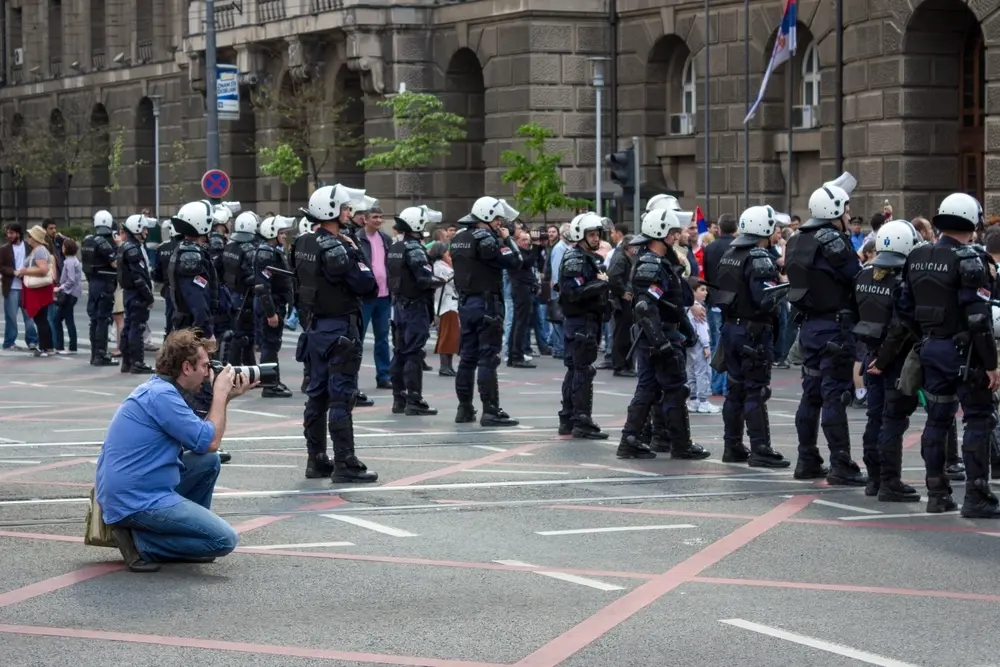
Belgrade, riot police during a protest © Studio Aurelia / Shutterstock
Belgrade, riot police during a protest © Studio Aurelia / Shutterstock
At the end of February, the International Federation of Journalists (IFJ) published its Killed List Report 2025, an annual report on killings and attacks against journalists. The report shows that Serbia is one of the European countries with the highest number of attacks against journalists and cases of journalist murders that remain unpunished.
The IFJ explains that in 2025, the largest number of journalists lost their lives while carrying out their work in conflict zones, such as Gaza, where the Israeli army killed at least 56 Palestinian media workers last year. The report highlights that attacks on journalists also occurred during protests in many European countries, “with the highest levels of physical in Georgia, Serbia and Turkey”.
In Serbia, 44 physical attacks against journalists were recorded in 2025, compared to 14 in 2024, as confirmed by data published on Mapping Media Freedom.
These assaults include “excessive use of force by law enforcement officers, as well as arrests, mainly during anti-corruption protests. Journalists and journalism students were affected”, writes the IFJ.
Serbia is not an isolated case. The IFJ’s annual report shows that attacks on journalists have intensified globally, registering a significant increase (almost 13%) compared to 2024.
The International Federation of Journalists focuses in particular on impunity for journalist murders and disappearances, seeing it as “another worrying finding”. The Council of Europe’s platform for the safety of journalists lists all cases of journalist murders that have remained unpunished. Of a total of fifty cases, nineteen involve journalists killed or disappeared in Kosovo between 1998 and 2005.
Among the countries with the highest number of unsolved journalist murders are Russia, Turkey, Ukraine and Serbia. One of the crimes than “remain scandalously unpunished” is the murder of Slavko Ćuruvija in Belgrade in April 1999.
Attacks continue
Assaults on journalists, unfortunately, continued in the first three months of 2026, and there is no hope of an end, as confirmed by journalists’ associations that carefully monitor and document attacks on media professionals. According to data released by the Independent Association of Journalists of Serbia (NUNS), 38 incidents were recorded in January and 34 in February, including eight physical attacks and as many death threats.
In January, the Slavko Ćuruvija Foundation (SĆF) recorded 160 verbal attacks against critical media and journalists by senior state officials and members of the Serbian Progressive Party (SNS). In February, the number of attacks rose to 71.
The Foundation’s analysis shows that the majority of attacks recorded since the beginning of 2026 came from SNS MPs Nebojša Bakarec and Milenko Jovanov, Parliament Speaker Ana Brnabić, Serbian President Aleksandar Vučić, and SNS leader Miloš Vučević. In its monthly report “Politicians Against Journalists in Serbia”, the SĆF states that the daily newspaper Danas, television stations N1 and Nova S, and, for the first time, the portal Istinomer, were the most targeted in February.
“As has become customary”, denounces the SĆF, “the targeted media outlets were labeled as anti-Serb, Ustasha, blokaderi and tycoon media, criminal Šolak’s media, poisonous, and the journalists of those editorial offices were labeled as fake journalists of Šolak’s media, cynics of the tycoon media, idiots of N1 and Nova S, lobbyists of N1 and Nova S, socio-political operators passing themselves off as journalists, self-proclaimed journalists and the like”.
The media are attacked for various reasons: sometimes for covering certain political issues, such as the recent amendment to the Judiciary Law and the visit of a European Parliament delegation to Belgrade, other times for covering civic and student protests and addressing uncomfortable issues such as the arrest of suspects in an alleged assassination attempt on Vučić and the protest in Novi Sad during the Matica Srpska anniversary celebrations.
These are mostly direct attacks, in which officials discredit the media and journalists, calling into question their professionalism and independence. One in ten attacks involves accusing journalists and the media of being traitors and foreign mercenaries, while one in five involves dehumanisation. Over a fifth of the attacks target journalists, accusing them of inciting, preparing and supporting criminal acts.
The goal of all attacks is to discredit, silence and intimidate independent and critical voices.
“In most cases, officials discredit the media and journalists, calling into question their professionalism, independence and honesty. […] Independent media have been accused, without any evidence, of inciting Vučić’s murder, of being ‘media sponsors of crimes and violence’ and of wanting to ‘hang, ride, and kill’ political opponents”, reads the report.
Malicious campaigns and hacker attacks
The beginning of the year was also marked by the campaign against Veran Matić, president of the board of the Association of Independent Electronic Media (ANEM) and a member of the Permanent Working Group on Journalists’ Safety. Specifically, the Center for Social Stability, a Novi Sad-based organisation close to the ruling leadership, produced a documentary in which Matić is labeled an enemy of the Serbian state and society and a foreign agent working against Serbia for decades. Given that the film was broadcast by numerous pro-government outlets, it is clear that this was a malicious campaign orchestrated against Matić, as confirmed by the Coalition for Media Freedom.
In addition to traditional attacks, the beginning of the year also saw numerous hacks targeting several media outlets, including Radar, Južne Vesti and Glas Šumadije. The Coalition for Media Freedom warns that these attacks are part of a broader, ongoing campaign threatening freedom of expression. The scale and intensity of the attacks suggest that the campaign is not driven by individuals, but by well-organised structures with significant financial resources.
As the Coalition for Media Freedom points out, the attacks are coordinated and often coincide with important political events, such as elections, protests and the publication of journalistic investigations. Although international institutions and Serbian organisations have repeatedly called for clarification on these cases, to date no cyberattack against media outlets in Serbia has resulted in a judicial outcome, nor has the identity of those responsible been identified.
“Hacking media websites is a crime, and the relevant institutions have an obligation to investigate and identify those responsible. Identifying those responsible is crucial to protecting media content, security and the public’s right to timely information”, says the Coalition for Media Freedom.
In a country like Serbia, where the ruling elite holds all public institutions hostage – including the Regulatory Body for Electronic Media (REM), which should be the first to respond to serious violations of the law – it is unlikely that attacks on the media, and on critical voices in general, will cease spontaneously.
The consequences of years of impunity for attacks against media workers and the growing presence of hate speech in the media, often emanating from high-ranking state officials and their associates, have long been felt. These phenomena contribute to the climate of impunity and legitimise pressure on journalists, thus restricting the space for free and critical journalism.
Without a clear institutional response and the political will to protect journalists and media freedom, this trend will not only continue but will undermine fundamental democratic principles and citizens’ right to timely and truthful information.
 This publication was produced within the Media Freedom Rapid Response (MFRR), co-funded by the European Commission. The contents of this publication are the sole responsibility of Osservatorio Balcani Caucaso Transeuropa and its partners and can in no way be taken to reflect the views of the European Union.