Presidential deadlock hits Kosovo
The failure to elect a new president risks forcing Kosovo to hold its third parliamentary elections in just 15 months. Current President Vjosa Osmani has dissolved parliament, a move Prime Minister Albin Kurti’s ruling party considers unconstitutional
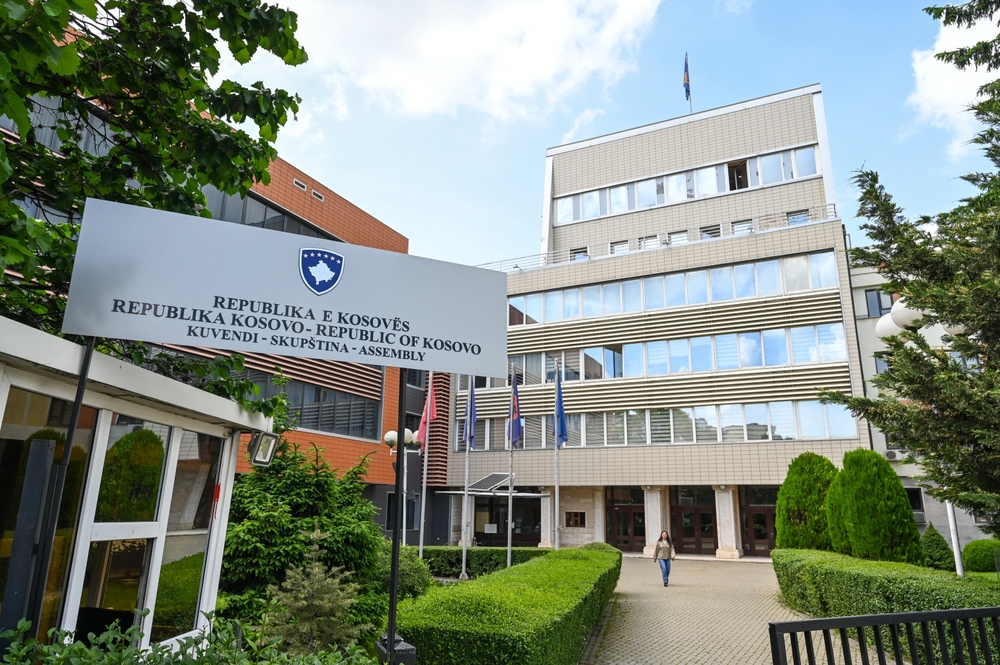
Pristina, Kosovo parliament © Ajdin Kamber/Shutterstock
Pristina, Kosovo parliament © Ajdin Kamber/Shutterstock
Kosovo has entered a new period of political uncertainty, less than a month after the formation of institutions that emerged from the late December 2025 elections.
The country failed to elect a new president within the constitutional deadline on Thursday, while steps have been taken that could lead to early elections. However, the case has been challenged in the Constitutional Court.
The president was not elected on the final day of the deadline, March 5, due to the lack of the required two-thirds quorum of lawmakers, after opposition parties boycotted the extraordinary parliamentary session.
This came after meetings between the ruling party Vetëvendosje Movement (LVV) and the two largest opposition parties failed to produce either a consensus candidate or a political agreement.
In the final hours, LVV nominated its deputy leader Glauk Konjufca, who serves as deputy prime minister and foreign minister. In order to meet the requirement for a competitive race, the party also nominated its lawmaker Fatmire Mulhaxha-Kollçaku.
However, the opposition did not support them.
What does the Constitution say?
Article 86 states that the election of Kosovo’s president “must take place no later than 30 days before the end of the current president’s mandate.”
Article 82 stipulates that the Assembly is dissolved “if within 60 days from the start of the election procedure the President of the Republic of Kosovo is not elected.”
Battle in the Constitutional Court
These developments triggered a clash and a deterioration in relations between Prime Minister Kurti and President Osmani, who had previously worked closely together.
After it was confirmed that Osmani would not be proposed as a candidate, she submitted several constitutional amendments to parliament dating back to 2011. Through these amendments, she sought to change the method of electing the president, allowing citizens to elect the president directly.
LVV welcomed the initiative, but the opposition did not support the amendments, describing them as outdated and unsuitable for the current situation. As a result, the amendments failed.
An extraordinary parliamentary session was then convened to elect the president, but it was interrupted because there was no quorum of at least 80 lawmakers required to start the vote.
Minutes after Thursday night’s failure, LVV filed a case with the Constitutional Court seeking a review of the procedure under Article 86 of the Constitution and a temporary suspension of the deadline for electing the president until the court’s decision. The party also asked the court to determine whether lawmakers who did not attend the session had violated the constitution.
On Friday morning, President Osmani issued a decree dissolving parliament, saying that the failure to elect a new president by midnight on March 5 had pushed the country toward new elections.
“Citizens did not want elections. This situation was created by the Assembly’s failure to fulfill its constitutional duty. No one should want another political cycle, especially at a time when the country needs stability. But irresponsible people with dangerous intentions brought the country to this point,” Osmani said.
Opposition parties welcomed Osmani’s move. However, the decree was described as unconstitutional by Prime Minister Kurti.
“If the third round of voting under Article 86, paragraph 6 has not taken place and at the same time 60 days have not passed since the start of the procedure under Article 82, paragraph 3, then there is no constitutional basis for dissolving the Assembly. In such a situation, the decree dissolving the Assembly and calling elections is not constitutional,” Kurti said.
LVV has also challenged the decree in the Constitutional Court.
On the same day she issued the decree, President Osmani invited political parties to a meeting to discuss the date of elections. The meeting was boycotted only by LVV and Serbian List.
Legal assessments
The decree dissolving parliament was described as arbitrary and unconstitutional by Enver Hasani, a former president of the Constitutional Court of Kosovo.
He said that the failure to elect a president does not automatically send the country to new elections because, according to him, the 60-day deadline begins once the procedure starts.
“This changes the form of state power from a parliamentary system to a presidential one. Such a change can only be made through a constitutional amendment. The way this was done represents an attempt to overturn the constitutional order — the most brutal attempt since the country’s independence,” Hasani said.
However, a different view was expressed by Hasan Shala, the former president of Kosovo’s Court of Appeals.
“Regarding the decree, it is clear that there is a blockade between the government and the opposition. The government does not want an agreement, while the opposition does not attend the session to elect the president. Therefore, I think the president made the right decision with this decree, because this situation could last another six months or even a year without political parties finding a solution. It is appropriate that the right returns to citizens, who will punish these parties through voting for failing to elect the country’s leaders,” Shala said.
How did this situation arise?
President Osmani was elected five years ago following a convincing joint electoral victory with the Vetëvendosje Movement.
She aimed for a second mandate, but Kurti’s party did not nominate her this time, arguing that it did not owe her such support and that, according to LVV, Osmani could not guarantee the required quorum.
Seeing it difficult to persuade the opposition, Kurti mentioned a representative of the Jashari family as a potential unifying candidate. The family is one of the most well-known in Kosovo and a symbol of Albanian resistance during the war against Serbian forces in the late 1990s. However, the family declined to become involved in the process.
It later emerged that during meetings Kurti had proposed to the Democratic Party of Kosovo (PDK) the lawmaker Andin Hoti, the son of Ukshin Hoti, a prominent Albanian activist who has been missing since the Kosovo war.
PDK said it would support a candidate from the Jashari family, but after the family refused, the largest opposition party demanded that the president be one of its own candidates, without naming anyone specifically. This was rejected by LVV.
The Democratic League of Kosovo (LDK) also supported the idea of a unifying candidate or political agreement for the presidency but, at least publicly, did not propose a specific name.
LVV said it was ultimately forced to nominate a party candidate.
The fate of the institutions and the next steps will depend on the rulings of the Constitutional Court on the matter. If new elections are confirmed, they would be the third within 15 months.