Kamza: the construction of a “collective desire”
Located a few kilometres from Tirana, Kamza is a symbol of the internal migration that followed the collapse of Albania’s socialist regime. Constructed by its inhabitants, the city is currently experiencing intense development and political tensions, with some residents opposing these changes. Reportage
kamza_1_apertura
Kamza, December 2025 | Photo: ©Federico Caruso
“Kamza is a living laboratory of a different kind of city-building, where the human dimension is expressed to its fullest, and is inseparable from the desire for life,” writes Albanian architect Dorina Pllumbi of a city that was once a mere suburb of Tirana.
Kamza has been an autonomous municipality since 1996. Literally built by its inhabitants, and telling the story of Albania in chiaroscuro, “laboratory” is indeed the correct term.
We spoke with Pllumbi before seeing with our own eyes the buildings that some have pejoratively termed “informal” or “illegal”, and which, Pllumbi explains, are “a kind of spatial and material response to architecture being exercised as a top-down system of power, especially after the deep political, social and economic transformations of the 1990s.” For Pllumbi, the construction not only of houses but of an entire city like Kamza is a “physical political act.”
Due to traffic congestion, it takes between 30 and 50 minutes by car or bus to travel the seven kilometres between Kamza and Tirana.
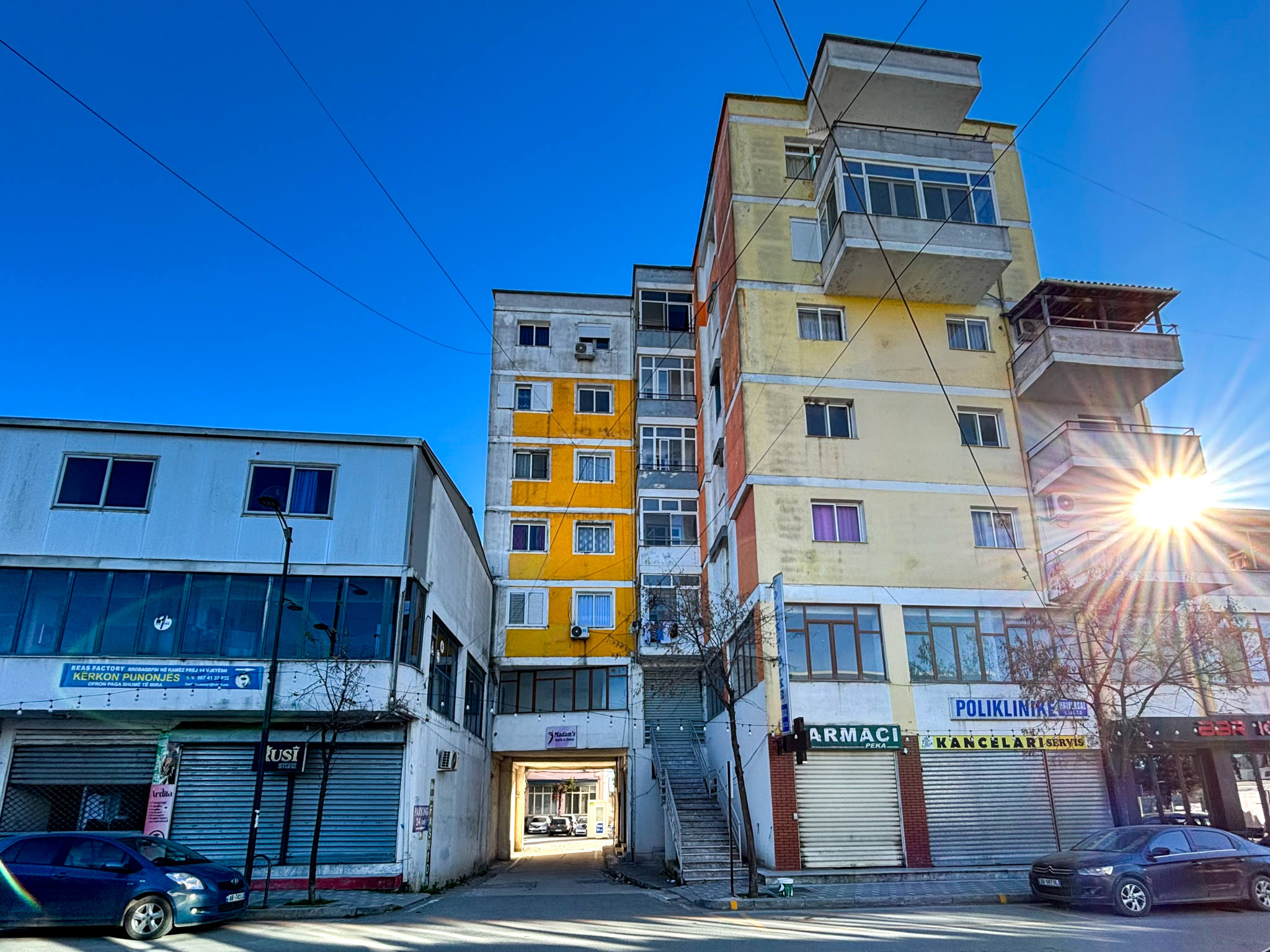
kamza_2
Photo: ©Francesca Barca
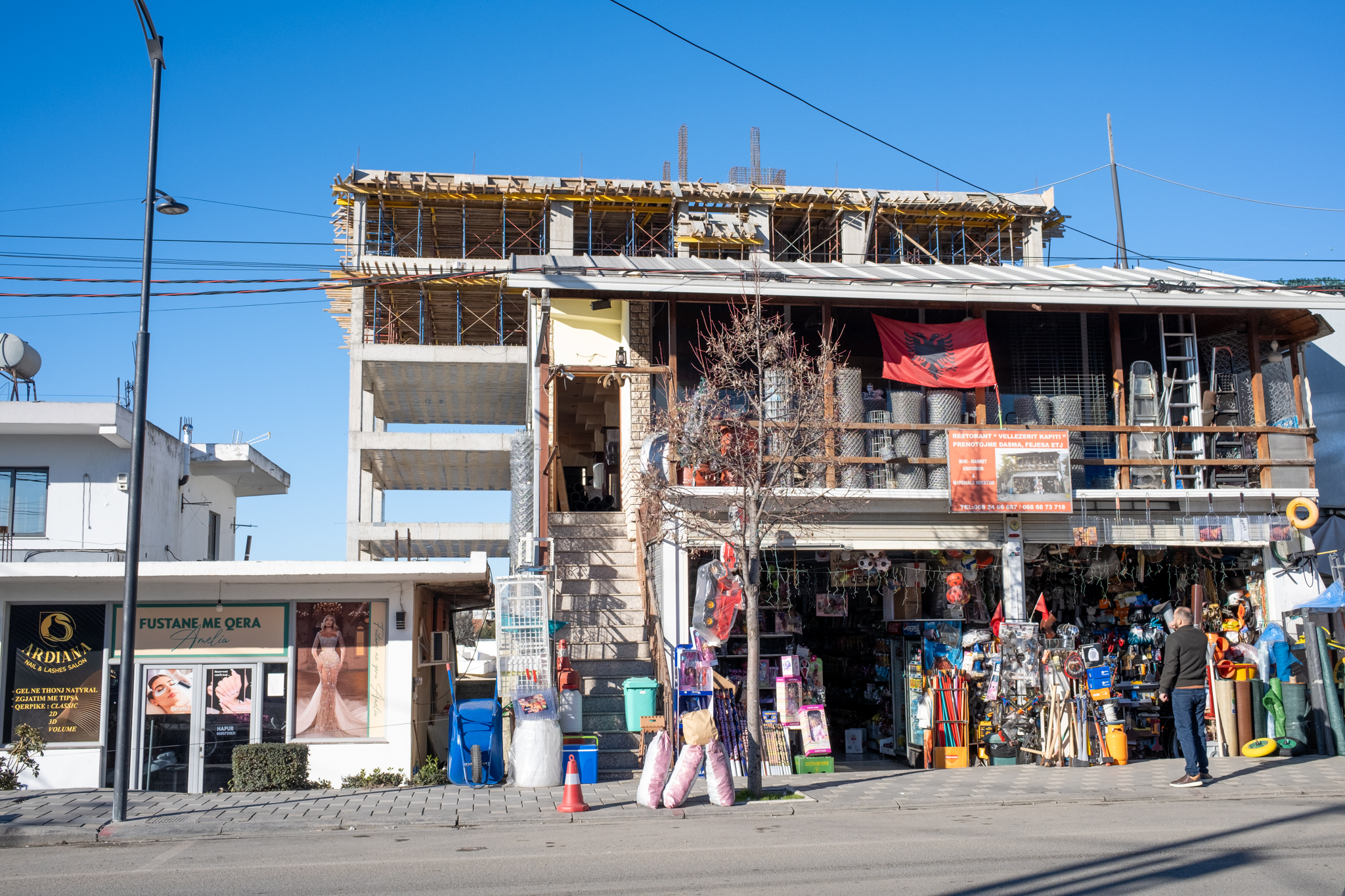
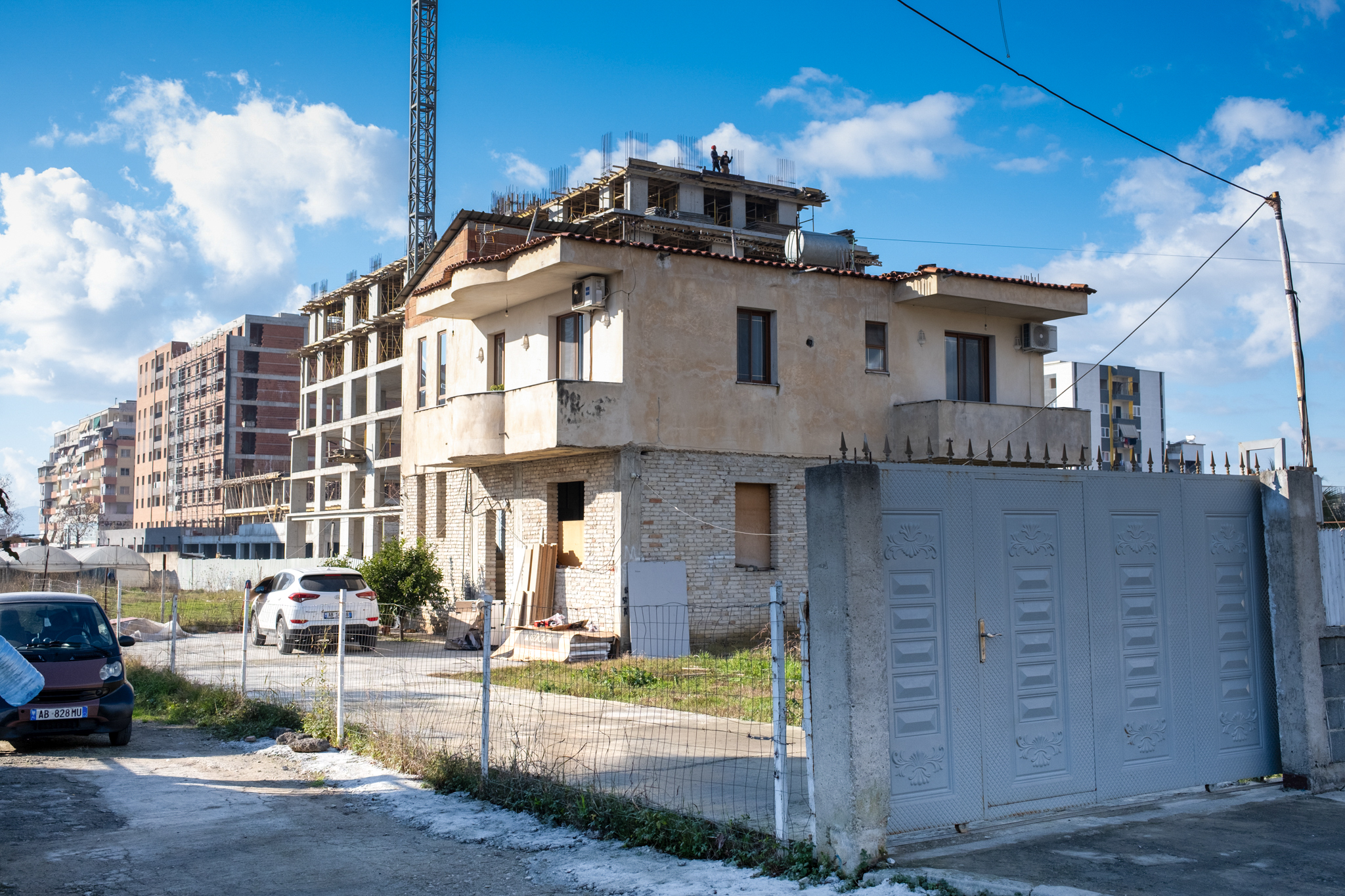
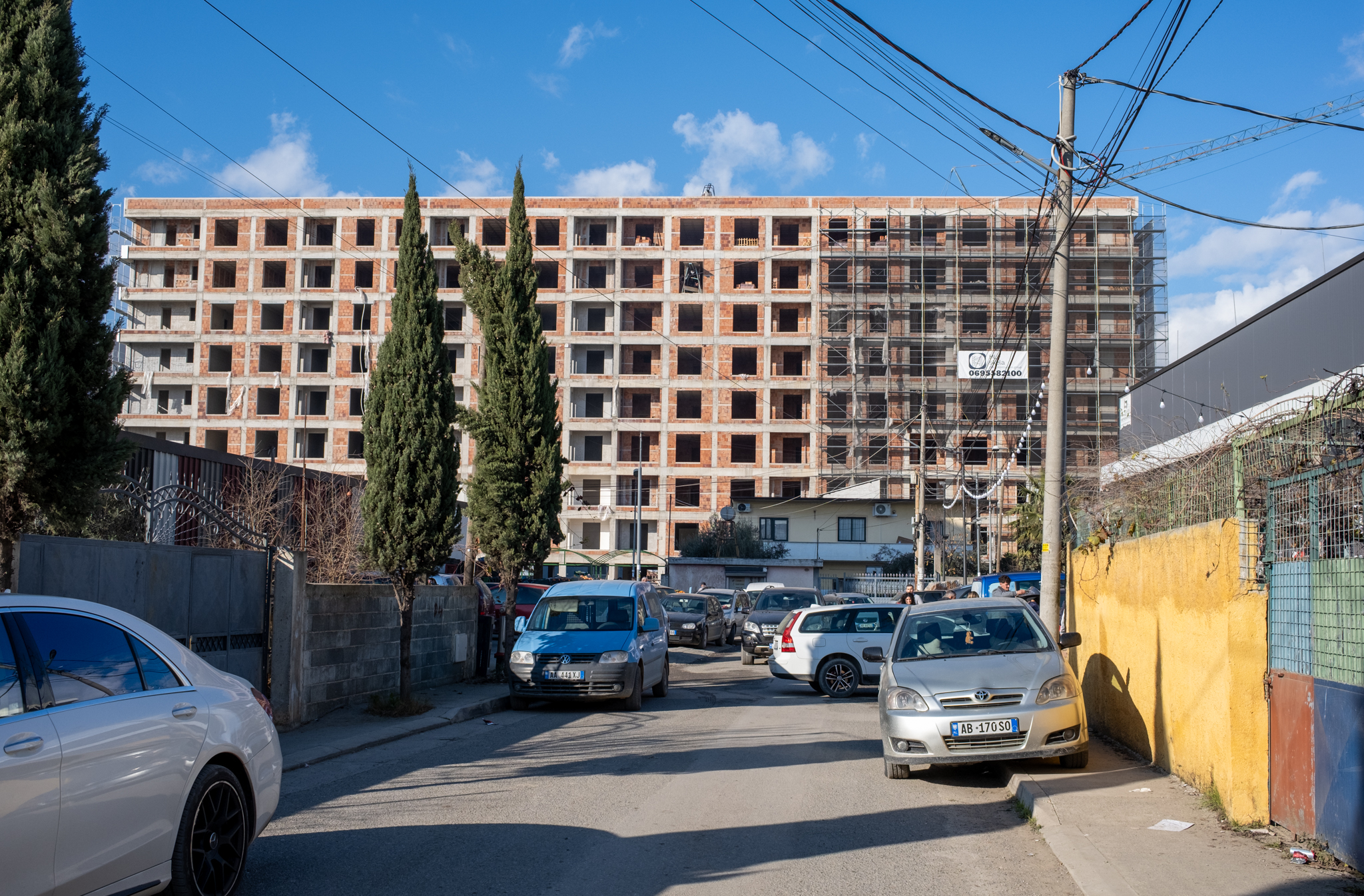
Walking through Kamza, two things stand out: the first is how each house has a different structure from the next, and is often in a state of “evolution”, partly finished and partly under construction to extend the surface area. The second thing is the number of construction sites for large developments.
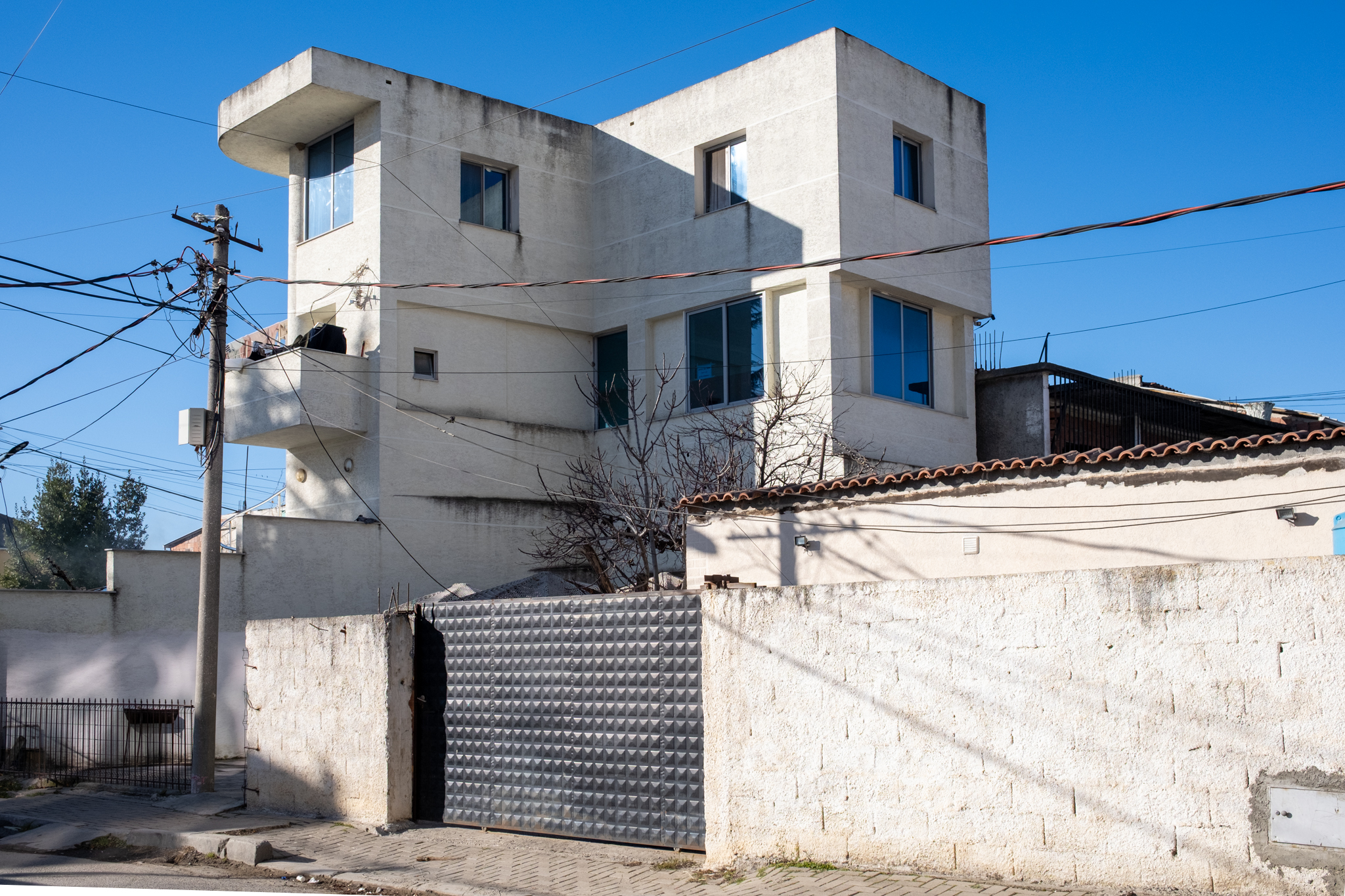
kamza_3
Photo: ©Federico Caruso
In 2019, Kamza made an appearance in the international press due to a curious decision by the local administration. Several streets are named after controversial political figures, including Donald Trump, George Bush, Silvio Berlusconi and Nicolas Sarkozy.
“Sorry to be so blunt, but people from the West often don’t understand the issue of right and left in Albania,” explains Nebi Bardhoshi, anthropologist. We met Bardhoshi in a bar in Kamza in late December.
After the end of the communist regime in the 1990s, Bardhoshi explains, the “most marginalised people – those expected to vote for the left, even if this dogma has now been abandoned everywhere – were those who opposed the regime.” This is why in Albania “the poorest areas voted and still vote for the Democratic Party (PDSH), which is a right-wing party. Obviously, no one voted for the names of the streets. There was no consultation. But people like them for some reason,” he says with a smile.
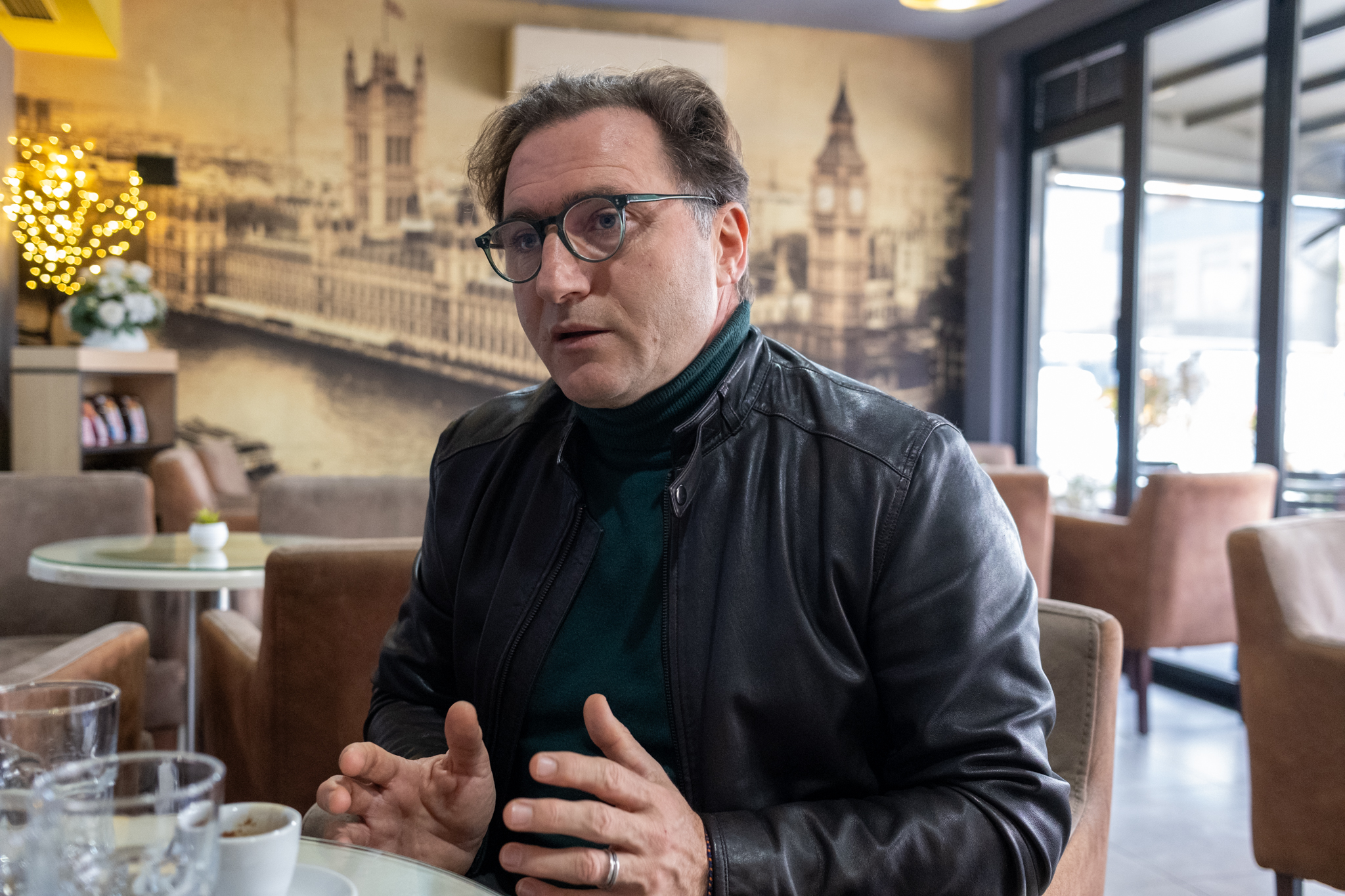
kamza_4
Nebi Bardhoshi, December 2025 | Photo: ©Federico Caruso
According to Erisa Kryeziu’s report published in Nyje.al, Kamza combines several paradoxes: “It is the smallest Albanian municipality in terms of area, but also the most densely populated, which makes it the most urbanised. Over the last twenty years, it has experienced extraordinary population growth. Around 160,000 inhabitants live in an area of 37.18 square kilometres.” The average age in the city is 27, while in the country at large it is 42.5, and has been rising steadily for some time.
Internal migration in Albania
After the end of the socialist regime (1946–92), Albania experienced massive emigration. According to the Albanian Department of Emigration, around half a million Albanians, or 15 percent of the population, left the country between 1990 and 1997. This movement was accompanied by internal migration from rural areas to the urban periphery, which helped to shape the urban and social geography.
Kamza was one of those destinations of internal migration. The people who came to Kamza mainly came from the north of the country, and were generally those who couldn’t afford to emigrate abroad, or could only afford to send one family member abroad, primarily to Italy or Greece.
Migrating abroad was difficult and mostly illegal, whether by sea to Italy, or by land to Greece. Bardhoshi tells us about the father of an acquaintance. “He spent nine months in Italy, made some money and then came back and built his house. This was the practice in the 1990s.” It was also a practice that involved entire families, including women.
The fall of communism in Albania meant many things, with many of the more significant changes involving land ownership, the decentralisation of the economy, and the introduction of freedom of movement.
As Bardhoshi explains, Albania had one of the lowest rates of urbanisation in Europe. In 1990, only 35 percent of the population lived in urban areas, which were mainly concentrated in the western districts, and the regime’s strategy was to keep people in rural areas.
“In 1991, state-owned farms and cooperatives were abolished, and the process of de-collectivisation began. At that point, people began to wonder where they would live.” The villages lacked housing, and the crisis in the mining sector had left many people unemployed.
For those who couldn’t leave the country, the other option was to move closer to the cities: “to survive, but also in the hope of a better life.” These people were emerging from a period and context in which “social control was intense. For young people, there was a sudden sense of liberty.”
No one knew what awaited them, Bardhoshi tells us. “I was young at the time. Poverty was real, but there was positive energy and belief in a better future. We were full of hope. And many of those hopes were realised.”
Bardhoshi describes this as a “social movement,” as well as an “illegal” phenomenon: the land belonged to the state, and in the early days no one – or at least not everyone – requested permits. In some cases, traditional land-use practices were applied; in other cases, people bought land from the people to whom the state had given it – sometimes on paper, and sometimes not. In short, it was a time of great legal and social confusion.
People wanted to buy, Bardhoshi insists, and it is important to emphasise this because the “rhetoric of the parties, and of the Socialist Party in particular, is to talk about these people as ‘illegal’ or ‘squatters.’”
The issue of “illegal” or “informal” settlements forms the core of a controversy that is deployed by politicians on all sides to drum up support. Since 2004, in Kamza as elsewhere, a process of regularisation has been underway, which involves inhabitants paying to regularise the houses that were built at their own expense.
It was no accident that this process was initiated just before the 2005 elections. “More than 50 percent of people were living in informal settlements. That’s a huge percentage,” explains Bardhoshi. The idea was to legalise, then legally expropriate, and then finally to “urbanise.”
Kamza, December 2025 | Photo: ©Federico Caruso
The Socialist Party, and specifically Edi Rama, the current prime minister, has a history of targeting the inhabitants of Kamza – as well as other areas built in a similar fashion – as uncivilised, anti-urban, and anti-state. Such discourse has been perpetuated for years, and, according to Bardhoshi, forms part of “a debate between rurality and urbanity that is quite widespread in Eastern Europe.” As in other post-socialist European countries, “there’s this clash between newcomers and the socialist bourgeoisie, who feel that their city – their ‘socialist paradise’ – doesn’t belong to them anymore.” Bardhoshi refers to this feeling as “socialist urban nostalgia.”
This attitude towards Kamza is also noted by Pllumbi, who describes it as the product of a specific political discourse. “As discussed among the activists of the city, Kamza’s identity was assigned by the elitist centre of power, Tirana. It was labelled as ‘the other,’ and now it stands as a symbol of this otherness,” as highlighted by research done by ATA group on how the media portrayed Kamza’s inhabitants at the time of the migration.
People came to Kamza with the idea of giving their children a better life, opportunities to study, and to work. There were no schools in the new settlement, so the inhabitants organised lessons in their own homes. “It’s fascinating how, in the absence of the state, these communities were able to do what they did.”
ATA, “they” and “the other”
The research Pllumbi referred to is the work of a group of Kamza residents that has turned this “otherness” into a political project. ATA “is not an acronym”, Diana Malaj tells us in perfect Italian, but the pronoun “they.” And who are “they”? “They” is how “people living on the margins of society are perceived.” Malaj, who co-founded the collective in 2014, is part of the generation that migrated from rural areas to Kamza with their families.
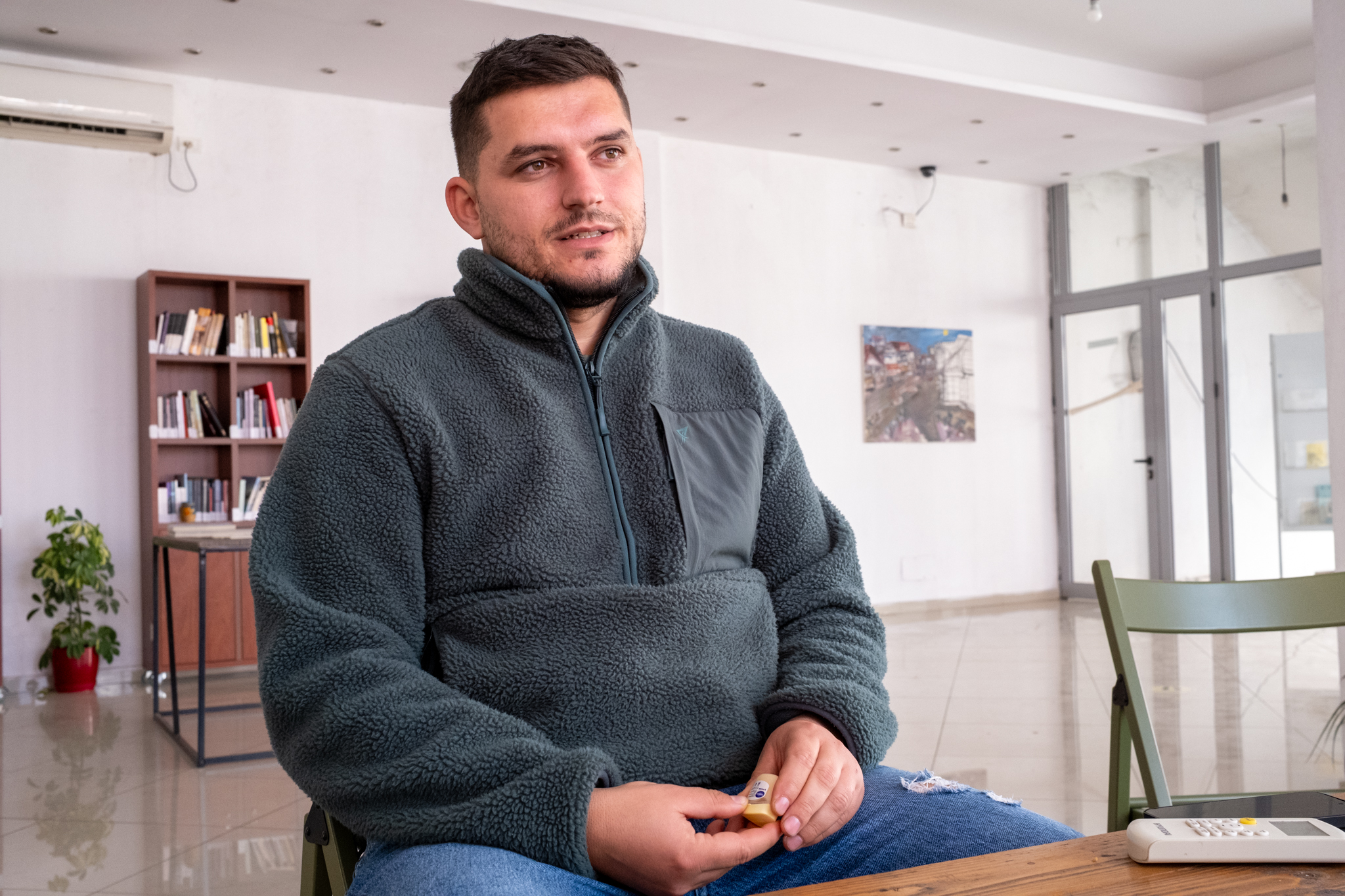
We visited the group’s premises accompanied by Ronald Qema, who joined in 2016 when he was still in high school. The group was created precisely because “we were tired of the stigma that Kamza continues to bear”: that of being “illegal occupants” or “squatters”.
kamza_5
Ronald Qema at the ATA headquarters, December 2025 | Photo: ©Federico Caruso
Malaj and Qema now live abroad, where they are completing their studies or research projects. “We live in a country where migration is mandatory to survive and build the future.”
Kamza has no cinema, theatre, archive or museum, Malaj tells us.
ATA began by engaging in cultural activism, mainly through theatre, to “find our language,” but also to “build a desire, not only individual desire, but above all a collective desire.”
kamza_6
Kamza, December 2025 | Photo: ©Federico Caruso
ATA also documents – through the online newspaper Nyje.al – and engages in urban anthropology, collecting stories and organising workshops with residents. As Qema shows us around the group’s space, which is also a library, he explains that ATA also provides legal and administrative assistance to citizens, and supports communities affected by the numerous hydroelectric development projects that are devastating the Albanian landscape.
“We are here to fill a gap within our collective and within ourselves.” Qema is quick to add that the goal is not to fill the political gap, but to expose it. “Our parents’ generation built this city, this community, out of necessity, to build their own lives. For me, it is our generation’s duty to work on the public life of this community.” To ensure that the community is heard by those who govern, it is also necessary to “create social desire.”
kamza_7
Kamza, December 2025 | Photo: ©Federico Caruso
While the parents of the ATA generation built the houses and “took care of us,” Qema tells us, today the task is to “make these stories visible, to talk about our community, to value how things were, and also, in a way, to document and protect what is happening now and what could happen in the future.”
kamza_8
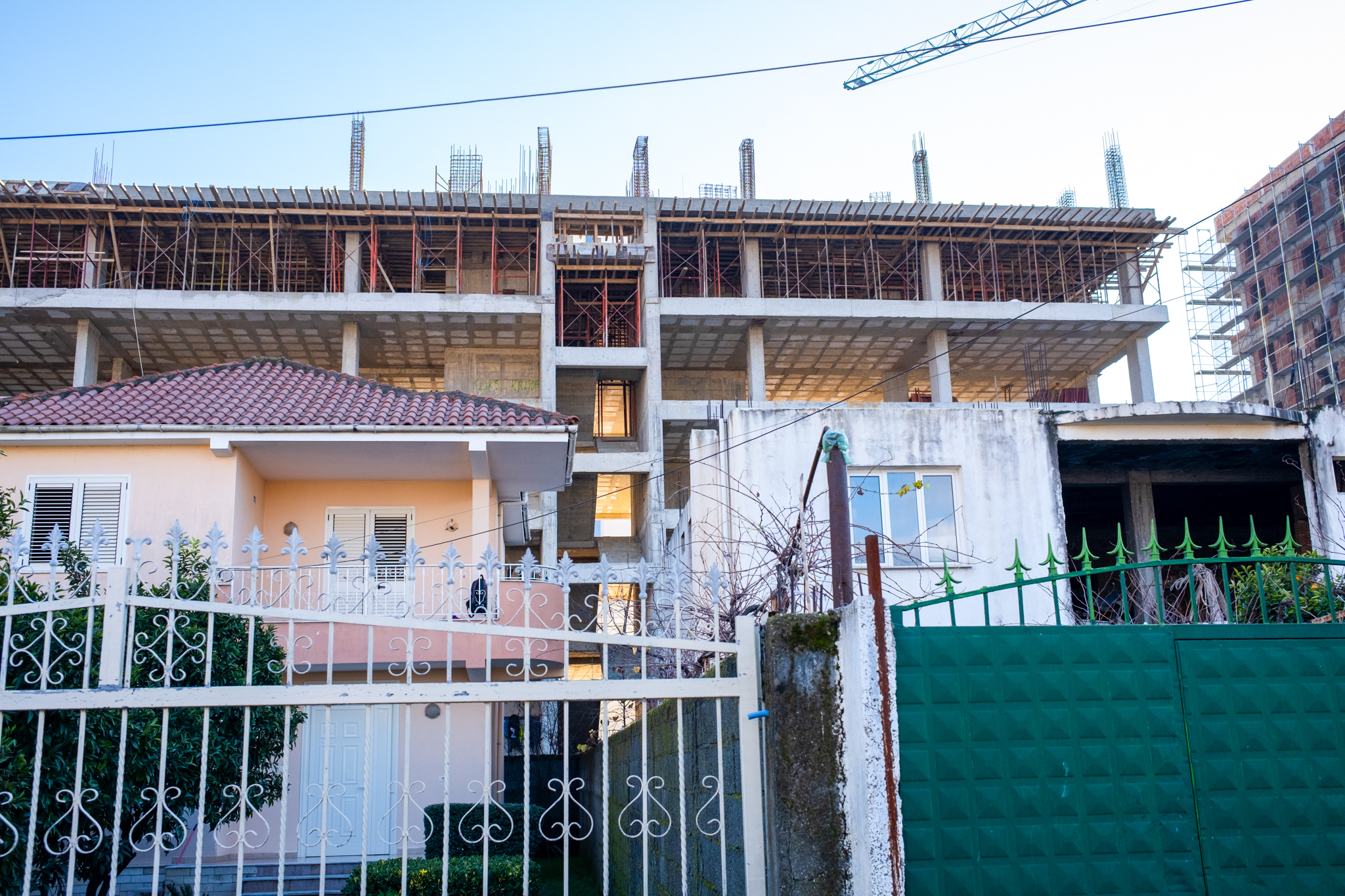
Kamza, December 2025 | Photo: ©Federico Caruso
Qema is referring to the 5 Maji and Kombinat neighbourhoods of Tirana, where some of the houses built by residents in the post-socialist period were destroyed to make way for new residential projects. As in Kamza, people have been living in legal limbo in these neighbourhoods for years. “The intention was to keep people in a situation of liminality, of not belonging anywhere,” says Qema.
This raises the question of all the construction sites that surround and tower over the two-storey houses built by Kamza’s inhabitants, cutting off both air and light. “These massive buildings are destroying the stories of those houses, built with so much sacrifice and promise of a new life.”
 This article was produced in the framework of PULSE, a European initiative coordinated by OBCT which promotes cross-border journalistic collaborations, and is part of a series on “peripheral” areas in Europe in collaboration with Il Sole 24 Ore, Voxeurop, and El Confidencial. We would like to thank Elira Kadriu of Citizens for her support in producing this report.
Tag: Architecture | Architettura | Kamza | PULSE | Urbanism | Urbanistica


Kamza: the construction of a “collective desire”
Located a few kilometres from Tirana, Kamza is a symbol of the internal migration that followed the collapse of Albania’s socialist regime. Constructed by its inhabitants, the city is currently experiencing intense development and political tensions, with some residents opposing these changes. Reportage
kamza_1_apertura
Kamza, December 2025 | Photo: ©Federico Caruso
“Kamza is a living laboratory of a different kind of city-building, where the human dimension is expressed to its fullest, and is inseparable from the desire for life,” writes Albanian architect Dorina Pllumbi of a city that was once a mere suburb of Tirana.
Kamza has been an autonomous municipality since 1996. Literally built by its inhabitants, and telling the story of Albania in chiaroscuro, “laboratory” is indeed the correct term.
We spoke with Pllumbi before seeing with our own eyes the buildings that some have pejoratively termed “informal” or “illegal”, and which, Pllumbi explains, are “a kind of spatial and material response to architecture being exercised as a top-down system of power, especially after the deep political, social and economic transformations of the 1990s.” For Pllumbi, the construction not only of houses but of an entire city like Kamza is a “physical political act.”
Due to traffic congestion, it takes between 30 and 50 minutes by car or bus to travel the seven kilometres between Kamza and Tirana.
kamza_2
Photo: ©Francesca Barca
Walking through Kamza, two things stand out: the first is how each house has a different structure from the next, and is often in a state of “evolution”, partly finished and partly under construction to extend the surface area. The second thing is the number of construction sites for large developments.
kamza_3
Photo: ©Federico Caruso
In 2019, Kamza made an appearance in the international press due to a curious decision by the local administration. Several streets are named after controversial political figures, including Donald Trump, George Bush, Silvio Berlusconi and Nicolas Sarkozy.
“Sorry to be so blunt, but people from the West often don’t understand the issue of right and left in Albania,” explains Nebi Bardhoshi, anthropologist. We met Bardhoshi in a bar in Kamza in late December.
After the end of the communist regime in the 1990s, Bardhoshi explains, the “most marginalised people – those expected to vote for the left, even if this dogma has now been abandoned everywhere – were those who opposed the regime.” This is why in Albania “the poorest areas voted and still vote for the Democratic Party (PDSH), which is a right-wing party. Obviously, no one voted for the names of the streets. There was no consultation. But people like them for some reason,” he says with a smile.
kamza_4
Nebi Bardhoshi, December 2025 | Photo: ©Federico Caruso
According to Erisa Kryeziu’s report published in Nyje.al, Kamza combines several paradoxes: “It is the smallest Albanian municipality in terms of area, but also the most densely populated, which makes it the most urbanised. Over the last twenty years, it has experienced extraordinary population growth. Around 160,000 inhabitants live in an area of 37.18 square kilometres.” The average age in the city is 27, while in the country at large it is 42.5, and has been rising steadily for some time.
Internal migration in Albania
After the end of the socialist regime (1946–92), Albania experienced massive emigration. According to the Albanian Department of Emigration, around half a million Albanians, or 15 percent of the population, left the country between 1990 and 1997. This movement was accompanied by internal migration from rural areas to the urban periphery, which helped to shape the urban and social geography.
Kamza was one of those destinations of internal migration. The people who came to Kamza mainly came from the north of the country, and were generally those who couldn’t afford to emigrate abroad, or could only afford to send one family member abroad, primarily to Italy or Greece.
Migrating abroad was difficult and mostly illegal, whether by sea to Italy, or by land to Greece. Bardhoshi tells us about the father of an acquaintance. “He spent nine months in Italy, made some money and then came back and built his house. This was the practice in the 1990s.” It was also a practice that involved entire families, including women.
The fall of communism in Albania meant many things, with many of the more significant changes involving land ownership, the decentralisation of the economy, and the introduction of freedom of movement.
As Bardhoshi explains, Albania had one of the lowest rates of urbanisation in Europe. In 1990, only 35 percent of the population lived in urban areas, which were mainly concentrated in the western districts, and the regime’s strategy was to keep people in rural areas.
“In 1991, state-owned farms and cooperatives were abolished, and the process of de-collectivisation began. At that point, people began to wonder where they would live.” The villages lacked housing, and the crisis in the mining sector had left many people unemployed.
For those who couldn’t leave the country, the other option was to move closer to the cities: “to survive, but also in the hope of a better life.” These people were emerging from a period and context in which “social control was intense. For young people, there was a sudden sense of liberty.”
No one knew what awaited them, Bardhoshi tells us. “I was young at the time. Poverty was real, but there was positive energy and belief in a better future. We were full of hope. And many of those hopes were realised.”
Bardhoshi describes this as a “social movement,” as well as an “illegal” phenomenon: the land belonged to the state, and in the early days no one – or at least not everyone – requested permits. In some cases, traditional land-use practices were applied; in other cases, people bought land from the people to whom the state had given it – sometimes on paper, and sometimes not. In short, it was a time of great legal and social confusion.
People wanted to buy, Bardhoshi insists, and it is important to emphasise this because the “rhetoric of the parties, and of the Socialist Party in particular, is to talk about these people as ‘illegal’ or ‘squatters.’”
The issue of “illegal” or “informal” settlements forms the core of a controversy that is deployed by politicians on all sides to drum up support. Since 2004, in Kamza as elsewhere, a process of regularisation has been underway, which involves inhabitants paying to regularise the houses that were built at their own expense.
It was no accident that this process was initiated just before the 2005 elections. “More than 50 percent of people were living in informal settlements. That’s a huge percentage,” explains Bardhoshi. The idea was to legalise, then legally expropriate, and then finally to “urbanise.”
Kamza, December 2025 | Photo: ©Federico Caruso
The Socialist Party, and specifically Edi Rama, the current prime minister, has a history of targeting the inhabitants of Kamza – as well as other areas built in a similar fashion – as uncivilised, anti-urban, and anti-state. Such discourse has been perpetuated for years, and, according to Bardhoshi, forms part of “a debate between rurality and urbanity that is quite widespread in Eastern Europe.” As in other post-socialist European countries, “there’s this clash between newcomers and the socialist bourgeoisie, who feel that their city – their ‘socialist paradise’ – doesn’t belong to them anymore.” Bardhoshi refers to this feeling as “socialist urban nostalgia.”
This attitude towards Kamza is also noted by Pllumbi, who describes it as the product of a specific political discourse. “As discussed among the activists of the city, Kamza’s identity was assigned by the elitist centre of power, Tirana. It was labelled as ‘the other,’ and now it stands as a symbol of this otherness,” as highlighted by research done by ATA group on how the media portrayed Kamza’s inhabitants at the time of the migration.
People came to Kamza with the idea of giving their children a better life, opportunities to study, and to work. There were no schools in the new settlement, so the inhabitants organised lessons in their own homes. “It’s fascinating how, in the absence of the state, these communities were able to do what they did.”
ATA, “they” and “the other”
The research Pllumbi referred to is the work of a group of Kamza residents that has turned this “otherness” into a political project. ATA “is not an acronym”, Diana Malaj tells us in perfect Italian, but the pronoun “they.” And who are “they”? “They” is how “people living on the margins of society are perceived.” Malaj, who co-founded the collective in 2014, is part of the generation that migrated from rural areas to Kamza with their families.
We visited the group’s premises accompanied by Ronald Qema, who joined in 2016 when he was still in high school. The group was created precisely because “we were tired of the stigma that Kamza continues to bear”: that of being “illegal occupants” or “squatters”.
kamza_5
Ronald Qema at the ATA headquarters, December 2025 | Photo: ©Federico Caruso
Malaj and Qema now live abroad, where they are completing their studies or research projects. “We live in a country where migration is mandatory to survive and build the future.”
Kamza has no cinema, theatre, archive or museum, Malaj tells us.
ATA began by engaging in cultural activism, mainly through theatre, to “find our language,” but also to “build a desire, not only individual desire, but above all a collective desire.”
kamza_6
Kamza, December 2025 | Photo: ©Federico Caruso
ATA also documents – through the online newspaper Nyje.al – and engages in urban anthropology, collecting stories and organising workshops with residents. As Qema shows us around the group’s space, which is also a library, he explains that ATA also provides legal and administrative assistance to citizens, and supports communities affected by the numerous hydroelectric development projects that are devastating the Albanian landscape.
“We are here to fill a gap within our collective and within ourselves.” Qema is quick to add that the goal is not to fill the political gap, but to expose it. “Our parents’ generation built this city, this community, out of necessity, to build their own lives. For me, it is our generation’s duty to work on the public life of this community.” To ensure that the community is heard by those who govern, it is also necessary to “create social desire.”
kamza_7
Kamza, December 2025 | Photo: ©Federico Caruso
While the parents of the ATA generation built the houses and “took care of us,” Qema tells us, today the task is to “make these stories visible, to talk about our community, to value how things were, and also, in a way, to document and protect what is happening now and what could happen in the future.”
kamza_8
Kamza, December 2025 | Photo: ©Federico Caruso
Qema is referring to the 5 Maji and Kombinat neighbourhoods of Tirana, where some of the houses built by residents in the post-socialist period were destroyed to make way for new residential projects. As in Kamza, people have been living in legal limbo in these neighbourhoods for years. “The intention was to keep people in a situation of liminality, of not belonging anywhere,” says Qema.
This raises the question of all the construction sites that surround and tower over the two-storey houses built by Kamza’s inhabitants, cutting off both air and light. “These massive buildings are destroying the stories of those houses, built with so much sacrifice and promise of a new life.”
This article was produced in the framework of PULSE, a European initiative coordinated by OBCT which promotes cross-border journalistic collaborations, and is part of a series on “peripheral” areas in Europe in collaboration with Il Sole 24 Ore, Voxeurop, and El Confidencial. We would like to thank Elira Kadriu of Citizens for her support in producing this report.
Tag: Architecture | Architettura | Kamza | PULSE | Urbanism | Urbanistica