İmamoğlu trial, the press under pressure
Ekrem İmamoğlu, mayor of Istanbul and Erdoğan’s main challenger in the 2028 presidential election, has been under arrest for a year. The opening of his trial, widely seen as politically motivated, was marked by severe restrictions on the press covering the event
shutterstock_2491119791
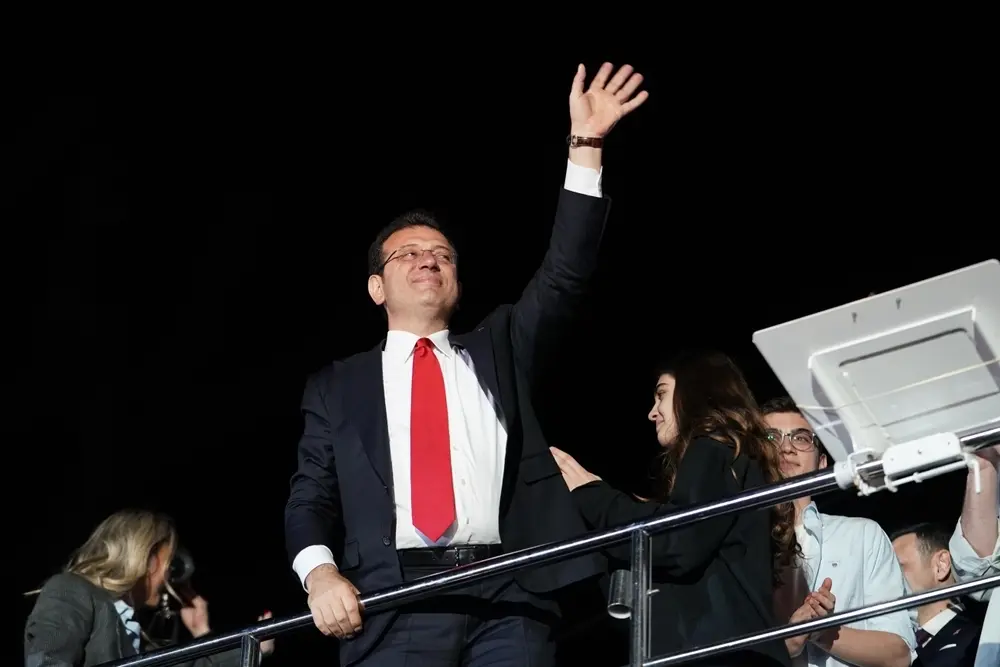
Ekrem İmamoğlu © EvrenKalinbacak/Shutterstock
“Neither fear nor anger is what gets me out of bed every morning. What lifts me up and keeps me standing is knowing that we are in the right, and that Ekrem İmamoğlu’s faith in this country will not be in vain. We are in the right.”
At a rally attended by thousands in Istanbul’s Saraçhane Square on March 18, 2026, Dilek Imamoğlu, wife of Istanbul’s jailed mayor Ekrem İmamoğlu, addressed the crowd in tears on the first anniversary of her husband’s detention.
Istanbul Mayor Ekrem İmamoğlu was taken into custody in March last year, the same day he was announced as the CHP’s candidate for the 2028 presidential election. His arrest sparked the biggest street protests Turkey had seen in over a decade, which were met with mass arrests and a heavy police crackdown. Imamoğlu faces a prison sentence of up to 2,430 years for allegedly establishing and leading a “criminal organization”.
On March 9, the trial of president Erdoğan’s strongest challenger began in a chaotic atmosphere at the courthouse of Silivri Prison in Istanbul. A major cause of the chaos was the arbitrary obstruction of journalists covering one of the most significant trials in Turkey’s political history.
Prior to the start of the trial, the Istanbul 40 High Criminal Court announced that it would impose a “press quota”. The court stated that only twenty local journalists and five foreign reporters would be permitted entry, with a maximum of one representative per media outlet. Although the large number of defendants was cited as the reason, half of the vast courtroom remained empty, the reporters said.
The trial of 402 defendants, including İmamoğlu, has been adjourned twice by the presiding judge for various reasons. One such incident occurred after the jailed Istanbul mayor answered brief questions from journalists in the courtroom on March 12.
The judge ordered the gendarmerie to move journalists to a location in the courtroom that would make it more difficult for them to follow the proceedings. Journalists who followed the hearings from desks next to the lawyers were then placed in a “blind spot”. The judge claimed that “the order of the court had been disrupted”, and the hearing was consequently adjourned.
Fırat Fıstık, one of the journalists covering the trial, describes the severe restrictions in the Silivri courtroom as “psychological warfare”. Journalists sent to the back of the courtroom found it difficult to follow the proceedings. Fıstık says, “We couldn’t hear what was being said, so we asked the lawyers. It was very difficult for all of us to see and hear.”
The journalists sent a petition to the court, requesting to return to their former seats as representatives of the public’s right to freedom of information, a right protected by the Constitution.
“On the fifth day of the trial, we find ourselves once again in the far right-hand corner of the courtroom, in the blind spot. In the name of journalism, the public’s right to information, and press freedom, we wish to follow the trial from the area where we previously did so, at the tables next to the lawyers, where we can practise journalism under suitable conditions,” they wrote.
Erol Önderoğlu, Reporters Without Borders (RSF) Turkey representative, condemned the court’s exclusionary treatment of the press. “We consider the court’s pushing of journalists into blind spots in the courtroom as an attempt at censorship. This attitude, imposing such physical conditions and thereby undermining the press’s role of informing the public, is unacceptable,” Önderoğlu said.
The trial of Ekrem İmamoğlu, a leading opposition figure, has drawn intense national and international attention, and is seen by many as a landmark case in Turkey’s politically charged judicial landscape. “A large segment of the population considers the criminal proceedings to be politically motivated,” says political scientist Dr. Yaşar Aydın, researcher at the Centre for Applied Turkey Studies at the German Institute for International and Security Affairs (SWP).
“Outside Erdoğan’s support base and the pro-government media, an alternative narrative has taken hold: he has been indicted because he triumphed four times against Erdoğan’s AKP in Istanbul, and he stands a strong chance of becoming the opposition’s presidential candidate,” Aydın adds.
Dr. Aydın’s words also shed light on the restrictions imposed on journalists. It can be said that there were efforts to prevent Imamoğlu’s remarks, both during the hearing and in the breaks, from reaching the public.
According to reporter Fırat Fıstık, from the very start of the trial, the judge has sought to convey the message “I’m in charge here”, resulting in the press, defendants, and lawyers facing various obstacles.
Journalist organizations have reacted to the restrictions imposed on the press. “Court proceedings are public, this stance constitutes an interference with the public’s right to information. If journalists are prevented from doing their jobs, it begs the question: What are you hiding from the public?”, the Journalists’ Union Of Turkey (TGS) said in a statement.
The trial will continue today, March 23. Hearings will be held for four days each week until the end of April.
Tag: Libertà di stampa