From dead-end to urban oasis: Bucharest’s community-designed park
Bucharest, the Romanian capital, Militari neighborhood. Where once stood a twenty-year-old abandoned railway line, overflowing with garbage, an intriguing urban oasis has sprung up: the brand-new Railway Park. Credit goes to an idea from PressOne newspaper and the direct involvement of the local community
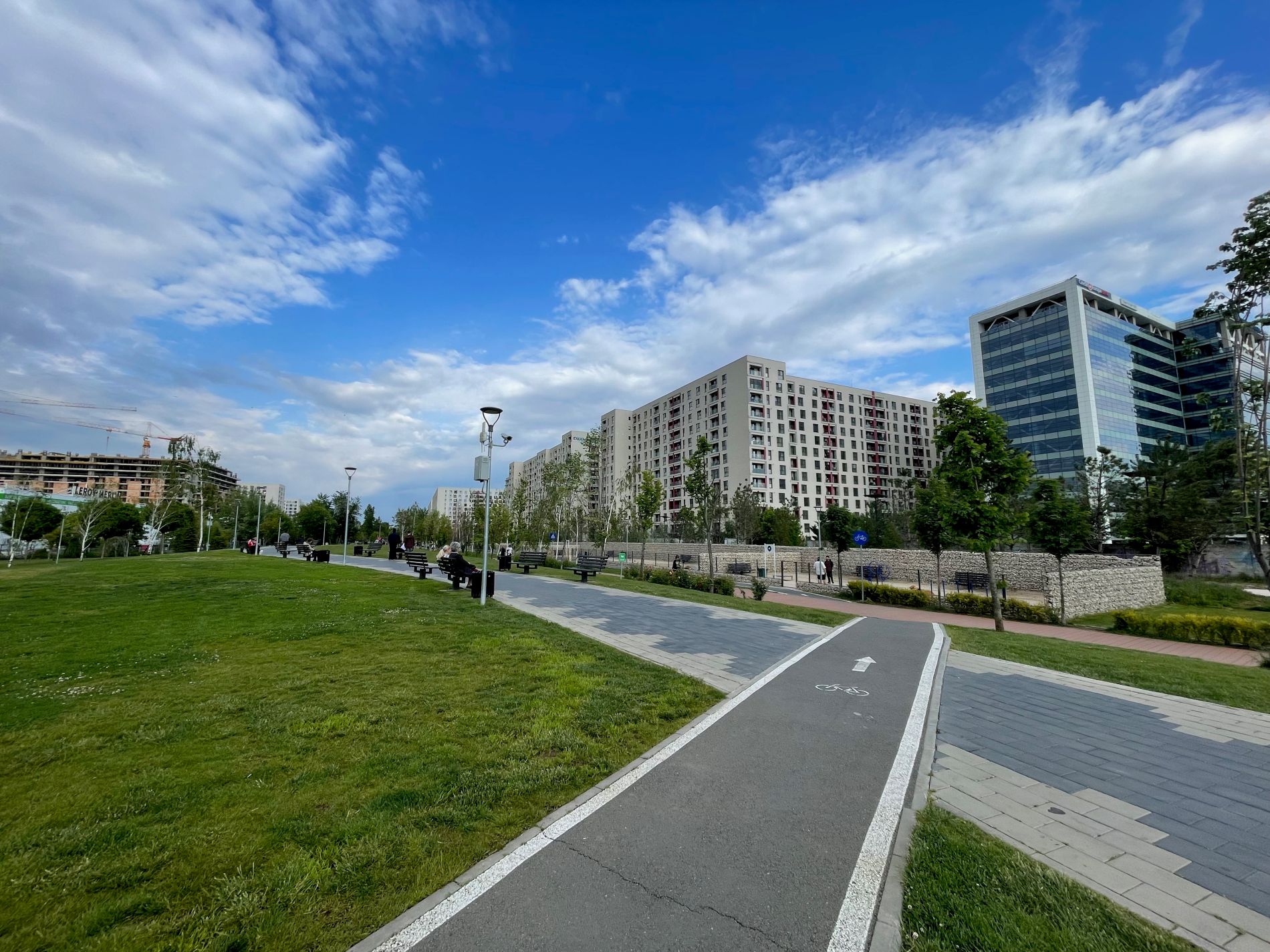
Parcul Liniei, Bucharest, Romania – Photo M. Ranocchiari
Parcul Liniei, Bucharest, Romania - Photo M. Ranocchiari
Bucharest, Militari neighborhood. A crowd patiently waits for the green light to cross one of the many multi-lane boulevards in the city’s Sector 6. In the background, ten-story block buildings, some peeling from the communist era, others ultra-modern, blazing white. Their silhouettes, along with those of the fragile rows of linden trees along the road, carve the sky.
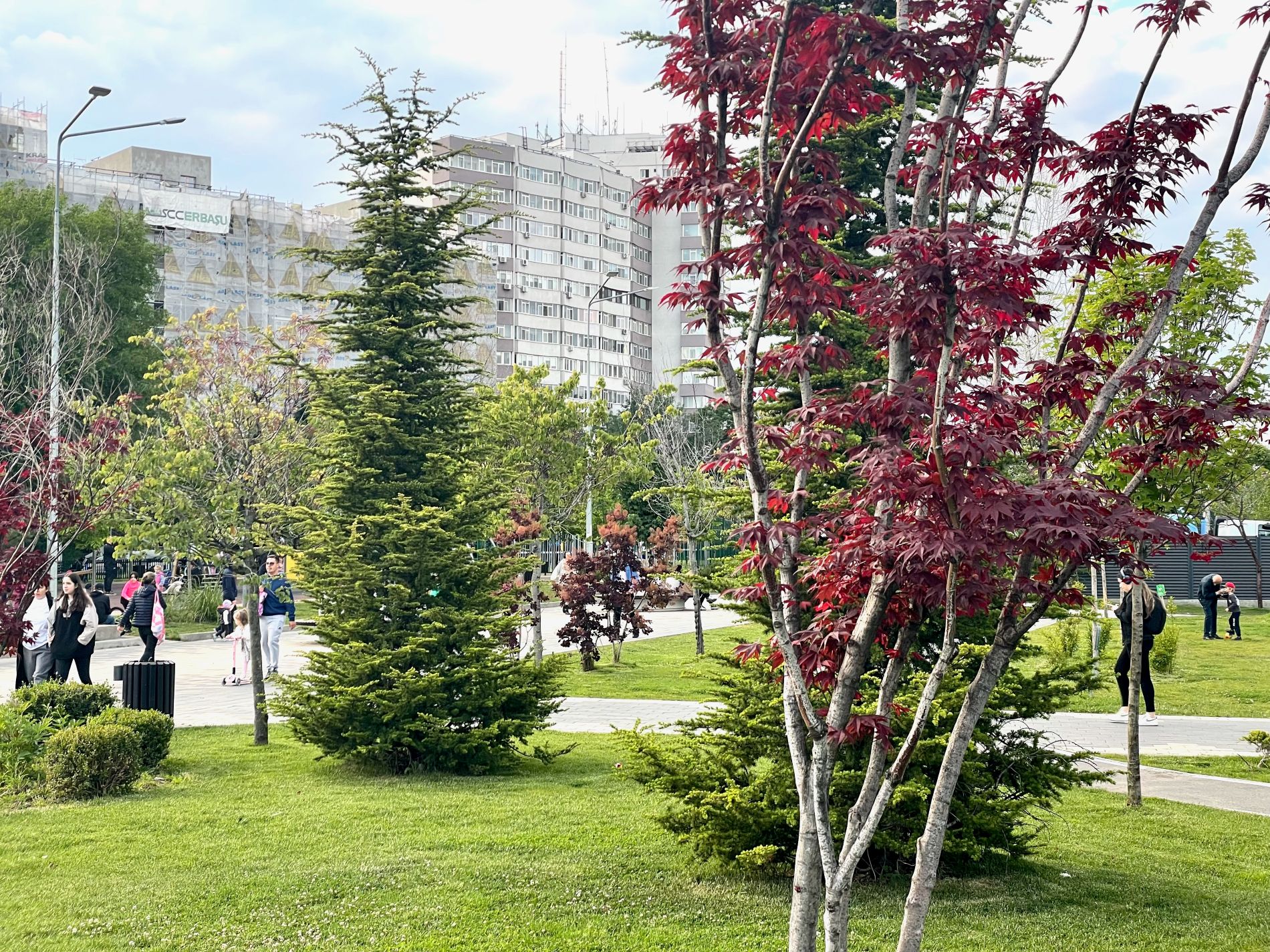
When the little green man lights up, the noise of traffic fades, only to begin again, until the next intersection, in a constant repetition that could get you across the entire city. Behind a seemingly ordinary intersection, however, the rhythm breaks. Instead of asphalt, the road is made of grass, dotted with rides, benches, and slender, newly planted trees.
It’s the brand-new “Parcul Liniei,” built on the remains of a railway abandoned for twenty years and filled with garbage. Today it is one of the largest linear parks in Europe (when completed, it will reach 4.2 kilometers), but until six years ago, it was unconceived.
It all began in 2020, with an article published by a small, independent online newspaper, PressOne. The idea, thanks to the direct involvement of the community, would soon become a concrete project.
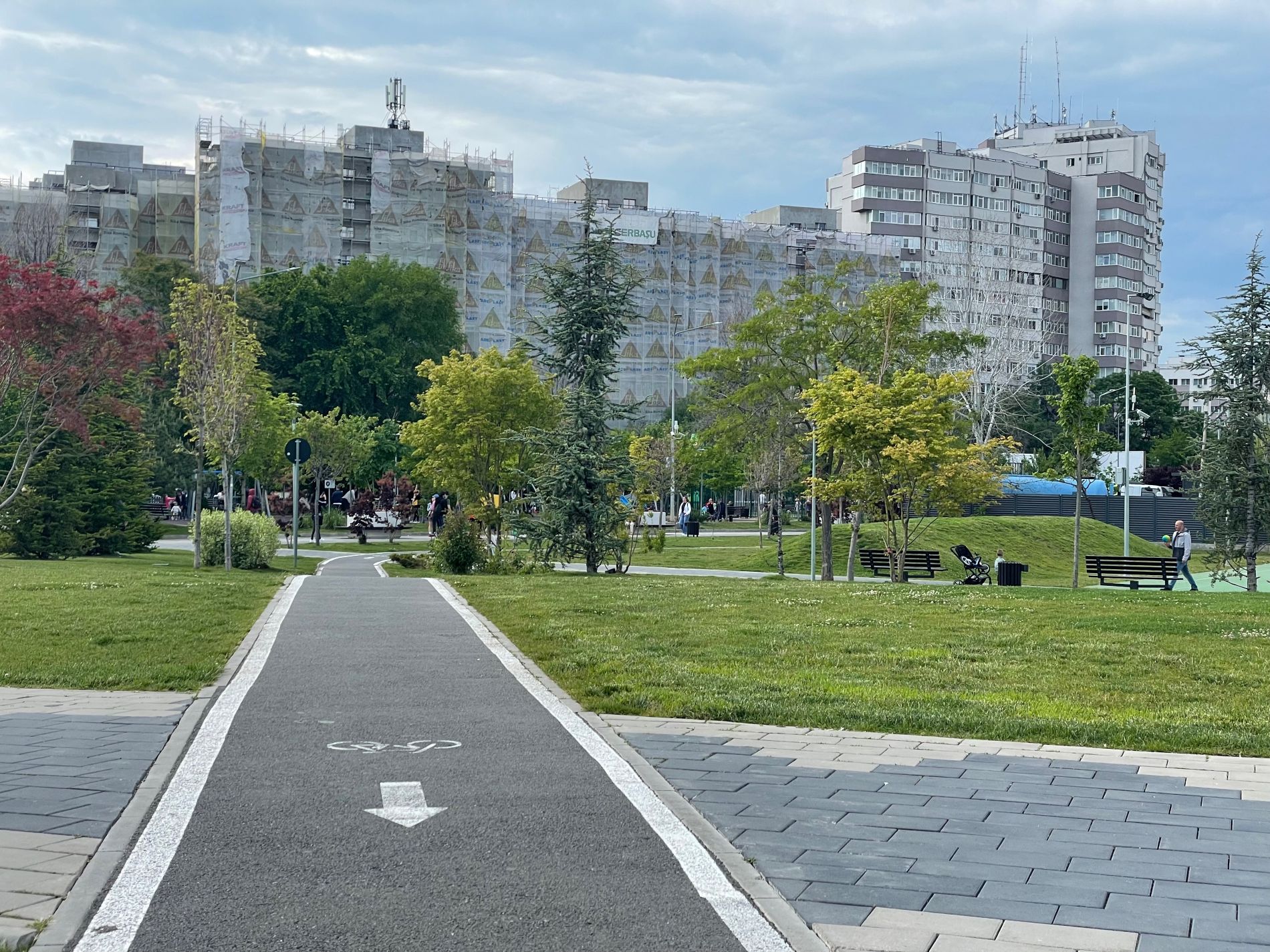
Parcul Liniei, Bucharest, Romania – Photo M. Ranocchiari
PressOne’s insight
Good ideas, as we know, often come from traveling. This was the case for Adrian Mihălțianu and his colleagues at the independent newspaper PressOne: “In 2019, I went to Boston for work. There,” he explains, “they used to have a large highway that ran along the sea. They buried it and built a beautiful park in its place.”
Other cities had made similar choices: Paris, New York, La Ciotat in France. Why not replicate it in Bucharest? The city had a disused railway line that ran across the entire western part of the city, for a length of 6 kilometers.
“The city hall’s idea was to create yet another avenue for cars. There was also the idea of a metro train, but the area was already well served by public transportation, with the subway not far away. Furthermore,” Mihălțianu continues, “the area is too narrow; the trains would have passed in front of residents’ windows.” The 200,000 people in the neighborhood, however, didn’t have a green space. “So in 2020, we launched an idea with an article in our newspaper.”
This article was published in the first issue of Clima, cavoli e cappucci, the Station For Transformation fanzine. OBCT curates the “Sguardi d’Europa” column, designed to broaden the horizon and engage with other European contexts, through insights that reveal how various European cities are transforming to respond to the challenges of the climate crisis and biodiversity loss.
The idea gains traction
Meanwhile, it was election time in Bucharest. “Since we interviewed all the reformist candidates for the Bucharest mayoral elections, we also presented this idea to them.”
The candidate who would eventually be elected mayor of Sector 6, Ciprian Ciucu, was also the most supportive. “We put him in touch with an NGO with experience in the regeneration of industrial spaces, Urbanize Hub. From the very beginning,” adds Mihălțianu, “it was clear that it shouldn’t be something that comes solely from the mayor’s office, but a shared process.”
A community journey
Thus began a long series of consultations. “We were in the midst of the pandemic,” says Mihălțianu, “and holding them in person wasn’t easy. Yet participation was very high by the standards of a city like Bucharest, where there aren’t many organized communities on the ground. Over 45 people attended the in-person meetings, and many more attended the online ones organized by Urbanize Hub.”
Over 4,000 people responded to the online questionnaires (with a peak of 3,600 in a single day), and more than 70 attempted to digitally design the new park themselves using the dedicated “Furban” app. The association also conducted sociological and anthropological surveys to understand the needs and desires of the population involved.
This genuine consultation yielded a more comprehensive result than the promoters had imagined. “People were asking not just for green spaces, as we had initially envisioned, but for bike paths, tennis courts, ping-pong tables, and basketball courts, and places for children to play.”
Parcul Liniei, Bucharest, Romania – Photo M. Ranocchiari
The park in progress
Since its first section opened on June 1, 2023, the park has been a gathering place for everyone. Not everyone who uses it has followed the participatory process that created it, and many aren’t even aware of it. Like the young Ukrainian mother, Tatiana, who arrived only a year ago and assures us that her son — climbing on a colorful slide — loves it.
“It’s a green neighborhood,” comments Tatiana, a color once unthinkable to associate with the austere Militari.
Andrei and Ana, architecture students, are preparing for an exam on the computer under a pavilion where the designers have installed electrical outlets for chargers, and electronic music at low volume accompanies their efforts.
Another Andrei watches his dog stroll in the designated area, while other young people snooze in hammocks. Meanwhile, the parkside cafes are doing a roaring trade.
“They put too much in there!” jokes Mihălțianu, “I would have preferred it more natural. In any case, the project favors low-maintenance and perennial plants, shrubs over lawns, and the use of local trees, shrubs, and flowers to create an oasis of biodiversity.” There have been challenges. “Access to the park is sometimes blocked by the private courtyards of some new buildings, but we will fight to ensure equal access for all.” There is also a more serious risk, common to many redeveloped areas: gentrification.
“It’s a problem, but less serious than elsewhere: it’s true that new middle-class buildings have sprung up, but the working-class ones have remained. It’s a mixed neighborhood. Everyone benefits from this park.”
Meanwhile, the park’s success is so evident that the municipality is considering replicating the project in Sector 5, an even more drab area than Militari. Mihălțianu has a dream for the “Parcul Liniei 2″: that it be built with the same process of involving the population. This is not a given in Romania.”
This material is published in the context of the Station4Transformation, co-funded by the European Union (EU). The EU is in no way responsible for the information or views expressed within the project. The sole responsibility for the content lies with OBC Transeuropa.
Tag: In evidenza