Extreme wildfires: Fire-Res ends, but the challenge continues
The Fire-Res project ends with a positive outcome, but the threat of extreme fires remains. We need to transform knowledge into concrete action through cooperation, economic tools, and citizen engagement

Fire prevention © Shutterstock
Four years of meetings, studies, and exchanges, from the Mediterranean countries most exposed to the flames – Spain, Portugal, Italy, and the Balkans – to Northern Europe, which once thought itself safe and now discovers its own vulnerability. This journey culminated on November 4th and 5th in Brussels, with a final conference at the heart of European institutions aimed at transforming knowledge and research into concrete policies for forest resilience.
With a budget of €21 million, 35 partners from 13 countries, and over 50 scientific publications, Fire-Res has generated more than 30 innovation actions, created 11 living labs across Europe, and fostered dialogue with local communities. This has also included dissemination, to which OBCT has contributed with an awareness campaign and dozens of journalistic investigations
The meeting in Brussels was not just a celebration: more than 120 participants (researchers, firefighters, policymakers, trade associations, and civil society) discussed results and the future.
Extreme fires do not end with the project: 2025, with over one million hectares burned in Europe, confirms a growing trend linked to the climate crisis.
“Fire resilience is not just a scientific and operational challenge: it is a political and social imperative. We now have the tools, knowledge, and partnerships to replicate and implement solutions at scale. This is what we intend to do in the coming years, transforming this project into a scaled-up international program,” explained Antoni Trasobares, coordinator and director of the CTFC, the lead agency.
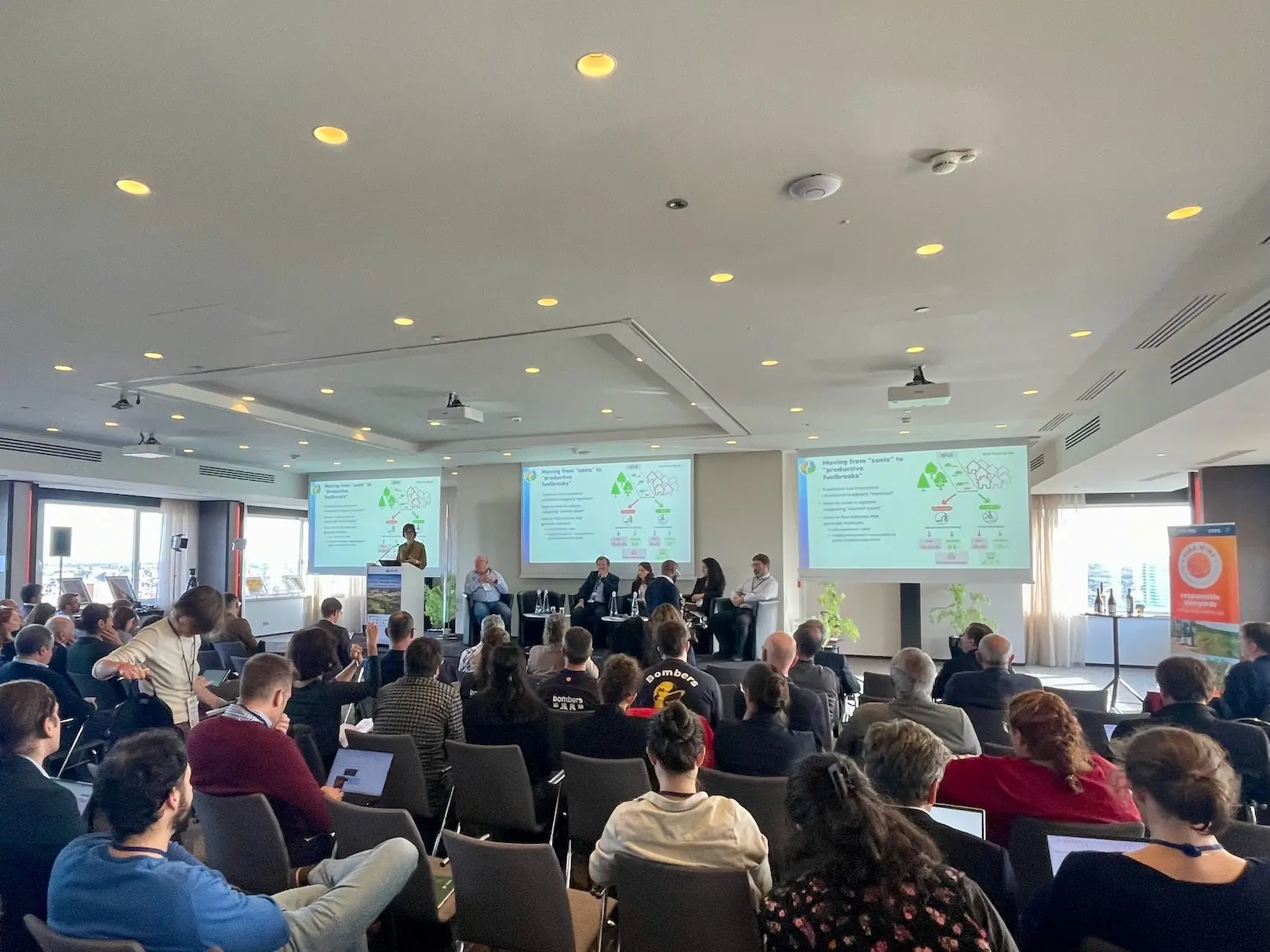
Fire-Res Final Conference Brussels – photo by M. Ranocchiari
A global problem
Extreme fires – unpredictable and difficult to contain – are now a global phenomenon. The dynamics observed in Europe are being replicated across every continent, as highlighted by guests from California, South Africa, Australia, Chile, and – in a video- from Canadian forests managed by indigenous communities.
“Fires are no longer seasonal or local events. They increasingly exceed the thresholds of our suppression capacity,” said Philip Selegue of CalFire, the California fire department. “Every year we repeat that it was the worst season, but the next one is even worse. The frequency of extreme fires has doubled in the last 20 years, and studies indicate up to 1.4 million deaths annually by the end of the century if emissions do not decrease.”
The response, according to Selegue, involves less emergency and more prevention, with more forecasting technology and better knowledge of forests and fires themselves, including rediscovering practices like prescribed burning. International coordination and cooperation are essential.
Involving the territory
One of the cornerstones of Fire-Res is an integrated approach: prevention, emergency management, forest ecology, local economy, and the needs of rural communities must be considered as parts of the same system.
“To address such a complex problem, we need to break it down into smaller, more manageable components: this is the logic that guided the development of the project’s work packages,” explained José Borges, professor at the University of Lisbon and coordinator of the work package dedicated to land management. “Above all, we cannot ignore the human dimension: data, models, and technology are not enough without the involvement of people.”
This is why the project invested in Living Labs: real-world spaces where citizens, businesses, and institutions could experiment with technological and social solutions and co-design more resilient landscapes.
But to ensure the transition does not remain theoretical, it must start with those who live and manage forests. One of the main obstacles, emphasizes Helena Koch, policy advisor for the Confederation of European Forest Owners (CEPF), is the fragmentation of ownership. “In the European Union, we estimate 15 million forest owners. Many areas cannot be actively managed without suffering economic losses. The knowledge exists, research is progressing, and solutions are known. But the structural resource problem remains.”
Financing change
Elena Górriz, of the CTFC, emphasizes the importance of connecting resilience and economics. “Excellent ideas on how to design landscapes risk remaining on paper without the resources to implement and maintain them.” The challenge is to transform expenditure into value, creating systems that generate benefits and sustain maintenance.
In Mediterranean forests, which are less profitable than Atlantic forests, initiatives such as targeted grazing, payments for ecosystem services, or brands like Fire Wine can make prevention cost-effective.
A growing role could also be played by environmental policies and the forest carbon credit market, which would encourage owners to invest in sustainable management even when forests are not their primary source of income.
Insurance: an open question
Insurance can provide economic relief and restore stability to territories after a fire. The conference dedicated a panel to the topic with Guillaume Bouffard of GFA and Ferran Bonet, Reinsurance Manager at PIB Group Iberia.
But the uptake of insurance tools is still limited. “There is little awareness of the available tools, and premiums are often too high and reimbursements are slow,” explains Górriz. Europe lacks coverage, especially for indirect damages, such as total crop loss due to smoke and ash. “A more agile structure is needed,” the experts conclude.
The demand for effective policies from Europe
Translating ideas into practice requires solid political instruments, and the place where they can emerge is Brussels. The second day took place in the European Commission’s offices, with a roundtable discussion among coordinators, regional representatives, and EU decision-makers.
Bulgarian MEP Andrey Kovachev emphasized the need for closer transnational cooperation and a shift in priorities: shifting more resources from fire suppression to prevention.
From their firsthand experience, Tiago Oliveira, president of the Portuguese Rural Fire Agency, and Katerina Trepekli, advisor to the Greek Ministry for Climate Crisis, recalled how the extreme fires of 2017 and 2018 forced their countries to rethink strategies and governance. But the pace of change, they warn, is still insufficient: “We are not moving as fast as climate change.” And the issue, they emphasize, is primarily political: “We are fighting more for power than for knowledge.”
Nicolas Faivre, Fire-Res project officer at the European Commission’s Research Agency, echoed these concerns. The decisive step, he explained, will be to transform the proposals developed in Fire-Res into concrete policies. The Union, he assured, will continue to invest in projects that continue on this path, ensuring continuity of the work already underway.
Looking to the future
Coordinator Antoni Trasobares is convinced that the end of the project is just a new beginning. “Our project has had the unique ability to focus on territorial transformation thanks to a balanced combination of science, involvement of local communities, and public and private stakeholders. The living labs – this implementation component – are truly its greatest strength.”
The challenge, he explains, is not so much producing knowledge, but “bringing this potential to the highest decision-making levels, both public and at the European Union and national levels.”
To do this, specific proposals must be presented: “It’s not enough to say what shouldn’t be done. We need to show how to manage territorial units, design landscapes, and involve local stakeholders.” Trasobares also emphasizes the importance of the private sector: “It’s an emerging market: there’s a great opportunity in the transformation of abandoned territories in Europe and around the world.”
The project will continue, albeit in new forms: “We will continue with the network of living labs and with key development partners. We will expand it with new partners, including in Canada and Australia, creating an international network of laboratories where transformation occurs on a large scale. The story continues in another format, but we can’t stop now. Change requires energy, solid arguments, and a healthy dose of tenacity.”
This material is published in the context of the "FIRE-RES" project co-funded by the European Union (EU). The EU is in no way responsible for the information or views expressed within the framework of the project. Responsibility for the contents lies solely with OBC Transeuropa. Go to the FIRE-RES page

Tag: FIRE-RES
Featured articles
- Take part in the survey
Extreme wildfires: Fire-Res ends, but the challenge continues
The Fire-Res project ends with a positive outcome, but the threat of extreme fires remains. We need to transform knowledge into concrete action through cooperation, economic tools, and citizen engagement

Fire prevention © Shutterstock
Four years of meetings, studies, and exchanges, from the Mediterranean countries most exposed to the flames – Spain, Portugal, Italy, and the Balkans – to Northern Europe, which once thought itself safe and now discovers its own vulnerability. This journey culminated on November 4th and 5th in Brussels, with a final conference at the heart of European institutions aimed at transforming knowledge and research into concrete policies for forest resilience.
With a budget of €21 million, 35 partners from 13 countries, and over 50 scientific publications, Fire-Res has generated more than 30 innovation actions, created 11 living labs across Europe, and fostered dialogue with local communities. This has also included dissemination, to which OBCT has contributed with an awareness campaign and dozens of journalistic investigations
The meeting in Brussels was not just a celebration: more than 120 participants (researchers, firefighters, policymakers, trade associations, and civil society) discussed results and the future.
Extreme fires do not end with the project: 2025, with over one million hectares burned in Europe, confirms a growing trend linked to the climate crisis.
“Fire resilience is not just a scientific and operational challenge: it is a political and social imperative. We now have the tools, knowledge, and partnerships to replicate and implement solutions at scale. This is what we intend to do in the coming years, transforming this project into a scaled-up international program,” explained Antoni Trasobares, coordinator and director of the CTFC, the lead agency.

Fire-Res Final Conference Brussels – photo by M. Ranocchiari
A global problem
Extreme fires – unpredictable and difficult to contain – are now a global phenomenon. The dynamics observed in Europe are being replicated across every continent, as highlighted by guests from California, South Africa, Australia, Chile, and – in a video- from Canadian forests managed by indigenous communities.
“Fires are no longer seasonal or local events. They increasingly exceed the thresholds of our suppression capacity,” said Philip Selegue of CalFire, the California fire department. “Every year we repeat that it was the worst season, but the next one is even worse. The frequency of extreme fires has doubled in the last 20 years, and studies indicate up to 1.4 million deaths annually by the end of the century if emissions do not decrease.”
The response, according to Selegue, involves less emergency and more prevention, with more forecasting technology and better knowledge of forests and fires themselves, including rediscovering practices like prescribed burning. International coordination and cooperation are essential.
Involving the territory
One of the cornerstones of Fire-Res is an integrated approach: prevention, emergency management, forest ecology, local economy, and the needs of rural communities must be considered as parts of the same system.
“To address such a complex problem, we need to break it down into smaller, more manageable components: this is the logic that guided the development of the project’s work packages,” explained José Borges, professor at the University of Lisbon and coordinator of the work package dedicated to land management. “Above all, we cannot ignore the human dimension: data, models, and technology are not enough without the involvement of people.”
This is why the project invested in Living Labs: real-world spaces where citizens, businesses, and institutions could experiment with technological and social solutions and co-design more resilient landscapes.
But to ensure the transition does not remain theoretical, it must start with those who live and manage forests. One of the main obstacles, emphasizes Helena Koch, policy advisor for the Confederation of European Forest Owners (CEPF), is the fragmentation of ownership. “In the European Union, we estimate 15 million forest owners. Many areas cannot be actively managed without suffering economic losses. The knowledge exists, research is progressing, and solutions are known. But the structural resource problem remains.”
Financing change
Elena Górriz, of the CTFC, emphasizes the importance of connecting resilience and economics. “Excellent ideas on how to design landscapes risk remaining on paper without the resources to implement and maintain them.” The challenge is to transform expenditure into value, creating systems that generate benefits and sustain maintenance.
In Mediterranean forests, which are less profitable than Atlantic forests, initiatives such as targeted grazing, payments for ecosystem services, or brands like Fire Wine can make prevention cost-effective.
A growing role could also be played by environmental policies and the forest carbon credit market, which would encourage owners to invest in sustainable management even when forests are not their primary source of income.
Insurance: an open question
Insurance can provide economic relief and restore stability to territories after a fire. The conference dedicated a panel to the topic with Guillaume Bouffard of GFA and Ferran Bonet, Reinsurance Manager at PIB Group Iberia.
But the uptake of insurance tools is still limited. “There is little awareness of the available tools, and premiums are often too high and reimbursements are slow,” explains Górriz. Europe lacks coverage, especially for indirect damages, such as total crop loss due to smoke and ash. “A more agile structure is needed,” the experts conclude.
The demand for effective policies from Europe
Translating ideas into practice requires solid political instruments, and the place where they can emerge is Brussels. The second day took place in the European Commission’s offices, with a roundtable discussion among coordinators, regional representatives, and EU decision-makers.
Bulgarian MEP Andrey Kovachev emphasized the need for closer transnational cooperation and a shift in priorities: shifting more resources from fire suppression to prevention.
From their firsthand experience, Tiago Oliveira, president of the Portuguese Rural Fire Agency, and Katerina Trepekli, advisor to the Greek Ministry for Climate Crisis, recalled how the extreme fires of 2017 and 2018 forced their countries to rethink strategies and governance. But the pace of change, they warn, is still insufficient: “We are not moving as fast as climate change.” And the issue, they emphasize, is primarily political: “We are fighting more for power than for knowledge.”
Nicolas Faivre, Fire-Res project officer at the European Commission’s Research Agency, echoed these concerns. The decisive step, he explained, will be to transform the proposals developed in Fire-Res into concrete policies. The Union, he assured, will continue to invest in projects that continue on this path, ensuring continuity of the work already underway.
Looking to the future
Coordinator Antoni Trasobares is convinced that the end of the project is just a new beginning. “Our project has had the unique ability to focus on territorial transformation thanks to a balanced combination of science, involvement of local communities, and public and private stakeholders. The living labs – this implementation component – are truly its greatest strength.”
The challenge, he explains, is not so much producing knowledge, but “bringing this potential to the highest decision-making levels, both public and at the European Union and national levels.”
To do this, specific proposals must be presented: “It’s not enough to say what shouldn’t be done. We need to show how to manage territorial units, design landscapes, and involve local stakeholders.” Trasobares also emphasizes the importance of the private sector: “It’s an emerging market: there’s a great opportunity in the transformation of abandoned territories in Europe and around the world.”
The project will continue, albeit in new forms: “We will continue with the network of living labs and with key development partners. We will expand it with new partners, including in Canada and Australia, creating an international network of laboratories where transformation occurs on a large scale. The story continues in another format, but we can’t stop now. Change requires energy, solid arguments, and a healthy dose of tenacity.”
This material is published in the context of the "FIRE-RES" project co-funded by the European Union (EU). The EU is in no way responsible for the information or views expressed within the framework of the project. Responsibility for the contents lies solely with OBC Transeuropa. Go to the FIRE-RES page
Tag: FIRE-RES