Cyprus: from a divided capital, Europe comes into focus
As Cyprus takes over the EU Council presidency, Brussels frames the moment as one of continuity and procedural competence. On the ground, in a capital shaped by division, the picture is more complex
shutterstock_2396138119
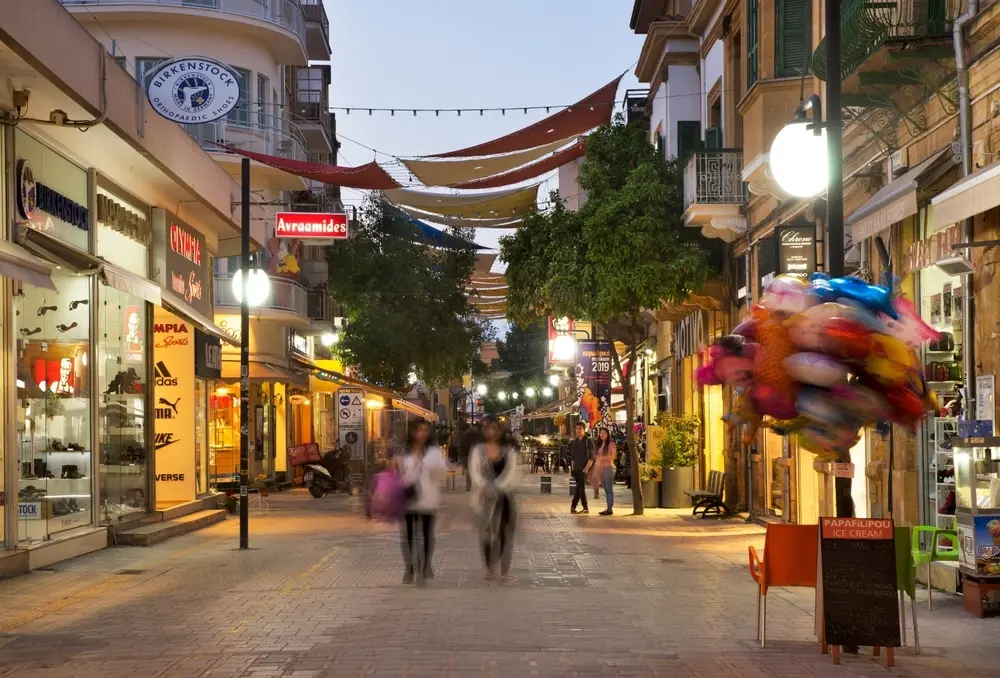
Nicosia, Ledra street © Shevchenko Andrey/Shutterstock
On a Saturday afternoon in the summer of 2025, a few months before Cyprus was due to assume the presidency of the Council of the European Union, I crossed the Ledras checkpoint on foot. The air was warm and humid, softened by a light breeze that made the heat bearable. On the Greek Cypriot side, Turkish floated through the air as clearly as Greek. Young people sat outdoors, coffees in hand, the street alive with conversation and movement.
Crossing north into Lefkoşa, the atmosphere shifted. Not abruptly, but decisively. The streets were quieter than I remembered. On a summer weekend, the Turkish Cypriot side of the city used to feel dense and animated late into the night. This time, it was subdued. The market was closed, as expected, but cafés and restaurants that once overflowed with people were nearly empty.
I walked through the cobbled streets toward Büyük Han. Small restaurants with vintage décor lined the way, the scent of cumin lingering in the air. Inside a colorful bistro, a Turkish pop song, Zeynep Bastık, playing directly from YouTube, filled the space, part of an all-time-classic playlist echoing for a handful of customers. On electricity columns nearby, photocopied sheets were glued unevenly. Written in Turkish, they advertised a student survey asking anonymously about division on the island and the upcoming EU presidency. Do you believe in unification? A QR code invited responses.
The square code, black and white, pixelated, felt like a quiet metaphor: Europe reduced to a scan, a question mark, a promise of anonymity.
The image of Lefkoşa felt unfamiliar. Investment and tourism had clearly shifted toward Girne, now competing with Limassol across the divide. I sat at the café I usually visit, where young Cypriots and bohemian tourists play backgammon – an unspoken counterpart to the ‘ouzeri’ cafés around Plateia Faneromenis, which I had crossed minutes earlier. The contrast was stark. Faneromenis square was crowded and loud. But here, tables stood empty. Prices, meanwhile, had risen sharply, nearly matching those on the Greek Cypriot side, despite significantly lower wages. The decline in tourism was no mystery.
A few months later, Cyprus would take over the presidency of the EU Council.
A presidency seen from the margins
Cyprus’s presidency of the Council of the European Union did not arrive with grand declarations, but rather framed by assurances of continuity and competence. Yet from the island itself, the presidency feels less like a moment of leadership and more like a mirror held up to Europe’s unresolved tensions. Cyprus is not only one of the EU’s smallest member states; it is also the only one whose capital remains divided. That fact has long shaped how the country is read abroad. But in 2026, as geopolitics moves to the centre of the European agenda, that division acquires renewed symbolic weight.
What 2012 taught a small state
This is Cyprus’s second turn at the helm. Its first presidency in 2012 unfolded at the height of the eurozone crisis, amid doubts about the Union’s stability and Cyprus’s own economic resilience. Independent journalist and analyst Andrianos Charalambous notes that, despite these conditions, the presidency was institutionally well received. The European Parliament explicitly described it as a “successful presidency of a small country,” recognising Cyprus’ role as a reliable mediator under intense pressure.
The lesson of 2012, Charalampous argues, was clear: for small member states, success lies not in imposing national priorities, but in credibility – managing procedures, brokering compromise and sustaining cohesion when consensus is fragile.
That logic still applies. The context does not.
From crisis management to geopolitical exposure
Fourteen years ago, Europe’s defining anxiety was economic. Today, it is mainly geopolitical. War in Ukraine, migration pressures, energy insecurity and debates over strategic autonomy dominate the EU agenda. Geography matters again and Cyprus’ position at the crossroads of Europe, the Middle East and North Africa is no longer peripheral.
Talking to OBCT, Limassol-based historian Savvas Stavrou argues that a presidency led by a divided member state exposes a fundamental tension within the EU itself: “When border and identity politics intensify, such a presidency forces a delicate balancing act between national interests and collective responsibility”. This dynamic, he notes, tests the EU’s foundational compromise: pooling sovereignty for shared goals while respecting national identities. In periods of resurgent nationalism, that compromise becomes harder to sustain, making consensus more elusive and national perspectives more pronounced, particularly on migration and security.
At this juncture, Cyprus’s presidency functions less as a driver of integration or major policy breakthroughs than as a lens through which Europe’s contradictions come into focus.
Bridges and the question of readiness
In her novel The Island of Missing Trees (2021), set in divided Cyprus, Elif Shafak writes that “bridges appear in our lives only when we are ready to cross them.” Today, ‘bridges’ on the island are not just metaphorical. They are concrete, guarded and crossed daily. The EU presidency does not build new bridges on the island. But it reveals how ready – or unready – Europe is to confront its own internal divisions.
Political visibility and vulnerability
Shortly after Cyprus formally assumed the rotating Presidency on 1 January 2026, domestic political dynamics drew intensified scrutiny. In early January, a video circulated online appearing to show senior officials in conversations that critics framed as relating to improper access to political influence and campaign financing.
While the government quickly characterised the footage as maliciously edited and potentially part of a broader disinformation effort timed to undermine the presidency, it nonetheless precipitated the resignations of the First Lady from a state‑linked social support body and of the president’s chief of staff, Charalambos Charalambous, who denied any wrongdoing and stated he left to protect the credibility of governing institutions.
Opposition parties have pressed for fuller transparency and investigations, illustrating how questions of governance, institutional integrity and public trust can intersect with Cyprus’s visibility in Brussels at a politically sensitive moment.
Northern politics and island-wide perceptions
Beyond the immediate concerns of the EU presidency, the island’s broader political landscape continues to evolve. In October 2025, Turkish Cypriots elected Tufan Erhürman as president of the unrecognised Turkish Republic of Northern Cyprus with a substantial majority.
Erhürman’s platform includes a more constructive engagement with reunification discussions on a federal basis and reflects a notable shift from the more hardline approaches of his predecessor, underscoring the diversity of political sentiment among Turkish Cypriots even within the constraints of Ankara’s pivotal role.
This development adds a further layer to how Cyprus’s division – and the hopes and frustrations it engenders on both sides – is perceived not only locally but in EU capitals, where Cyprus’s presidency seeks credibility and leadership on issues tied to cohesion and conflict resolution.
What the presidency reveals
From Brussels, the Cyprus presidency may look like a carefully managed six-month exercise in continuity. From Nicosia, it feels more like a diagnostic moment. Like in 2012, Cyprus is judged on its ability to manage rather than transform. Unlike in 2012, it does so in a Union where geopolitics, borders and identity are no longer background conditions but defining pressures.
The student’s survey pasted on electricity columns in Lefkoşa did not ask about policy files or legislative timelines. It asked whether people still believed in unification. In that sense, it captured something essential. Cyprus’s presidency will not resolve Europe’s contradictions. But it reveals them; quietly, persistently, and from the margins where Europe’s ideals are most often tested.