Albania: Protests against the government
For over two months, the opposition in Albania has been taking to the streets to denounce high-level corruption and demand the resignation of the government. The protests were sparked by the case of Belinda Balluku, Deputy Prime Minister and Minister of Infrastructure, who is under investigation by the Special Anti-Corruption Prosecutor’s Office
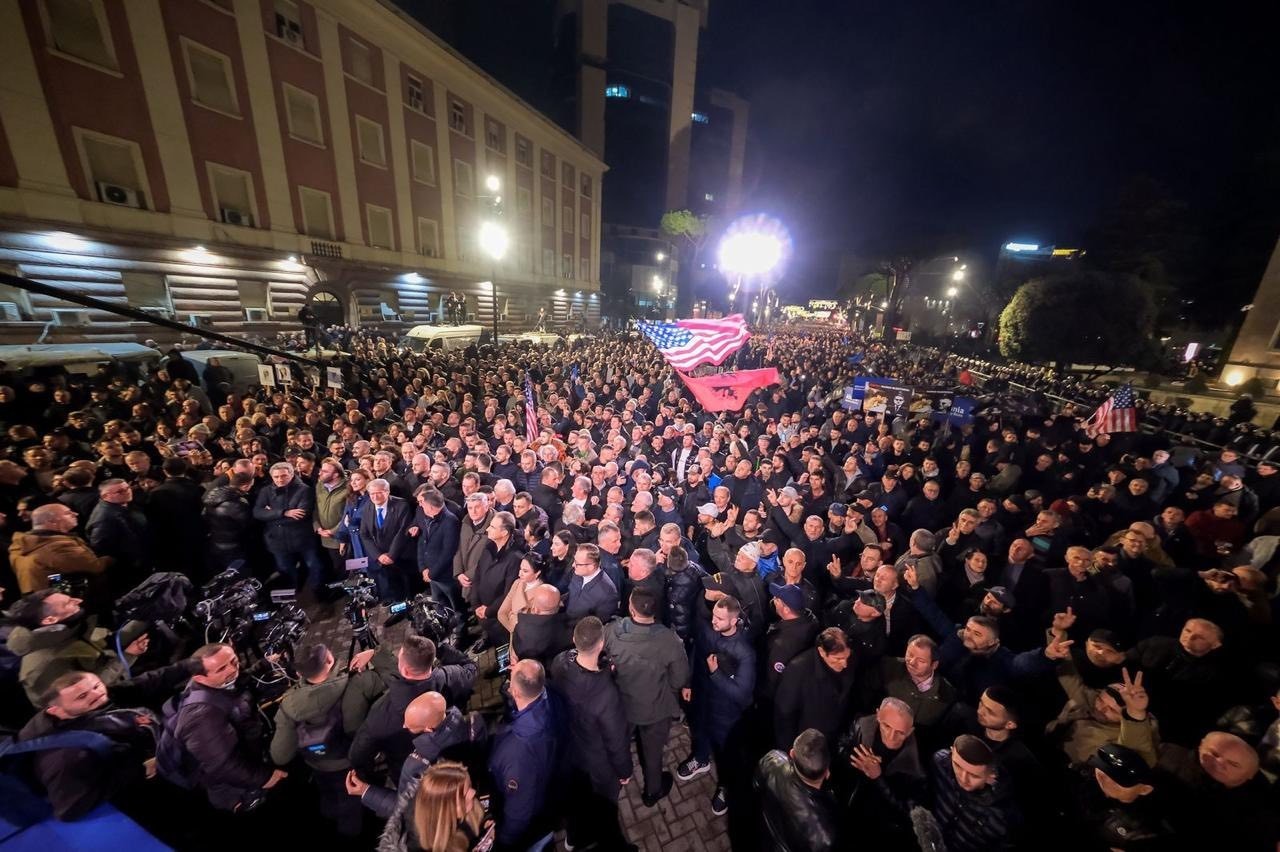
The Democratic party of Sali Berisha at a protest rally in Tirana, Albania – Photo by Democratic party
The Democratic party of Sali Berisha at a protest rally in Tirana, Albania - Photo by Democratic party
On the evening of 20 February, in front of the Prime Minister’s Office in Tirana, the Democratic Party of Albania organised a protest against the government led by Edi Rama.
The protest, with the slogan “The last kilometre”, took place amid a tense political climate, in a context where investigations into high-ranking officials and clashes between the government and the judiciary dominate public debate.
The gathering also aimed to draw a parallel with the events of thirty-five years ago, when on 20 February 1991 the bust of dictator Enver Hoxha was toppled, marking the end of the dictatorship in Albania.
In his speech, Democratic Party leader Sali Berisha stated that Edi Rama, despite being a “political corpse”, will remain in power until he is removed in the same way the statue of Hoxha was removed 35 years ago.
“Today, the regime of Edi Rama stands on three pillars of shame that destroy our existence every day. If Hoxha, with poverty, oppression and indoctrination, turned Albanians into ghost people, Rama, with his policies, theft, electoral farces, crime and shield law, is turning Albania into the land of the non-Albanians, desolating the nation and the country”, said Berisha addressing the protesting citizens.
Earlier, the state police declared that it would not take responsibility for the gathering, also citing violent incidents during a protest organised on 10 February by the same political force, which left sixteen police officers and dozens of citizens injured.
Once again, the protest focused on accusations of corruption, state capture and the distortion of political competition.
The February 20 gathering was just the latest in a series of recent protests organised by the Democratic Party in Albania. With messages calling for the government’s ousting, protests have been taking place regularly since December 2025.
However, apart from some episodes of violence and clashes with police, these protests have not brought any real change to the country’s political landscape.
The Albanian opposition is broad and fragmented. In addition to the Democratic Party, the longest-standing political force currently in opposition, several new parties have intensified protests in recent weeks.
Over seventy days of protest
Since 8 December 2025, the entrance to the Prime Minister’s office has been obstructed. A group of citizens and activists from the “Albania Becomes” Movement, led by Adriatik Lapaj, has been protesting in front of the office.
The protest began on 8 December, a date also commemorating the December 1990 movement that marked the beginning of the end of the dictatorship in Albania.
The main reasons for the protest are accusations against Deputy Prime Minister and Minister of Infrastructure and Energy Belinda Balluku for abuses in public tenders and the Prime Minister’s refusal to replace her.
Dorina Prethi, vice president of the “Albania Becomes” Movement, explains that the protest started as a reaction to “the political protection the Prime Minister provides to his deputy”, attacking the actions of the Special Tribunal against Corruption and Organized Crime (GJKKO) at the Constitutional Court. The protests then evolved into a revolt against the governance model as a whole.
“Of course, this came as a result of the government’s mismanagement in all directions. We have seen that during Rama’s fourth term, the government has not governed a single day, but has been fortifying its shield against the law, becoming a real obstacle to the new justice system”, explains to OBCT Dorina Prethi.
According to her, the decision to continue protesting in front of the Prime Minister’s office was also meant to push citizens toward a point of no return.
“If Albanians decide to stand in front of the Prime Minister’s Office, we are convinced that the government will resign within a few days”, says Prethi.
The main demand that the “Albania Becomes” Movement is launching with the protests is the resignation of Edi Rama and the creation of a transitional government with a 12-month mandate to prepare the country for early elections.
“This is a process that involves all Albanians, and the reaction must be comprehensive. Negotiations after the Prime Minister’s resignation must necessarily include changes to the Electoral Code, turning Albania into a single electoral zone, with a national proportional system, open lists and pre-election coalitions”, explains Prethi.
The Balluku case
Deputy Prime Minister and Minister of Infrastructure and Energy Belinda Balluku was officially indicted by the SPAK on 31 October 2025, facing charges of violating equality in public tenders.
SPAK suspects that Balluku, along with her subordinates at the Albanian Road Authority (ARRSH), was involved in manipulating tenders for the “Unaza e Madhe” project in Tirana and the Llogara tunnel in southern Albania, contracts worth over 200 million Albanian lek.
Investigations revealed thousands of pages of communications between her and subordinates, exposing a structured practice of illegal favors and misuse of public funds.
The Special Prosecutor’s Office for corruption and organised crime suspended Balluku from office on 20 November 2025, for violating tender equality in at least two cases, while the investigations continued.
Instead of removing Balluku from office, Rama pledged his support by challenging the SPAK’s decision before the Constitutional Court. On 12 December 2025, the Constitutional Court reinstated Balluku, highlighting the tension between the two branches of government.
Following this move, SPAK officially requested the lifting of Balluku’s immunity to impose a stronger security measure, implying her arrest.
On 17 December 2025, Parliament denied the Council of Mandates access to the investigative file, calling it “confidential”.
On 6 February 2026, after a 10-hour marathon session, the Constitutional Court upheld Balluku’s suspension.
Belinda Balluku has been part of the Rama government since 2019, holding key positions such as Deputy Prime Minister and leading one of the largest portfolios in the cabinet, the Ministry of Infrastructure and Energy, for more than five years.
“Hand over Balluku!”
The end of 2025 and start of 2026 saw the left-leaning Together Movement protesting in front of Parliament. From demonstrations against the 2026 budget, which they deemed unfair and exclusionary, to protests demanding Balluku’s resignation amid corruption allegations.
Redi Muçi from the Together Movement said during a January protest that theft has been normalised for 35 years and that it was time to fight for a state that represents its citizens.
“Priority must be given to protecting those in need, to pensioners erased from employment records, to those dying alone in their homes, to children and elders begging in the streets”.
Interviewed by OBCT, Muçi explains that Albania faces an institutional crisis due to an open clash between the judicial and executive powers and a representation crisis because traditional parties have lost legitimacy among the public.
“There is also a crisis of trust because people see fundamental change as impossible. This is reflected in the low turnout at protests. ‘The old world is dying. The new is slow to be born’, to quote Antonio Gramsci”, says Muçi.
According to him, the situation is influenced by the new justice system, which, despite the difficulties encountered, has broken the myth that politicians are untouchable.
“The social context is characterised by a deep demographic crisis due to youth emigration, which is reflected in the pension system. On top of this stands the economic oligarchy, monopolising key sectors such as construction, tourism and natural resources, driving the emigration of skilled and unskilled labor”, explains Muçi.
As a continuation of protests and citizen engagement, the Together Movement has proposed a platform to exit the crisis: increasing penalties for passive and active corruption, eliminating statutes of limitation for crimes related to high-ranking officials’ corruption, establishing investigative commissions for major privatisations and concessions and strengthening whistleblower protection laws.
Muçi points out that early elections are necessary as the only way out of the institutional crisis.
“We believe these measures would consolidate the justice system, prevent corruption and hold politicians accountable for abusing power and public assets”, concludes Muçi.
Petitions to fight corruption
Apart from other opposition parties, the right-leaning Mundësia Party (the Opportunity Party), together with former Democratic Party activists, also organised protests.
In December, amid the heated situation following Balluku’s communications and corruption allegations, the Mundësia Party, along with unaffiliated citizens, protested in front of Parliament, calling for Balluku’s political immunity to be stripped.
During the Council of Mandates review, protesters demanded accountability from top government levels, including Prime Minister Rama.
Under the slogan “Resign”, the Mundësia Party leader Agron Shehaj stated that the Council did not want to take into consideration the evidence that incriminated Rama.
The deputy of the Mundësia Party Erald Kapri said that “Belinda Balluku is merely an alibi to protect Edi Rama”.
The party also began a petition campaign in defense of justice and anti-corruption, submitting 20,000 signatures to the Constitutional Court on 22 January 2026.
“We face a historic decision: every high-ranking official caught stealing from Albanian citizens must be suspended! We call for the fight against corruption to continue and an end to impunity in Albania”, said the Mundësia Party.
Opposition: between cooperation and distrust
Although all opposition forces call for change and early elections, differences among them are evident.
Redi Muçi from the Together Movement says Albania’s biggest problem is not the current government, but the two-party system, built on the foundations of an economic-media oligarchy fueled by organized crime money.
“As long as other opposition parties do not share the same approach as the Together Movement regarding what Albania needs, and fail to emphasise politicians’ complicity with oligarchs, seeing the recycling of discredited figures as a solution, cooperation with them remains uncertain”, says Muçi.
For Dorina Prethi, the Albania Becomes Movement remains open to collaboration.
“We are open and in the square. This is our fundamental condition: take to the streets, united, to fight the corrupt system while preserving individuality”, says Prethi.
She points out that since their protest began, citizen participation has increased for daily issues such as water, floods, expropriations and property theft.
“By keeping the fire of protest alive, we have toom different groups of citizens to the streets. Many have protested elsewhere, but not in front of the Prime Minister’s Office. As with any goal, one must strike the same place consistently and persistently in order to succeed”, argues Prethi.
Muçi adds that the traditional opposition’s protests are as old as its leader, referring to the Democratic Party.
“The traditional opposition is incapable of articulating a coherent vision for Albanian society and lacks legitimacy to govern, just like the ruling party. Moreover, their protests always focus on Edi Rama and never support local communities against injustices they face”, points out Muçi.
According to Prethi, Albania has never had true democracy as power has always served narrow interests.
“The first step toward democratisation is democratising and improving the quality of parliament through fundamental changes in the Electoral Code. By guaranteeing genuine competition for representation, we can spread it throughout society”, concludes Prethi.