Albania: Democratic reform of public broadcaster RTSH remains only viable option
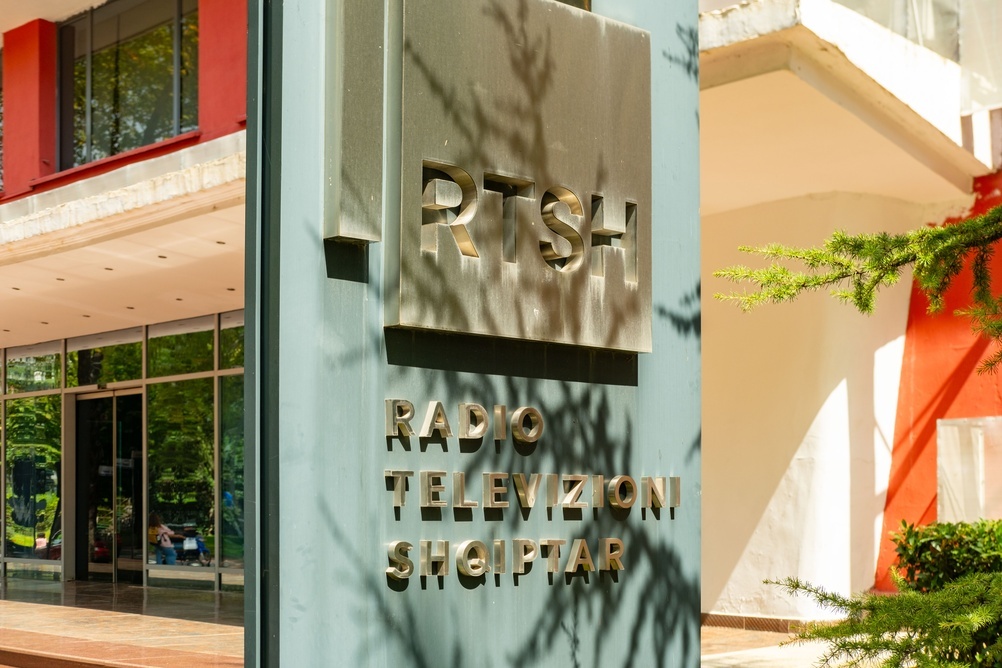
RTSH logo on a building © Kittyfly/ Shutterstock
RTSH logo on a building © Kittyfly/ Shutterstock
The undersigned Albanian and international media freedom and journalist organisations jointly call on the Albanian government to support the reform of the public service broadcaster Radio Televizioni Shqiptar (RTSH) through lawful, democratic and institutional means, in line with democratic norms and EU standards
Our organisations note the recent public remarks by Prime Minister Edi Rama about the performance and funding of RTSH, which set out potential options of funding suspension, privatisation or eventual closure. The critical comments renewed public debate on the future of the broadcaster in the EU candidate country.
There is broad recognition domestically and internationally that RTSH has faced serious, systemic and long-standing problems, including weaknesses in independent governance and oversight, financial instability, declining public trust, and professional shortcomings in fulfilling its public service remit.
The conclusions have long been shared by our organisations. We jointly agree that these challenges require credible reform and clear accountability, particularly in light of the appointment in 2025 of a new Steering Council and a new General Director, whose mandate is to address precisely these issues.
At the same time, European standards draw a clear distinction between the need for reform and the means through which reform is pursued. Agreement on reform objectives does not imply agreement on all instruments used to achieve them.
RTSH is a public service media institution established by law and operating under a continuous public mandate. It is financed through a combination of lawful public sources, including a mandatory public service broadcasting fee paid by households via the electricity bill, alongside other public and commercial revenues. This funding model is designed to guarantee continuity and to shield public service media from political leverage.
For this reason, European standards are clear that public service media funding must be stable, predictable, and safeguarded from political discretion. Funding mechanisms exist to enable reform and protect editorial independence—not to serve as leverage through performance-based or political conditionality. Using funding withdrawal, suspension of broadcasting, or institutional closure as reform tools is incompatible with the EU principles governing public service media.
Reform of RTSH must therefore be pursued through lawful and institutional means. This must include effective oversight by the Steering Council and other competent bodies; transparent performance benchmarks, public reporting and accountability of management; independent supervision and enforcement of governance standards; legislative or regulatory improvements where gaps are identified; and strong guarantees for editorial independence and journalists’ professional autonomy.
Public service media operate under a mandate distinct from that of commercial broadcasters. Their role is not to compete on market terms, but to ensure universal access to impartial information, cultural and educational programming, and democratic debate. Market performance or audience metrics alone cannot replace public service accountability frameworks.
The European Media Freedom Act (EMFA) and Council of Europe standards require states to safeguard public service media from direct and indirect political interference, including through financial pressure, and to ensure that reform strengthens—rather than destabilises—the conditions for independence, accountability, and public trust.
In the context of Albania’s EU accession process, particularly under Cluster 1 – Fundamentals, a stable, accountable, and independent public service broadcaster is a core democratic requirement. Our organisations, which have long supported and called for the democratic reform of RTSH as part our wider advocacy for free and independent media in Albania, therefore urge all national authorities to ensure that:
· RTSH reform is pursued through governance, oversight, and accountability mechanisms provided by law;
· Public service media funding remains safeguarded and insulated from political conditionality;
· Reform efforts strengthen institutional independence, editorial freedom, and public trust;
· Public debate on RTSH supports constructive, standards-based reform rather than institutional uncertainty.
We stand ready to support and engage in a serious, inclusive and standards-based reform process that strengthens RTSH as a genuinely independent, accountable, and future-oriented public service media institution, in line with European principles and the public’s right to independent and pluralistic information. International organisations remain open to visiting Albania in the coming year to take part in ongoing debates.
Signed:
Media Freedom Rapid Response (MFRR) Partners
- International Press Institute (IPI)
- European Federation of Journalists (EFJ)
- European Centre for Press and Media Freedom (ECPMF)
- Osservatorio Balcani Caucaso Transeuropa (OBCT)
Reporters Without Borders
Public Media Alliance (PMA)
SafeJournalists Network
- Association of BH journalists
- Association of Journalists of Kosovo
- Association of Macedonian Journalists
- Croatian Journalists’ Association
- Independent Journalists’ Association of Serbia
- Trade Union of Media of Montenegro
Civil society organisations in Albania:
- Association of Professional Journalists of Albania (APJA)
- Center Science and Innovation for Development (SCiDEV)
- Albanian Media Council (KSHM)
- Union of Journalists and Media Workers (SGPM)
- Albanian Woman in Audiovisual (AWA)
- Association of Journalists of Albania (AGSH)
- Balkan Investigative Reporting Network Albania (BIRN Albania)
- Amfora Center
- Albanian Center for Quality Journalism (ACQJ)
This statement was produced as part of the Media Freedom Rapid Response (MFRR), a Europe-wide mechanism which tracks, monitors, and responds to violations of press and media freedom in EU Member States and candidate countries.