Minorities, migrants, the unemployed: on the Danube, food becomes inclusion
Two EU projects promote the gastronomic diversity of Southeast Europe, focusing on disadvantaged groups, depopulated areas, and land conservation
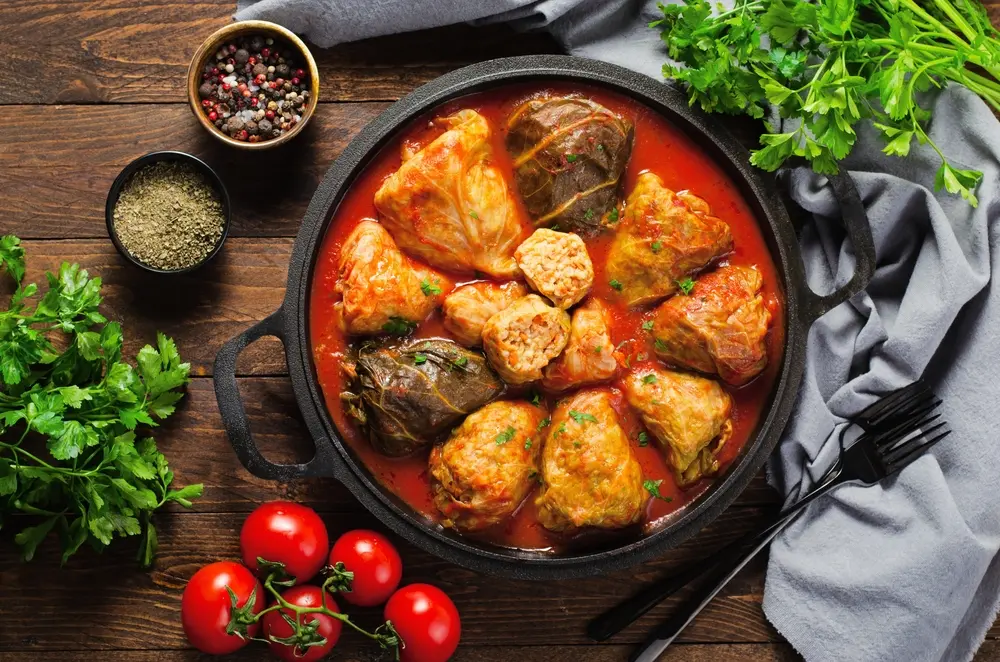
A plate of sarma © Julie208/Shutterstock
A plate of sarma © Julie208/Shutterstock
There’s no set way to browse the catalog. You can try alphabetical order and start with the spiced peppers and eggplants of Adjapsandal, which arrived from the Caucasus to Hungary, where it is still prepared by the small but vibrant Armenian community.
Or, more conveniently, you can search by area of origin or by ethnic-cultural group: you’ll come across podovarak “ciganski,” a unique dish of meat, rice, and sauerkraut from the Roma of Serbia, rosnica from the Gorani of the Dinaric Alps, or bobici soup from the Italians of Istria.
Over 700 recipes have been collected in the European Culinary Trail project, which traces and promotes the gastronomy of minorities present in various countries of the Danube region. SReST, another initiative of the same community program – Interreg Danube – takes things to a whole new level: involving immigrants, minorities, and socially disadvantaged groups in a “slow” gastronomic chain that promotes traditional dishes.
Both projects stem from the belief that food, in addition to representing a much more diverse cultural heritage than official “typical cuisines” portray, can become a tool for social emancipation.
Minority cuisine
That the Danube, one of the world’s most international rivers, is an intrinsically multicultural territory is nothing new. What’s less obvious is that this plurality emerges in official narratives of national cuisines, especially since food has become a product to be sold to tourists seeking an often ad hoc authenticity.
In this process, nuances – and with them the contribution of minorities – tend to disappear. It is precisely here, according to the promoters of Culinary Trail, that a chance for redemption opens up.
“The project is based on the idea of protecting and promoting the culinary heritage of the Danube region,” explains Janja Lozar, a researcher at the Nova Gorica School of Advanced Studies and responsible for methodological development. “But there’s also a social innovation aspect: we want to incorporate this heritage into new business models, including through tourism.”
With a budget of €2.2 million, 20 countries involved, and 28 partners, Culinary Trail works with 30 ethnic and cultural groups in the Danube region. Some – such as Roma, Jews, Gorani, and Bunjevci – are minorities spread across multiple countries; others are national communities elsewhere but minority communities in the project contexts, such as Slovenians in Austria or Italians in Istria. “This allows us to bring out specificities that otherwise remain invisible in the narratives of ‘typical’ cuisines,” observes Lozar, citing the case of Italian cuisine on the Slovenian coast: “It’s closer to Venetian tradition, but in most restaurants the menus are standardized.”
Alongside the historical groups, the project also involved more recently settled communities – Filipinos, Thais, Indians, and Chinese – interested in promoting their gastronomic traditions. “For some restaurateurs,” says Lozar, “the Culinary Trail brand can become an incentive to offer dishes tied to their region of origin.”
The participating groups are numerous, but they represent only a fraction of the region’s enormous diversity, explains Jasmina Jakomin, project manager. “We selected the most present, vibrant, and interested communities to engage with us. Once the groups are identified, the engagement process is gradual, with meetings and participatory analyses. Then we proceed to collect data for the catalog, which includes not only recipes, but also drinks, cooking methods, and tools.”
The end goal – as the name suggests – is to build a truly transnational culinary itinerary, in dialogue with other forms of slow tourism, such as the cycle paths along the Danube rivers. This is all accompanied by professional training activities and detailed strategies implemented at seven pilot sites.
Equally important are public gastronomic events, including food trucks and riverboats serving as refreshment stops. A grand finale is planned for May 30th in Novo Mesto, Slovenia.
Anyone who frequents Southeast Europe knows this: traditions jealously claimed as exclusive often turn out to be very similar. “It happened several times on the Culinary Trail,” smile Lozar and Jakomin. “For example, during one event, Turkish and Macedonian communities both brought sarma wrapped in vine leaves. At first glance, they looked identical, but the flavor was completely different. Even when they share the same name, the recipes vary from village to village.”
From heritage to inclusion
If the Culinary Trail works on mapping and promoting minority cuisines, SReST – Socially Responsible Slow Food Tourism – works on the social side of gastronomy.
With a budget of €1.5 million (80% of which comes from cohesion funds) and partners in seven countries (Slovenia, Croatia, Slovakia, Hungary, Montenegro, Serbia, and Bosnia and Herzegovina), the project aims to engage migrants, minorities, and socially disadvantaged groups within a gastronomic supply chain inspired by the principles of Slow Food, while strengthening the connection between food and local areas.
“Food is a very concrete tool for creating inclusion,” explains Snežana Simić of Visit Postojna (the municipality home to the famous caves is the lead organization). “It creates jobs by activating the entire local value chain, connecting farmers, chefs, tour guides, and local communities. This,” she continues, “generates new roles for the unemployed, young people, migrants, and other vulnerable groups, integrating them into the production and provision of authentic gastronomic experiences, helping them become active participants in the local economy.”
SReST’s strategy, in fact, starts with agrobiodiversity – traditional varieties, local ingredients, wild foods – to develop “slow” gastronomic itineraries, capable of generating demand for local products and retaining economic value in the regions involved.
The actions have been tested in several pilot areas. In the Slovenian region of Inner Carniola-Karst, and on the island of Krk, the project worked on the inclusion of migrants in slow food tourism through culinary and cultural training. “In Postojna, many participants have found employment in various branches of the tourism sector,” Simić explains. “Among these, a group of Ukrainian women who participated in our activities created an association through which they run a series of small businesses.”
In Sarajevo, the focus was on chefs with disabilities, who participated in courses ranging from basic culinary skills to hygiene and food safety certifications. In Hungary, in the Hajdú-Bihar region, the focus was on the unemployed, while in Bratislava and the Croatian county of Primorsko-Goranska, educational curricula dedicated to Slow Food practices were developed.
A cross-cutting theme is that of rural areas and depopulation: SReST seeks to involve those who remain, young and old, by capitalising on often informal knowledge. In this context, women are recognized as key custodians of traditional recipes and community hospitality, and the project aims to transform these skills into economic opportunities.
Even for small producers, often without formal certification, SReST is experimenting with alternative forms of recognition, based on transparency, the description of the products’ origins, and their inclusion in food tourism networks.
“Building trust takes time,” concludes Simić, “especially with people who have experienced instability or exclusion. But when it works, food becomes a common language: not just a heritage to be preserved, but a means of creating jobs, relationships, and a sense of belonging.”
Found an error in this article? Please contact our editorial team at redazione@balcanicaucaso.org.
This publication has been produced within the EuSEE project, co-funded by the European Union. Views and opinions expressed are however those of the author(s) only and do not necessarily reflect those of the granting authority and the European Union cannot be held responsible for them.
Tag: EU Cohesion | EuSEE | Food | Minorities