From Bosnia to Ukraine: forgotten human rights in modern peace negotiations
An analysis of the forgotten aspects of the Dayton Peace Agreement: human rights as a basis for a just and lasting peace and their importance for the peace talks in Ukraine
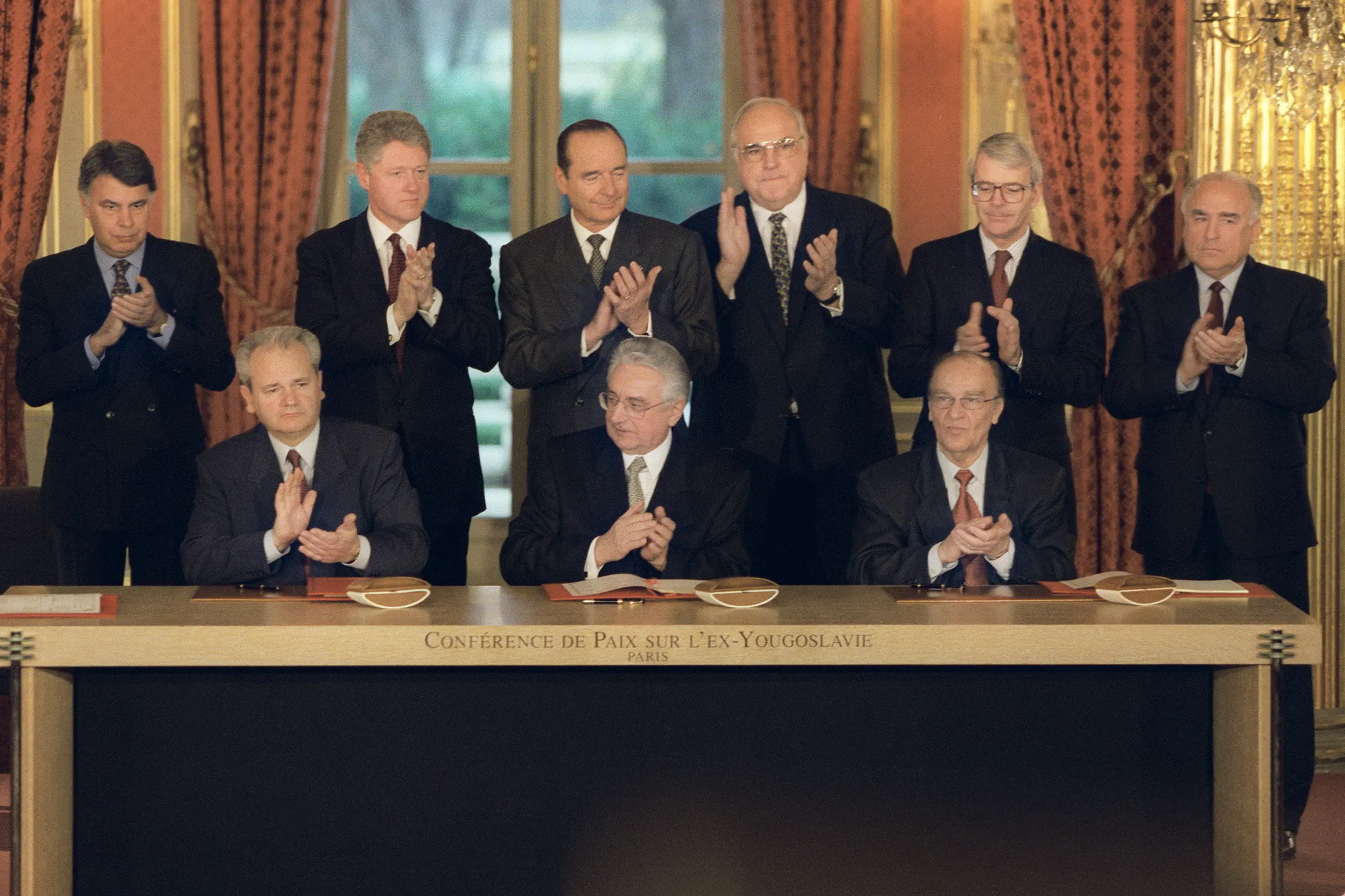
Paris, dec. 1995. Signing the Dayton Agreement – Public domain
Paris, dec. 1995. Signing the Dayton Agreement - Public domain
Sunday 14 December marks the 30th anniversary of the formal ratification of the General Framework Agreement for Peace or Bosnia and Herzegovina. The agreement, initialled in November at the Wright-Patterson Air Force Base of Dayton, Ohio and more widely known as Dayton agreement, was finally ratified in Paris on December 14.
On the occasion of the anniversary of its ratification, most of the comments focus on the complicated constitutional architecture of the post-conflict BIH, highlighting how the country is very often still paralyzed by the struggle amongst the political parties claiming to represent the three ethnic groups and how Dayton failed to build a functional state.
Yet, most of the comments seem to be oblivious of the complexity and amount of details provided in the Dayton agreement and they overlook the provisions related to the protection of human rights in Bosnia and Herzegovina and in particular of those displaced by the conflict, provisions that have rarely been questioned by the political leaders, even if they resisted their implementation.
Those provisions are even more relevant nowadays, when in the light of the peace discussions for the ongoing conflict in Ukraine (but the same principle applies to Gaza as well), the rights of individuals and especially of those most affected by the conflicts seems to have completely disappeared from the negotiating table, as if they were an unnecessary constraint to negotiators, in favour of state and corporate interests.
Carving up Bosnia and Herzegovina
The conflict in Bosnia and Herzegovina lasted 3 and half years, causing around 100,000 deaths (on a population of little more than 4 million people): out of those the civilian victims were at least 38,000 civilians (i.e. 40% of the overall total). The conflict caused also one million of internally displaced persons and one million of refugees abroad, i.e. around 50% of the overall population of the country.
The conflict in Bosnia started in April 1992 after Bosnia and Herzegovina declared independence from rump Yugoslavia, following the declarations of independence of Slovenia and Croatia. Immediately, its larger neighbours, Serbia first and Croatia later, under the pretext of protecting ethnic Serbs and Croats from a supposed Islamic threat, armed and supported Bosnian Serb and Bosnian Croat secessionist leaders whose aim was to carve up the country and possibly seek annexation with neighbouring Croatia and Serbia, while the central government in Sarajevo tried to preserve the territorial integrity of the country.
It ensued a 3 and half year conflict, where the war crimes, crimes against humanity were committed by the warring factions. The expression “ethnic cleansing” was widely referred to as the practice of forcibly expelling a whole ethnic group from a certain area which came under the control of the enemy faction.
During the peace discussions, brokered by the US with the support of Russia and European countries, the continuity of Bosnia and Herzegovina as an independent country meant that ethnic cleansing would not be rewarded by allowing the areas under Serb and Croat control to secede and join Serbia and Croatia.
However, concessions were to be made to the de facto leaders and the constitutional arrangements emerging at the peace table reflected the situation on the ground: the frontline became an administrative line between entities, and the de facto authorities were recognised as legitimate institutions of the state of Bosnia and Herzegovina.
While these constitutional arrangements, and their implementation by the warring sides, presented the risk of perpetuating the tensions between the warring party and in the long run creating a dysfunctional state, the peace agreement offered robust guarantees for the protection of human rights at the national level, guarantees that were also aimed at providing refugees and displaced persons with the possibility of finding a solution for their displacement.
A country only on paper
However, three and half years of conflict had completely transformed the country, and it wouldn’t be an exaggeration to say that at the end of the conflict Bosnia and Herzegovina as a whole country existed only on paper. International officials (and I was one of them) working in Bosnia immediately after the war had the impression of operating in three completely independent statelets.
The three warring sides had carved up the whole country: Bosnian Serb and Bosnian Croat leaders had proclaimed their own independent republics, expelling non-Serbs and non-Croats respectively while the central government in Sarajevo retained control of what was left of the country, an area mostly inhabited by Bosniaks.
Everything was divided into three: there were three national governments, three currencies, three phone and post systems, three different car registration systems, three official languages (all of them minor variations of Serbo-Croatian).
There was no freedom of movement between the statelets and the three sides actively operated to make sure that the displacement would be permanent and that the return of those expelled would be discouraged: for instance, they reallocated property belonging to displaced persons, they flattened to the ground religious buildings, desecrated monuments and graveyards or they changed the names of streets and towns to erase any sign of a common past. Similar practices are happening in today’s parts of Ukraine under Russian control.
Human Right provisions in the Dayton Peace Agreement
It shouldn’t be a surprise therefore that despite what they had signed at Dayton, the parties were reluctant to implement those provisions of the peace agreement which didn’t suit their political agenda, and they were actively engaged in making displacement permanent. The implementation of the peace agreement ran counter to the war time agenda of the secessionist leaders, and it also conflicted with certain aspects of the agenda of the Sarajevo government which was seeking to create a more centralised country.
The provisions of the peace agreement contained a robust framework for the protection of human rights. In particular Annex VI was entirely dedicated to the protection of human rights and it contained an extensive list of rights to be enjoyed by everyone in Bosnia and Herzegovina.
Besides the rights contained in the Constitution (which was also one of the Annexes to the Dayton Agreement), Annex VI made a detailed list of international human rights and humanitarian law treaties which are directly applicable in Bosnia and Herzegovina, including the four Geneva Conventions on the Protection of Victims of War and the European Convention on Human Rights. Human rights provisions would have priority over all other law, which meant that local authorities were obliged to disapply domestic law if this ran counter human rights provisions.
The same Annex VI also foresaw the creation of Human Rights Commission, composed of an international Ombudsman and a Human Rights Chamber. The Chamber was modelled after the European Court of Human Rights and tasked with deciding on individual complaints alleging violations of the rights contained in the Annex. The decisions of the Chamber were final and binding and all the authorities in the country were obliged to comply with them.
Annex VII of the Peace Agreement was dedicated to displaced persons and refugees, who had the right to freely return to their homes of origin: this provision was indeed a novelty in the history of peace agreements. Displaced persons and refugees also had the right to repossess property of which they were deprived during the hostilities or to be compensated for property which couldn’t be restored.
The local authorities were obliged to create the conditions under which refugees and displaced persons could return in safety to their places, without fear of intimidation or discrimination. The authorities were also responsible for the repeal of any legislation and practice which had a discriminatory effect, and they were obliged to transfer, dismiss or prosecute any person responsible for serious violations of human rights and humanitarian law.
A Commission on Displaced Persons and Refugees (later called the Commission on Real Property Claims) was supposed to be created with a mandate to decide claims for real property owned by displaced persons and refugees. The claims submitted to the Commission were for either the return of property or for compensation in lieu of return.
Under Annex III, which covered the organisation of elections, displaced persons and refugees had the right to choose whether to vote for their municipality of origin or for the municipality where they were currently living. Elections were to be organised under the supervision of OSCE.
Fast forward to todays’ “peace” talks about Ukraine and Russia
The provision of the Dayton Peace Agreement therefore created a robust and detailed normative framework for the protection of human rights in Bosnia and Herzegovina. The existence of such framework to which all the parties had previously agreed, while it required a massive and sustained effort to ensure that the parties implemented it and complied with their obligations, it however turned out to be the commonly agreed backbone for the protection of human rights in Bosnia and Herzegovina.
Remarkably, in over 30 years, while the main ethnic parties in Bosnia have constantly disagreed about constitutional arrangements and the relationship between state and entities, they have never really challenged the human rights provisions of the Dayton agreement.
It is therefore striking that 30 years on, while another US administration is trying to mediate a peace agreement between Russia and Ukraine, the lessons learned about the respect for human rights in the Dayton peace agreement, appear to be completely overlooked or forgotten.
The alarm bells are already ringing for what concerns the proposed blanket amnesty which was foreseen in the initial version of the 28 point plan reportedly agreed between the US and Russia. Such blanket amnesty, while allowing perpetrators to walk free, it would deprive the victims of the right to justice and reparations.
A similar concern needs to be raised about all those displaced by the conflict, and in particular, those who were forced to flee Russian occupied regions, which amount to several million persons, out of those at least 2.7 million are internally displaced. Like in the Minsk I and Minsk II agreements, the 28-point plan makes no reference whatsoever to the rights of those displaced by the conflict or to the protection of human rights.
It is particularly disheartening to read about territories being handed over and profits made by states, without any mention of the fate of the persons living in those areas and who are the ones experiencing the brutality of the conflict.
It would also be naïve to think that human rights protection can be added at a later stage once the conflict is frozen. The ongoing policies of “russification” of the territories occupied by Russia and the reports about forcible deportations of civilians from those territories closely remind us of the “ethnic cleansing” policies conducted during the Bosnian war.
These policies clearly indicate a long-term strategy to permanently alter the demographic composition of those areas, and it is logical to expect resistance to any measures which could undermine this plan. Human rights aspects therefore need to be included in all negotiations from the beginning, building on the existing efforts to document and seek accountability for violations of human rights and humanitarian law and creating a system that guarantees the protection of the human rights in any post conflict settlement.
An important statement in this direction comes from the Council of Europe Human Rights Commissioner, Michael O’Flaherty, who in a recent memo, reiterated the concept that there can be no real “just, lasting and effective peace” unless this is “anchored in the international human rights framework”. O’Flaherty reiterates the centrality of human rights in peace negotiations, a concept that should have been at the heart of any sincere and honest peace negotiation, but which continuous to remain conspicuously absent in the current discussions.
30 years later negotiation efforts seem to have forgotten the lessons learned at Dayton and again treat individuals as pure commodities in bargains between large and powerful nations, while carving up the world in their own spheres of influence.
Found an error in this article? Please contact our editorial team at redazione@balcanicaucaso.org.
Featured articles
 History and politics
 Montenegro Pride 2026