Reproductive rights, mounting pressure in Central and Eastern Europe
Legal frameworks that appear modern, healthcare systems that remain uneven, and civil-society groups bridging the distance between them. An overview of access to reproductive care and information in Central and Eastern Europe
shutterstock_2436480401
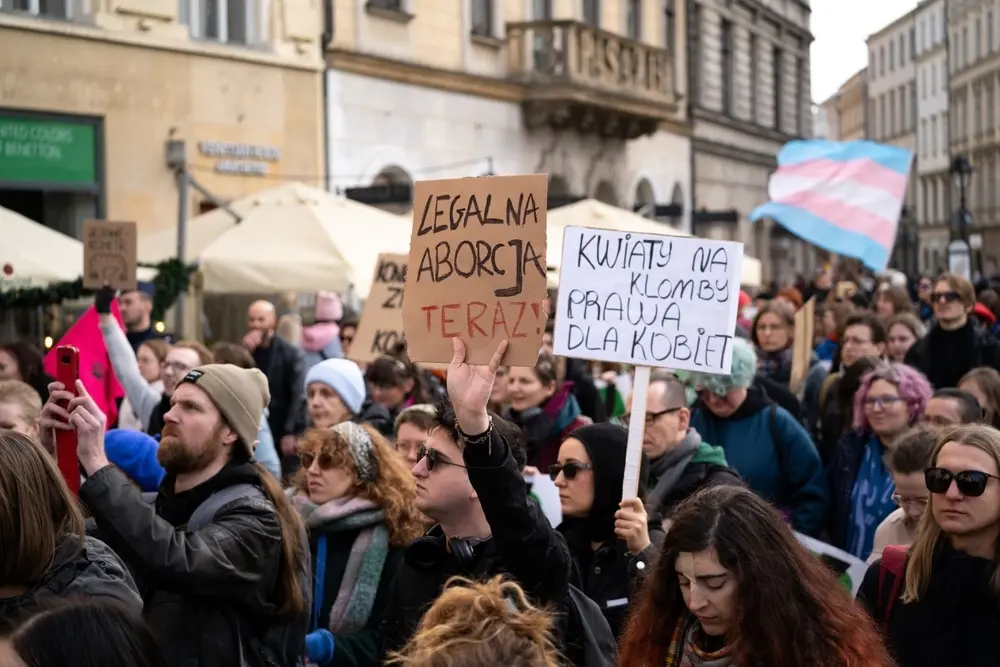
Women's Strike protest in Krakow, Poland © Longfin Media / Shutterstock
When lawyer and activist Justyna Wydrzyńska offered abortion pills to a woman in crisis in Poland, she saw it as an act of basic solidarity.
“Helping someone in need should never be a crime,” she says. “Whether it is a cup of soup, a warm jacket or abortion pills, it’s the same principle.”
Her prosecution and conviction in 2023 became emblematic of how quickly reproductive rights have shrunk across Central and Eastern Europe. Wydrzyńska is the first human rights activist in Europe to be prosecuted for providing abortion pills after she helped a woman in her native Poland, where restrictive measures against abortion have been put in place.
From Warsaw to Budapest and Chișinău, governments are invoking “traditional values” and “pro-family” agendas to reshape reproductive and sexual healthcare policy. The measures are framed as support for families but have often resulted in restrictions on abortion, contraception, and sexuality education. Those most affected tend to be the least visible: Roma and traveler women, rural youth, and women without stable income or citizenship status.
Hungary: unequal access behind family policy
Hungary promotes childbirth through generous incentives — tax exemptions, subsidized loans, and housing credits for married couples. Yet for many women, particularly from Roma or low-income communities, these programs do little to improve access to healthcare.
At the EMMA Association, a Budapest-based organization supporting women through pregnancy and early motherhood, President Julianna Kupcsok describes a system that is formally universal but practically exclusionary.
“The process is extremely complicated,” she explains. “Even a middle-class woman may struggle to navigate where to go, when, to whom and for what test. For women living in poverty or in remote settlements, it becomes almost impossible.”
Kupcsok’s organization has documented cases in which Roma women were denied information about prenatal options or faced dismissive treatment at clinics. EMMA’s volunteers have tried to fill the gaps through peer support and informal counseling.
“Support among women is often the only consistent form of care available,” Kupcsok says, “We try to make the system navigable, but it should not depend on volunteers.”
Since 2022, the government has required women seeking abortions to listen to a fetal heartbeat before obtaining approval. Officially justified as “strengthening maternal awareness,” the measure has been criticized by medical associations as an unnecessary and manipulative hurdle.
Moldova: between progressive law and conservative practice
Moldova’s legal framework on reproductive health is comparatively liberal. Abortion is permitted up to 12 weeks, and contraception is formally covered by public healthcare. In practice, however, implementation varies sharply between urban centers and rural districts.
At the Reproductive Health Training Center in Chișinău, project manager Catalina Comendant says the issue is not policy but professional capacity.
“We still meet women who have never been offered a contraceptive method by a doctor,” she explains. “Family physicians are often not trained or are uncomfortable initiating these discussions. The result is that access exists on paper but remains limited in practice.”
Her organization has worked with the Ministry of Health to train hundreds of doctors and midwives in family planning and safe abortion care. During the pandemic, the center piloted a telemedicine model allowing women to receive counseling and medication by phone — a first for Moldova.
“It showed that decentralizing services works,” Comendant says, “Women appreciated that they could speak confidentially, without traveling long distances.”
Despite such progress, the government’s emphasis on reversing population decline has led to a cautious approach to public discussion of contraception. Civil-society groups like Reproductive Health Training Center remain essential in keeping reproductive health visible in national health policy.
Poland: restriction through law
Poland’s abortion restrictions are among the strictest in Europe. Following a 2020 Constitutional Tribunal ruling, termination is legal only in cases of rape, incest, or threat to the woman’s life. Even in emergencies, hospitals sometimes refuse to act, citing legal uncertainty.
So when Wydrzyńska, a survivor of an abusive relationship, admitted to providing an abortion pill to a fellow Polish woman in need, she was punished and sentenced to community service. Wydrzyńska, a member of the Foundation for Women and Family Planning (FEDERA), described her conviction not as an isolated case but as part of a systematic deterrent.
“What happened to me is meant to silence others,” she says. “It tells doctors, activists, and ordinary people that helping can have consequences.”
FEDERA continues to run hotlines and cross-border networks connecting Polish women with clinics abroad – so they can travel abroad and get help there. However, not every woman can afford such a journey. The foundation reports that the number of women seeking information about medical abortion has more than doubled since 2021.
“Every day, women call saying they have nowhere to go,” Wydrzyńska says. “We try to make sure they still have options.”
Ukraine: continuity amid conflict
In Ukraine, the ongoing Russian war has not halted access to reproductive care; in many areas, it has forced a transformation. The United Nations Population Fund (UNFPA) and local partners operate mobile gynecological teams providing contraception, prenatal services, and counseling to displaced women and survivors of violence. UNFPA supports 28 mobile teams working across 23 regions, serving women in shelters, rural areas, and temporary housing.
“In 2024, just 176,700 children were born — a 35% drop compared to 2021, according to the Ministry of Justice of Ukraine,” says Jacqueline Mahon, UNFPA’s Representative in Ukraine, “The fertility rate is projected to fall to just 0.9 children per woman, far below the replacement level of 2.1.”
Many women are afraid to give birth due to security issues, or because of war-related trauma.
“There is a lot of pain surrounding the topic of family planning,” says Inna Ukhabova, a nurse in Zaporizhya, a Southern city close to the frontline.
“Many women are not engaging in sexual activity right now, and some are in mourning for their husbands,” she continues, “We have to be very careful when approaching this subject, as it is not always the right moment to talk about family planning.”
According to UNFPA, more than a million women and girls have received reproductive-health or gender-based-violence services since 2022, including many Roma or internally displaced people. Despite severe infrastructure damage, Ukraine’s experience shows that decentralized, community-based systems can sustain reproductive health even in conflict conditions.
Shrinking civic space
The trajectory across Central and Eastern Europe reveals a complex landscape: legal frameworks that appear modern, healthcare systems that remain uneven, and civil-society groups bridging the distance between them. What unites these experiences is access — who receives timely care, information, and respect within public systems.
Many feminist and community-based organizations that once complemented state health systems are now essential to their functioning. Yet many operate in an increasingly constrained environment. In Hungary, women’s organizations have lost access to national funding. In Poland, groups that cooperate with international partners risk political labeling as “foreign agents.”
Kupcsok describes the situation as endurance rather than activism.
“We focus on what can be done locally,” she says, “Small-scale work with mothers, practical advice, and peer support — it is not political in form, but it matters.”
In Moldova, Comendant says international cooperation remains vital.
“Training, supplies, and basic equipment often depend on external grants,” she notes. “Without them, access would shrink even further.”
The activists underscore inequities in healthcare access. For example, Roma women – who reside across Ukraine, Poland, Hungary, and other neighboring countries – tend to experience earlier pregnancies, lower contraceptive use, and higher maternal mortality than non-Roma peers. This shows how ethnic minorities and other marginalized groups tend to be less protected across the region.
This is linked to systemic exclusion — limited access to clinics, poor infrastructure, discrimination, and absence of targeted outreach. Public-health researchers have argued that regional family-planning strategies rarely include programs for marginalized communities such as ethnic minorities or impoverished women, perpetuating inequality even where laws are nominally inclusive.
For many women, particularly those from vulnerable groups, access continues to narrow despite formal guarantees.
Found an error in this article? Please contact our editorial team at redazione@balcanicaucaso.org.