Laura Codruța Kövesi, a mirror for the EU’s judicial systems
From Romania to Greece and Bulgaria, the work of the EU’s first Chief Prosecutor reveals the possibilities, limits, and fractures of anti-corruption enforcement across Europe
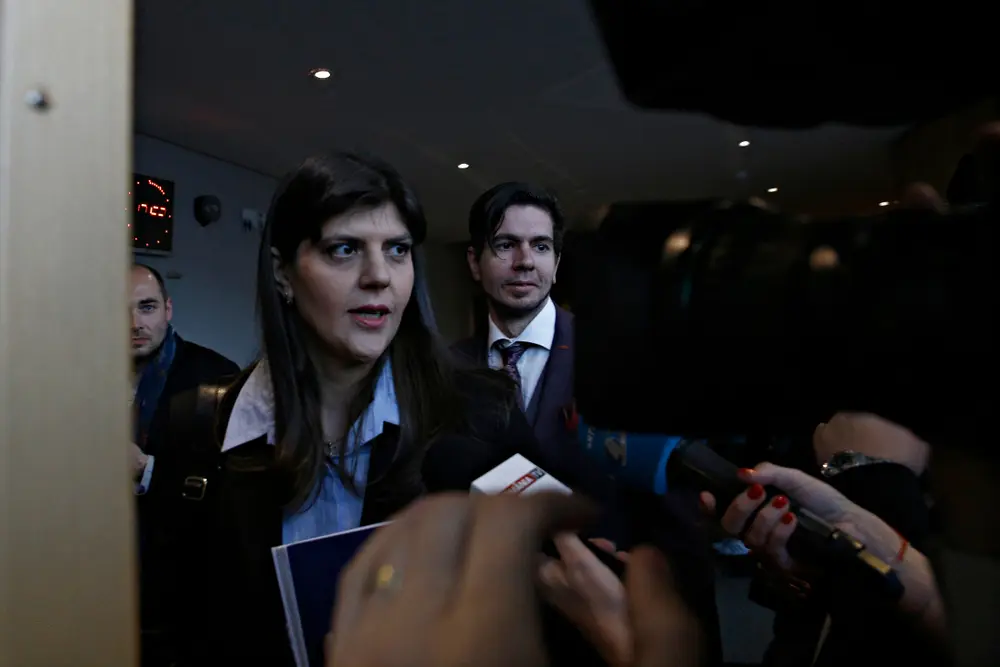
Laura Codruța Kövesi
Laura Codruța Kövesi (© Alexandros Michailidis/Shutterstock)
Laura Codruța Kövesi moves through Europe with the quiet force of someone who has spent years being underestimated. A woman in a system dominated by entrenched political interests, skepticism toward the judiciary, and the persistent expectation that prosecutors should yield to power.
When she became the EU’s first Chief Prosecutor in 2019, she brought with her not only a formidable track record but an institutional style: uncompromising legality, procedural discipline, and a refusal to bend to national political pressures.
What followed was not uniform admiration or uniform resistance. Instead, Kövesi became a kind of diagnostic instrument; a stress test for national systems. Wherever the European Public Prosecutor’s Office (EPPO) intervened, it illuminated something deeper: the limits of domestic judicial independence, the resilience of networks of influence, or the public’s appetite for accountability.
The effect varies sharply. In some countries, Kövesi is seen as the embodiment of what a functional justice system could look like; in others, her presence exposes how profoundly institutions have been hollowed out. And in places where European oversight is welcomed but not wholly trusted, she stands as a proxy for a justice that citizens have stopped expecting from their own state.
To examine the “Kövesi Effect” is not to profile an individual, but rather to watch how different states respond when confronted with a common European standard. Kövesi has become a mirror; and the reflections vary dramatically.
Romania: the memory of a lost momentum
In Romania, Laura Codruța Kövesi is not just a prosecutor. She is the living memory of a time when the impossible briefly seemed routine. As head of the National Anticorruption Directorate (DNA), she oversaw investigations into ministers, parliamentarians, local barons; even colleagues of hers. Televised arrests, asset freezes, and high-profile convictions gave citizens a sense that the country had finally turned a corner.
Her legacy in Romania stretches beyond headlines. As Chief Prosecutor of the DNA and later the EU’s first Chief Prosecutor, she became both admired and feared; a symbol of anti-corruption in a country still wrestling with impunity.
Cristian Pîrvulescu, Dean of the Faculty of Political Science at the National University of Political Studies and Public Administration, describes Kövesi’s EPPO appointment as a transformative moment: it turned the European body into “a laboratory for convergence between European norms and national legal practices, testing the limits of member states’ autonomy.”
Through investigations spanning Romania, Bulgaria, and Slovakia, Kövesi’s EPPO demonstrated how European institutions could impose real constraints on entrenched clientelist networks, rewarding states that internalize integrity standards while marginalizing those that resist.
At home, Mircea Kivu, sociologist, recalls that during her DNA years, Kövesi “represented, for most of the public, a symbol of the fight against corruption.” Her move to the EPPO was widely perceived as a continuation of that struggle. Yet Kivu notes that the overturning of many high-profile cases and recent judicial setbacks has left citizens with a persistent sense of powerlessness.
Cristi Danileț, former judge, emphasizes the symbolic weight of Kövesi’s EPPO role: it “symbolized the defeat of Romanian politicians who wanted control over the judiciary” and was seen by many as a form of “revenge of honest citizens.” Her departure made Romania keenly aware of losing a protective force, even as she became “feared in Europe” for tackling transnational networks that looted EU funds.
Romania once believed that institutional courage might be a permanent state. Then politics intervened and the momentum stalled. For Romanians today, Kövesi’s work for EPPO in Luxembourg is a daily reminder of what they briefly were and what they fear they may never be again.
Greece: the labyrinth of expectations
In Greece, Laura Codruța Kövesi has been met with both curiosity and skepticism. She is neither a political firebrand nor a media personality, yet her notable presence in the public sphere carries symbolic weight. The EPPO embodies a legal authority that transcends domestic political entanglements. For a society long accustomed to corruption scandals dissolving into impunity, Kövesi represents a potential inflection point.
The Greek press reflects a divided perception. Pro-government outlets tend to frame her work in cautious, bureaucratic terms, emphasizing procedural necessity. Opposition-aligned media, by contrast, portray Kövesi almost mythically, as a modern-day Artemis descending from Brussels to challenge entrenched corruption. Her reputation from Romania, her refusal to yield to political pressures, and her procedural rigor reinforce this narrative.
Two EPPO cases have particularly captured public attention in Greece. The first was the Piraeus Port investigation, which concerns €5.4 million in EU funds allegedly misrepresented by a company bidding for the environmental upgrade of the port’s passenger terminal.
The second, the OPEKEPE scandal, strikes even closer. It involves €55 million in EU agricultural subsidies allegedly siphoned through a hidden software layer within the national payment system. Farmers all across Greece were directly affected. The simplicity and audacity of the alleged scheme has made the case a lightning rod for public outrage, which has already implicated a former agriculture minister and high-level appointees, highlighting systemic weaknesses in oversight.
For many Greeks, Kövesi is a mirror of what they hope justice could be: capable, impartial, and willing to confront the powerful. Yet, that mirror also reflects frustration. Even as her EPPO office investigates, the slow-moving wheels of the Greek judiciary and the entrenched networks she faces temper expectations. Her challenge is not only legal but symbolic: to prove that European mechanisms can influence national systems long considered resistant to accountability.
Bulgaria: when the mirror cracks
In Bulgaria, the “Kövesi Effect” exposes systemic fragility. While Romanians saw her as a symbol of momentum and Greeks project both hope and doubt, Bulgarians increasingly perceive Kövesi’s European mandate as entangled in the same dysfunction that plagues their national institutions.
The turning point arrived in 2025, when the EPPO’s College decided to suspend Bulgaria’s own member of the institution, Teodora Georgieva, pending disciplinary proceedings. This marked an unprecedented move and sent shockwaves through Bulgaria’s fragile political-judicial landscape. The suspension was only the visible tip of a deeper crisis, which has been documented by Bulgarian investigative media and civil society: the very people meant to enforce European-level justice appear to be entangled in national judicial politics.
EPPO’s own 2024 statistics show over 250 open investigations in Bulgaria. Yet, the prosecutorial yield is limited: only 14 individuals were charged, 12 cases were submitted to court, and 3 convictions were reported by the end of last year. Such results fuel public skepticism: according to Boyko Stankushev, Executive Director of the Anti-Corruption Fund of Bulgaria, “at present, no one believes that anything will change because of the EPPO.”
Local watchdogs point to structural obstacles. In several instances, EPPO prosecutors in Bulgaria reportedly requested special surveillance measures (e.g., wiretapping), only for courts to refuse. Observers argue that this reflects not just legal complexity but a lack of institutional readiness or political will to support European investigations.
Adding to the unease is a leaked recording involving Petyo Petrov, a judicial influencer with deep ties to informal power networks. In the recording, voices suggest that Georgieva’s appointment to EPPO may have been orchestrated. While the recording itself has raised serious questions, it has not been conclusively adjudicated – leaving an open wound in the public’s trust.
Ekaterina Baksanova, a judicial analyst at the Institute for Market Economics, warns that when those chosen for European prosecutions are vetted through a national system perceived as compromised, “their loyalties travel with them.” In her view, unless the selection mechanism is reformed, the EPPO risks being co-opted.
Instead of being a force of institutional transformation, EPPO is seen by many in Bulgaria as another institutional battleground stretched between European ideals and local practices. EPPO highlights the vulnerability of Bulgarian structures to informal influence, political capture, and procedural inertia, but the question remains of whether these cracks will be repaired.
What the mirror teaches Europe
Kövesi is often cast in mythological terms, yet the true significance of her work is institutional rather than personal. The EPPO does not transform national systems; it exposes them, rendering visible the contours of power, compliance, and resistance.
Across Romania, Greece and Bulgaria, the mirror Kövesi holds up reveals distinct realities: reforms that can inspire but also slip backward; aspirations constrained by entrenched structures; and a system so captured that even European-level oversight struggles to gain traction.
The EPPO compels states to confront the truth of their institutions, not merely the narratives they project. In the years ahead, the resilience of Europe’s anti-fraud architecture will depend less on Kövesi as an individual and more on whether the countries reflected in her mirror act to change the image they see staring back.
Krasen Nikolov (Mediapool, Bulgaria) and Laurențiu Ungureanu (HotNews, Romania) contributed to the production of this article.
Found an error in this article? Please contact our editorial team at redazione@balcanicaucaso.org.

This article was produced in the framework of PULSE, a European initiative coordinated by OBCT which promotes cross-border journalistic collaborations.
Tag: Corruption | EPPO | PULSE
Featured articles
 Montenegro Pride 2026
 Political deadlock