In Albania, memory regains centrality in the public debate

The debate on how the communist dictatorship should be remembered has been rekindled by the ongoing conservation and restoration work at the former prison and forced labour camp of Spaç. Although public policies and interventions for the memory of this difficult part of the past have long been called for in the country
11/06/2025, Giulia Avanza

In-Albania-memory-regains-centrality-in-the-public-debate

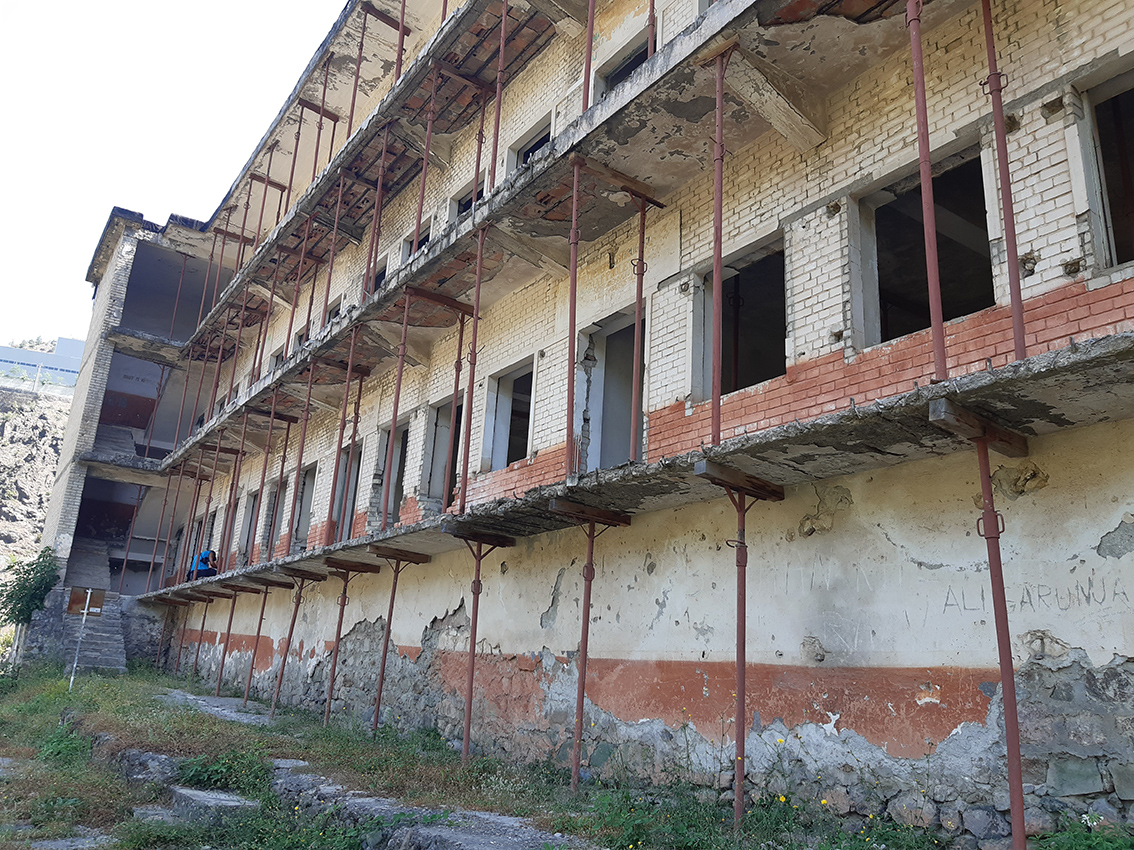
Spaç, Albania - Foto G. Avanza

In order to punish suspected political opponents and control the population through fear and deterrence of dissent, the communist regime in power in Albania from 1944 to 1991 had established a system of detention and ‘re-education’ consisting of a high number of prisons , forced labour camps, temporary labour units and internment camps.

From 1968, the so-called ‘re-education unit 303’ was installed in Spaç, in the municipality of Mirdita, in a remote mountainous area in northern Albania. The isolated location, which ensured the separation of the prisoners from the rest of the population, had been chosen because of the copper and pyrite deposits in the area, that prisoners were forced to extract through long forced labour shifts and in inhuman conditions.

It is estimated that up to the early 1980s, between 900 and 1,200 political prisoners at a time were imprisoned in the camp, only men. From 1984, the regime also began to use Spaç to house ordinary prisoners, until the prison was closed after the release of political prisoners in December 1990 and ordinary prisoners in 1991.

Spaç has established itself as one of the most symbolic places of the suffering and human rights violations caused by the communist dictatorship in Albania, but it also remains in the national memory as a place of resistance to the regime’s repression. Indeed, it was here that one of the few episodes of collective revolt in the decades of the regime, the Spaç Revolt of 1973, was recorded, which was harshly repressed.

The site’s value as testimony of the past was confirmed by Spaç’s listing as a Cultural Monument in 2007 by what is now the Ministry of Economy, Culture and Innovation.

Despite being the only one of the detention facilities created or used by the communist regime to benefit from this status, the former prison has remained in a state of neglect since its closure. Many elements of the complex – the barbed wire fences, the entrance gate, the watch towers – have been stolen. The access tunnels to the mine have collapsed, some camp buildings have crumbled down, and others remain in a precarious condition.

Several factors have contributed to the inaction of public institutions towards Spaç, at least until today. The severe political, economic and social instability of the 1990s, culminating in the period of anarchy in 1997, imposed other priorities on the fragile Albanian institutions in the first decade of post-dictatorship transition. Another significant issue was the uncertainty surrounding the ownership of real estate and land once state socialism ended. No less decisive, however, has been the reluctance of governments of various political affiliations to openly confront the communist past. With a few exceptions, there remains a certain difficulty in promoting memory initiatives that are free from party logics, as well as in supporting policies to protect the material legacy of the dictatorship that respond to the educational and commemorative needs expressed by part of the population.

In spite of this, calls for the preservation of Spaç by former political prisoners, the Municipality of Mirdita, civil society organisations and autonomous public institutions have never stopped. These actors have also carried out commemoration, education and reflection activities around Spaç, often organising on-site events and guided tours. Some independent organisations have also incurred expenses over the years for guarding the site, mowing the grass and minor maintenance of the paths, as well as emergency interventions to stabilise buildings in danger of collapse, which were carried out in 2018.

In December 2024, the National Institute of Cultural Heritage, part of the Ministry of Economy, Culture and Innovation, took action to carry out the first publicly funded interventions at Spaç, defined as ‘conservation-restoration’. The drafted project includes the repair of the walls of some buildings, the installation of metal gates, railings and handrails, the reconstruction of an observation tower, and plastering and painting works.

Launched in May 2025, the construction site entrusted to an external company seems to have been suspended – at least temporarily – due to protests that have arisen regarding the impact the work would have on the authenticity of the site.
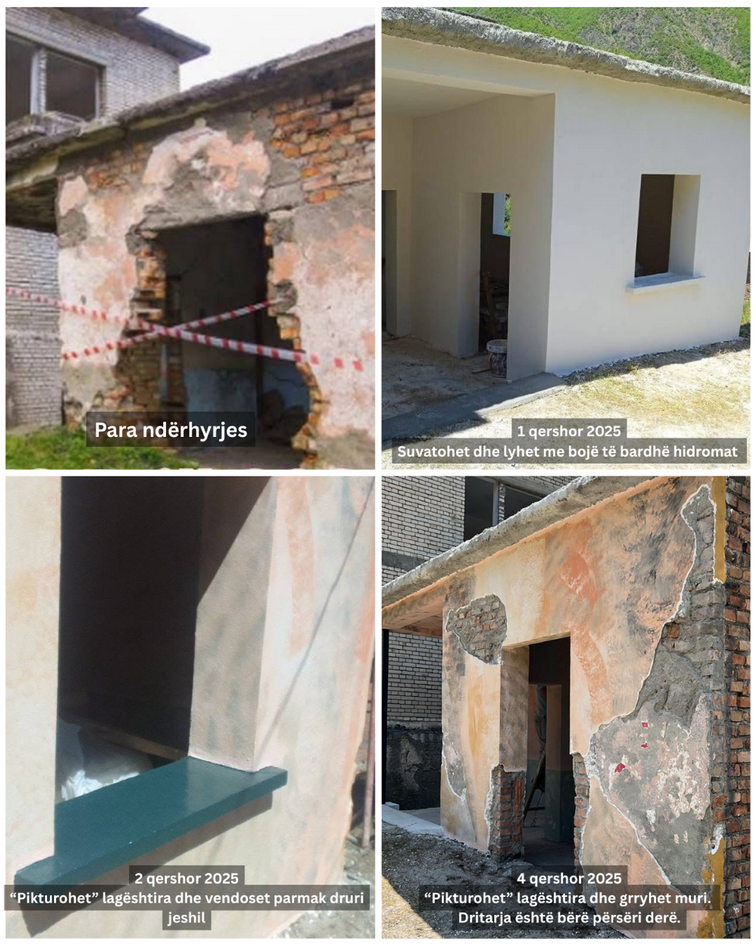
An image released by the Ministry of Economy, Culture and Innovation shows the progress of the interventions on one of the Spaç buildings

An image released by the Ministry of Economy, Culture and Innovation shows the progress of the interventions on one of the Spaç buildings: top left, the building before the interventions. Top right, the building on 1 June 2025 after the restoration of parts of the structure and with the entrance door converted into a window, plastered and painted with white paint. Bottom left the building on 2 June, with the walls painted with coloured paint and the installation of a wooden sill. Below right, the building on 4 June, with part of the plasterwork having been peeled off in search of an ‘antique’ effect and the door having been restored by demolishing the lower portion of the wall.

What caused the public reaction were some images of the first interventions carried out, images initially circulated online and then the subject of a post published on social networks by an Albanian activist, which was shared dozens of times. Within a few days, the crescendo of attention brought the issue to the national and international press, and to television stations.

The demands of a group of citizens and organisations were summarised in a petition available online , addressed to the Ministry of Economy, Culture and Innovation and the National Institute of Cultural Heritage, asking them to ‘stop uncontrolled interventions that damage the authenticity of Spaç prison’.

According to the text of the petition, the interventions carried out so far in Spaç risk deforming the collective memory, erasing the traces of time on the ruins of the buildings and reconstructing portions of the site in a way that is not faithful to either the testimonies offered by the former political prisoners – who have participated in numerous protests in recent days – or the available archive material. According to the signatories of the petition, the approach with which the work is being conducted follows an aesthetic logic that diminishes the possibility of perceiving Spaç as a place of pain and suffering, a true document of historical events.

According to statements made by some members of the informal group, the concern was raised that this type of intervention was conceived with the sole purpose of preparing the former prison to host the film set of a movie about the 1973 Spaç Revolt announced by Albanian director Namik Ajazi . During a public meeting organised in a cultural centre in Tirana on 3 June 2025 with activists and in subsequent press statements , the director is said to have confirmed his intention to make the film, while denying that the ongoing interventions would compromise the authenticity of the site, and rather stating that they would be consistent with the intention of creating a museum in Spaç. In turn, the protest group stated that they had nothing to object to in the making of the film, and that their demands concerned the approach of the conservation work, which they demanded be addressed in a transparent and public consultation process.

After a few days of waiting, the Albanian Ministry of Economy, Culture and Innovation published on 6 June on its Facebook profile a statement in response to the protests, in very colourful tones. The statement reiterates the synergy between the conservation interventions and the film project, and defends the approach implemented, pointing out that the interventions were carefully designed to ‘preserve and enrich historical memory’, integrating and harmonising scenographic techniques and restoration works.

On Saturday 7 June, a group of citizens led by some former political prisoners visited Spaç to verify the status of the ongoing interventions. What is unprecedented in comparison to similar protests in the past is that a considerable proportion of those who took action to oppose the construction site are young people from the generation born around the time of the fall of the regime or in the years that followed, including numerous professionals and activists from the cultural sector.
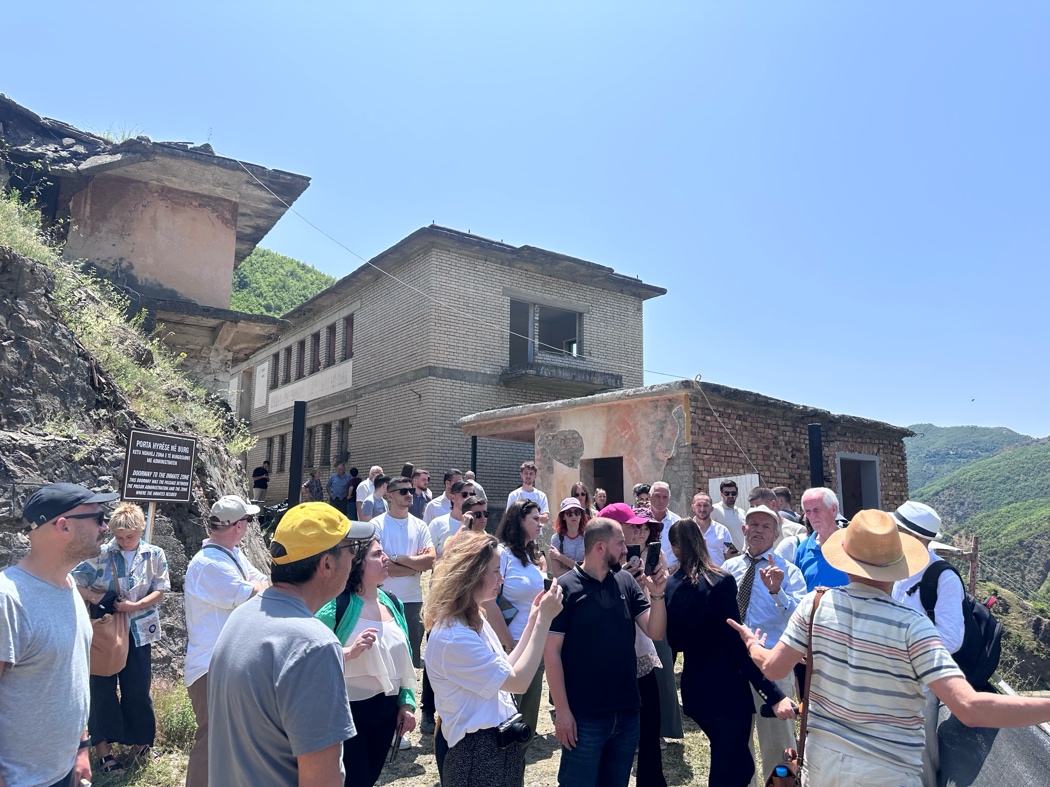
A group of citizens visiting Spaç on 7 June to observe the impact of the construction site on the site.

A group of citizens visiting Spaç on 7 June to observe the impact of the construction site on the site.

It seems clear that this lively debate on the approach to be adopted in the conservation of Spaç turns the spotlight on broader symbolic and political choices related to how the memory of the period of communist dictatorship is transmitted in Albania. What implications can reconstruction have on respect for historical truth?

This occasion appears precious to initiate a public debate on issues that too rarely emerge in the national debate: how collective memory is constructed, who has a voice in defining it, and what spaces and instruments are considered legitimate to recount a still unresolved past.

The former prison and forced labour camp of Spaç is already changing its face: its fate – and its future relevance in the collective consciousness – will inevitably depend on the quality and outcome of this confrontation.


In Albania, memory regains centrality in the public debate

The debate on how the communist dictatorship should be remembered has been rekindled by the ongoing conservation and restoration work at the former prison and forced labour camp of Spaç. Although public policies and interventions for the memory of this difficult part of the past have long been called for in the country

11/06/2025, Giulia Avanza

In-Albania-memory-regains-centrality-in-the-public-debate

Spaç, Albania - Foto G. Avanza

In order to punish suspected political opponents and control the population through fear and deterrence of dissent, the communist regime in power in Albania from 1944 to 1991 had established a system of detention and ‘re-education’ consisting of a high number of prisons , forced labour camps, temporary labour units and internment camps.

From 1968, the so-called ‘re-education unit 303’ was installed in Spaç, in the municipality of Mirdita, in a remote mountainous area in northern Albania. The isolated location, which ensured the separation of the prisoners from the rest of the population, had been chosen because of the copper and pyrite deposits in the area, that prisoners were forced to extract through long forced labour shifts and in inhuman conditions.

It is estimated that up to the early 1980s, between 900 and 1,200 political prisoners at a time were imprisoned in the camp, only men. From 1984, the regime also began to use Spaç to house ordinary prisoners, until the prison was closed after the release of political prisoners in December 1990 and ordinary prisoners in 1991.

Spaç has established itself as one of the most symbolic places of the suffering and human rights violations caused by the communist dictatorship in Albania, but it also remains in the national memory as a place of resistance to the regime’s repression. Indeed, it was here that one of the few episodes of collective revolt in the decades of the regime, the Spaç Revolt of 1973, was recorded, which was harshly repressed.

The site’s value as testimony of the past was confirmed by Spaç’s listing as a Cultural Monument in 2007 by what is now the Ministry of Economy, Culture and Innovation.

Despite being the only one of the detention facilities created or used by the communist regime to benefit from this status, the former prison has remained in a state of neglect since its closure. Many elements of the complex – the barbed wire fences, the entrance gate, the watch towers – have been stolen. The access tunnels to the mine have collapsed, some camp buildings have crumbled down, and others remain in a precarious condition.

Several factors have contributed to the inaction of public institutions towards Spaç, at least until today. The severe political, economic and social instability of the 1990s, culminating in the period of anarchy in 1997, imposed other priorities on the fragile Albanian institutions in the first decade of post-dictatorship transition. Another significant issue was the uncertainty surrounding the ownership of real estate and land once state socialism ended. No less decisive, however, has been the reluctance of governments of various political affiliations to openly confront the communist past. With a few exceptions, there remains a certain difficulty in promoting memory initiatives that are free from party logics, as well as in supporting policies to protect the material legacy of the dictatorship that respond to the educational and commemorative needs expressed by part of the population.

In spite of this, calls for the preservation of Spaç by former political prisoners, the Municipality of Mirdita, civil society organisations and autonomous public institutions have never stopped. These actors have also carried out commemoration, education and reflection activities around Spaç, often organising on-site events and guided tours. Some independent organisations have also incurred expenses over the years for guarding the site, mowing the grass and minor maintenance of the paths, as well as emergency interventions to stabilise buildings in danger of collapse, which were carried out in 2018.

In December 2024, the National Institute of Cultural Heritage, part of the Ministry of Economy, Culture and Innovation, took action to carry out the first publicly funded interventions at Spaç, defined as ‘conservation-restoration’. The drafted project includes the repair of the walls of some buildings, the installation of metal gates, railings and handrails, the reconstruction of an observation tower, and plastering and painting works.

Launched in May 2025, the construction site entrusted to an external company seems to have been suspended – at least temporarily – due to protests that have arisen regarding the impact the work would have on the authenticity of the site.

An image released by the Ministry of Economy, Culture and Innovation shows the progress of the interventions on one of the Spaç buildings

An image released by the Ministry of Economy, Culture and Innovation shows the progress of the interventions on one of the Spaç buildings: top left, the building before the interventions. Top right, the building on 1 June 2025 after the restoration of parts of the structure and with the entrance door converted into a window, plastered and painted with white paint. Bottom left the building on 2 June, with the walls painted with coloured paint and the installation of a wooden sill. Below right, the building on 4 June, with part of the plasterwork having been peeled off in search of an ‘antique’ effect and the door having been restored by demolishing the lower portion of the wall.

What caused the public reaction were some images of the first interventions carried out, images initially circulated online and then the subject of a post published on social networks by an Albanian activist, which was shared dozens of times. Within a few days, the crescendo of attention brought the issue to the national and international press, and to television stations.

The demands of a group of citizens and organisations were summarised in a petition available online , addressed to the Ministry of Economy, Culture and Innovation and the National Institute of Cultural Heritage, asking them to ‘stop uncontrolled interventions that damage the authenticity of Spaç prison’.

According to the text of the petition, the interventions carried out so far in Spaç risk deforming the collective memory, erasing the traces of time on the ruins of the buildings and reconstructing portions of the site in a way that is not faithful to either the testimonies offered by the former political prisoners – who have participated in numerous protests in recent days – or the available archive material. According to the signatories of the petition, the approach with which the work is being conducted follows an aesthetic logic that diminishes the possibility of perceiving Spaç as a place of pain and suffering, a true document of historical events.

According to statements made by some members of the informal group, the concern was raised that this type of intervention was conceived with the sole purpose of preparing the former prison to host the film set of a movie about the 1973 Spaç Revolt announced by Albanian director Namik Ajazi . During a public meeting organised in a cultural centre in Tirana on 3 June 2025 with activists and in subsequent press statements , the director is said to have confirmed his intention to make the film, while denying that the ongoing interventions would compromise the authenticity of the site, and rather stating that they would be consistent with the intention of creating a museum in Spaç. In turn, the protest group stated that they had nothing to object to in the making of the film, and that their demands concerned the approach of the conservation work, which they demanded be addressed in a transparent and public consultation process.

After a few days of waiting, the Albanian Ministry of Economy, Culture and Innovation published on 6 June on its Facebook profile a statement in response to the protests, in very colourful tones. The statement reiterates the synergy between the conservation interventions and the film project, and defends the approach implemented, pointing out that the interventions were carefully designed to ‘preserve and enrich historical memory’, integrating and harmonising scenographic techniques and restoration works.

On Saturday 7 June, a group of citizens led by some former political prisoners visited Spaç to verify the status of the ongoing interventions. What is unprecedented in comparison to similar protests in the past is that a considerable proportion of those who took action to oppose the construction site are young people from the generation born around the time of the fall of the regime or in the years that followed, including numerous professionals and activists from the cultural sector.

A group of citizens visiting Spaç on 7 June to observe the impact of the construction site on the site.

A group of citizens visiting Spaç on 7 June to observe the impact of the construction site on the site.

It seems clear that this lively debate on the approach to be adopted in the conservation of Spaç turns the spotlight on broader symbolic and political choices related to how the memory of the period of communist dictatorship is transmitted in Albania. What implications can reconstruction have on respect for historical truth?

This occasion appears precious to initiate a public debate on issues that too rarely emerge in the national debate: how collective memory is constructed, who has a voice in defining it, and what spaces and instruments are considered legitimate to recount a still unresolved past.

The former prison and forced labour camp of Spaç is already changing its face: its fate – and its future relevance in the collective consciousness – will inevitably depend on the quality and outcome of this confrontation.


Comment and share

OBCT's Newsletter

To your inbox every two weeks